Why 2026 Feels Different for Embedded Engineers
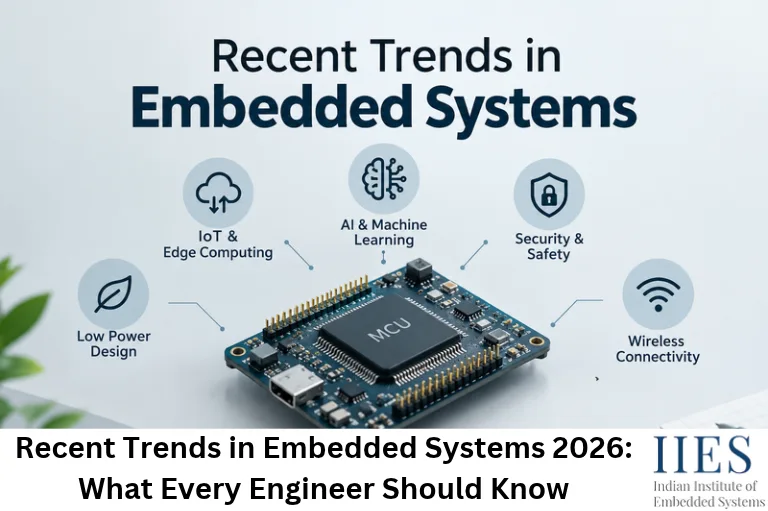
Every year brings a new ‘top trends’ list. This year is different because several shifts stopped being experiments and started showing up in datasheets, regulations and job descriptions.
- Devices now outlive their first release. Products ship, then get patched, audited and supported for years. Jacob Beningo sums up 2026 as the year embedded systems are finally treated like long-lived software systems, and regulators have started to agree.
- AI is a design assumption. Chip vendors now put NPUs inside the microcontroller instead of leaving AI to the cloud.
- The market keeps growing. One published market study estimates global embedded systems at roughly USD 133 billion in 2025, heading toward about USD 271 billion by 2034. Forecasts differ between firms, so read it as direction, not gospel.
- Analysts see the same pattern. IoT Analytics’ 2026 landscape report tracks 18 technology trends and calls agentic, physical edge AI the next big theme.
Let’s walk through the trends one by one: what changed, and what you can do about it.
Trend 1: Edge AI and TinyML Move Onto Dedicated NPUs
For years, AI on a microcontroller meant squeezing a tiny model onto a Cortex-M core and hoping the battery survived. In 2026 the silicon is built for the job.
What changed in 2026
- Renesas RA8P1 pairs a 1 GHz Cortex-M85 and a 250 MHz Cortex-M33 with an Arm Ethos-U55 NPU, rated at about 256 GOPS at 500 MHz. It is built on TSMC’s 22 nm ultra-low-leakage process with embedded MRAM.
- Arm’s Ethos-U85 scales from 128 to 2,048 MAC units, is about 20% more energy-efficient than the U55 and U65, and is the first Ethos NPU able to run transformer models.
- Alif Semiconductor’s Ensemble E4, E6 and E8 pair Cortex-M55 cores with Ethos-U85 and target small language models running locally.
- Vendors now ship matching toolchains, for example Renesas RUHMI inside the e2 studio IDE, so you are not hand-porting models.
Why it matters
- Latency: decisions in milliseconds, with no network round trip
- Privacy: audio and camera data never leave the device
- Power: an NPU does multiply-accumulate work for far less energy than the CPU core
- Cost: no cloud inference bill for every device in the field
What to learn
- Quantization: converting FP32 weights to INT8 cuts model size roughly 4x
- Memory budgeting: weights live in flash or MRAM, activations need SRAM
- Frameworks: TensorFlow Lite for Microcontrollers, Edge Impulse and vendor toolchains
- Sensor pipelines: windowing, feature extraction and DMA so the CPU can sleep
Engineer’s takeaway: The winning skill is not training the fanciest model. It is fitting a good-enough model into your SRAM and power budget, then proving it works in the field.
Trend 2: RISC-V Becomes a Production Choice
- The SHD Group’s 2026 RISC-V market report describes adoption accelerating, with AI-capable SoCs a major driver.
- RISC-V International’s Embedded World 2026 preview framed the story as production-ready, automotive-grade and AI-native.
- The RVA23 profile has been ratified, which gives software vendors one stable target to build against.
- Custom vector extensions let chip makers tune a core for AI and signal processing without inventing a new instruction set.
- India has its own RISC-V thread: SHAKTI from IIT Madras, VEGA from C-DAC and the newer DHRUV64.
Reality check
- Arm is not going away. Cortex-M still dominates microcontrollers because of its tooling, middleware and certified ecosystem.
- RISC-V’s edge is flexibility and supply-chain independence. Software maturity still varies by vendor.
- Learn the concepts (registers, CSRs, privilege modes, interrupt controllers). They transfer between architectures.
Engineer’s takeaway: Treat RISC-V as a second architecture to be comfortable with, not a replacement for what you already know.
Trend 3: Security Is Now the Law, Not a Feature
If you ship connected products into Europe, this is the trend with a deadline attached.
What changed in 2026
- The reporting duties of the EU Cyber Resilience Act (Regulation (EU) 2024/2847) applied from 11 September 2026. Most other obligations follow from 11 December 2027.
- Manufacturers must report actively exploited vulnerabilities and severe incidents through ENISA’s Single Reporting Platform, starting with an early warning within 24 hours.
- It covers products already on the market, not only new designs.
- Fines can reach 15 million euros or 2.5% of worldwide turnover, whichever is higher.
- Non-EU manufacturers are treated the same way, so Indian companies exporting connected products to the EU are in scope.
- European Commission guidance published on 27 July 2026 clarified when a manufacturer counts as ‘aware’ of an issue.
A practical firmware checklist
- Secure boot anchored in a hardware root of trust (TrustZone-M, PSA Certified parts or a secure element)
- Signed, rollback-protected OTA updates
- An SBOM (software bill of materials) generated for every release
- A vulnerability disclosure policy and a named owner for incident reporting
- Secure defaults: no hard-coded passwords, debug ports locked in production
- Crypto agility: NIST finalised its first post-quantum standards (FIPS 203, 204 and 205) in 2024, so devices that must live ten years or more should plan for them
Engineer’s takeaway: Security work that once looked like overhead is now a compliance line item. Secure boot, key management and threat modelling are directly hireable skills.
Trend 4: Zephyr, RTOS Maturity and Platform-Based Firmware
- Zephyr 4.4 arrived on 14 April 2026 as the first release under a twice-a-year cadence, with WireGuard VPN, Wi-Fi Direct and OpenRISC support among the highlights.
- The 3.7 line remains the long-term-support release (LTS3), which matters if you need years of stable fixes.
- Devicetree, Kconfig and west let one codebase move across vendors, which is why chip makers keep joining the project.
- The community is growing locally too: Zephyr had a presence at Open Source Summit India in Mumbai in 2026.
- FreeRTOS is still the default for small, simple devices, and embedded Linux (Yocto) still wins for rich gateways.
Why platform thinking wins
- Standard build systems, CI and static analysis catch problems before they reach hardware
- Layered architecture and reusable drivers stop every board from becoming a fork
- Product lines with many variants cannot afford one-off firmware
Engineer’s takeaway: Learn one RTOS properly, including its build system and power management, rather than skimming five.
Trend 5: Rust Joins C and C++ (It Does Not Replace Them)
- Ferrocene, the qualified Rust toolchain, is certified for ISO 26262 (ASIL D), IEC 61508 (SIL 3) and IEC 62304 (Class C medical software).
- In December 2025 a subset of Rust’s core library was certified to IEC 61508 SIL 2, and Ferrocene 26.02.0 (March 2026) added ISO 26262 ASIL B for a certified core subset.
- By mid-2026 surveys, Embassy is the default async framework for bare-metal Rust.
- C++ keeps growing too. In his 2026 trends talk, Jacob Beningo notes it has gone from about 3% to 30% of the market over two decades, while C remains dominant.
How to approach it
- Master C and C++ first: pointers, volatile, memory-mapped I/O, interrupts
- Build one small Rust project (blink, UART, a sensor read) on an STM32 or Raspberry Pi RP2040 board
- Do not rewrite working firmware for fashion. Use Rust for new, security-sensitive modules such as parsers and protocol stacks
Engineer’s takeaway: Memory safety is becoming a hiring and compliance topic. Knowing why C code fails makes you better at both languages.
Trend 6: AI-Assisted Development, Digital Twins and Hardware-in-the-Loop CI
- AI assistants now draft boilerplate drivers, test scaffolds and register headers.
- Digital twins and virtual platforms (QEMU, Renode, vendor simulators) let teams test firmware before the board exists.
- CI pipelines with hardware in the loop flash a real board on every commit and run automated tests.
- The risk: Beningo warns that a copy-paste culture can erode the deep hardware-software debugging skills embedded work depends on.
A working rule
- Let AI draft, but review timing, interrupts, DMA and register code line by line
- Verify against the datasheet and reference manual, not against the chatbot
- Run AI-written code through the same static analysis (MISRA C checks) and tests as everything else
Trend 7: Connectivity: Matter, Bluetooth, Cellular and Beyond
- Matter 1.5 (November 2025) brought smart cameras, and Matter 1.6 followed on 17 June 2026. The standard now spans 50-plus device types and updates roughly twice a year.
- Bluetooth 6.0 introduced Channel Sounding for secure, fine-grained distance measurement, aimed at digital keys and asset tracking.
- LTE-M, NB-IoT and 5G RedCap cover wide-area and mid-tier IoT without Wi-Fi.
- Satellite (non-terrestrial) IoT is opening remote monitoring where there is no coverage.
Engineer’s takeaway: Pick the protocol from the power budget, range and certification path first, then the chip.
Trend 8: Chiplets, MRAM and Heterogeneous Silicon
- Chiplet architectures are moving from server silicon into embedded platforms, letting vendors mix CPU, NPU and I/O dies.
- MRAM is replacing flash in advanced-node MCUs for faster writes and better endurance (the RA8P1 above is one example).
- One package now often holds Cortex-A, Cortex-M, a GPU and an NPU, so debugging multi-core, heterogeneous systems is a skill in its own right.
The India Angle: Why This Matters for Careers
- India Semiconductor Mission 2.0 was announced in the 2026-27 Budget, with a reported outlay of about 1.27 lakh crore rupees focused on equipment, design IP, supply chains and R&D.
- Micron’s Sanand assembly and test plant was inaugurated on 28 February 2026, and the Tata-PSMC fab at Dholera (28 nm and above) is the first approved front-end fab.
- India accounts for roughly one in five of the world’s semiconductor design engineers, and the Design Linked Incentive scheme had backed 24 design start-ups by January 2026.
- Homegrown processors such as ISRO’s Vikram 3201 and DHRUV64 show where local design is heading.
- What it means for you: steady demand for firmware, validation and security skills at product companies and design houses across Bangalore and beyond.
Embedded Systems Trends 2026 at a Glance
Trend | What changed in 2026 | Skills to build |
Edge AI | NPUs inside MCUs (Ethos-U85, RA8P1) | Quantization, TinyML toolchains, SRAM budgeting |
RISC-V | Production-ready, RVA23 profile | ISA basics, CSRs, open toolchains |
Security | EU CRA reporting live since 11 Sep 2026 | Secure boot, signed OTA, SBOM, threat modelling |
RTOS | Zephyr 4.4, twice-yearly releases | Devicetree, Kconfig, west, RTOS design |
Languages | Certified Rust, growing C++ | Modern C++, embedded Rust basics, MISRA |
Workflow | AI assistants, digital twins, HIL CI | Renode or QEMU, CI pipelines, test design |
Connectivity | Matter 1.6, BLE channel sounding | Matter, BLE, LTE-M and NB-IoT basics |
Your 2026 Embedded Skills Roadmap
- Step 1, foundation: C and C++ basics, number systems, pointers, bit manipulation
- Step 2, hardware: one MCU family (STM32, ESP32 or nRF), GPIO, UART, SPI, I2C, ADC, timers and datasheet reading
- Step 3, RTOS: FreeRTOS concepts first, then Zephyr
- Step 4, edge AI: a keyword-spotting or vibration-anomaly project with TinyML
- Step 5, security basics: secure boot, signed OTA updates and a simple threat model
- Step 6, tooling: Git, CI, a debugger, a logic analyser and static analysis
- Step 7, stretch goal: a Rust or RISC-V board project
Common Myths vs Reality
- Myth: AI will replace firmware engineers. Reality: AI drafts code, but timing, hardware debugging and safety judgment stay human.
- Myth: RISC-V will replace Arm. Reality: they will coexist, and many teams will use both.
- Myth: Rust replaces C. Reality: it complements C and C++ in new, security-sensitive code.
- Myth: Security rules only hit big companies. Reality: the CRA reaches any manufacturer selling connected products in the EU.
Key Takeaways
- AI is moving into the microcontroller itself, so learn quantization and memory budgeting
- RISC-V is a production option, but Arm skills still carry most jobs
- Security is now a legal duty for anyone selling connected products in the EU
- Learn one RTOS deeply, and Zephyr is a strong choice
- Add Rust to C and C++, do not swap them
- Use AI tools to draft, and keep humans on timing and safety-critical code
- India’s chip investments are widening the job market for embedded engineers
Conclusion
The recent trends in embedded systems for 2026 show how the industry is evolving from dedicated hardware controllers toward intelligent, connected, and maintainable computing platforms.
Edge AI is expanding what devices can accomplish locally. RISC-V is broadening processor design options, while RTOS platforms and software tooling help developers manage increasingly complex firmware. At the same time, cybersecurity, predictable communication, power efficiency, and testing remain essential to reliable embedded products.
For developers, the strongest approach is to build a solid foundation in C/C++, microcontrollers, peripheral interfaces, debugging, and real-time concepts before specializing in emerging technologies.
Understanding both the latest developments and the engineering requirements behind them is what makes it possible to build embedded systems that work reliably in real-world applications.