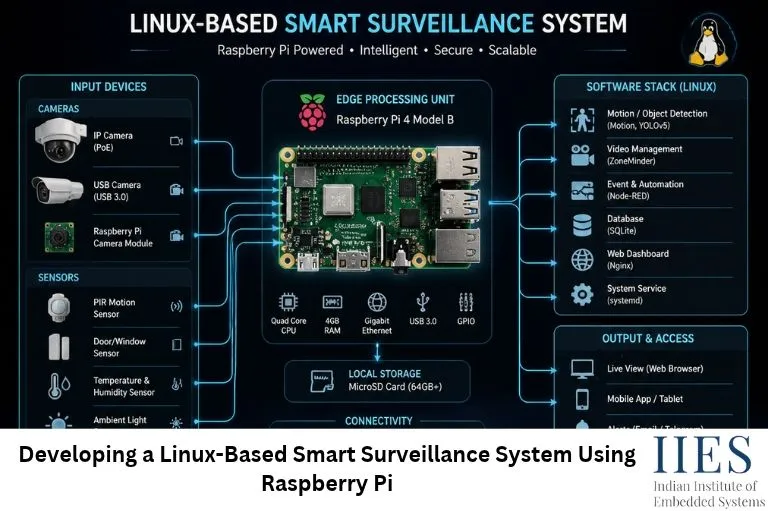
What Is a Linux-Based Smart Surveillance System?
A Linux-based surveillance system is an electronic security solution that uses a Linux-powered computing device to capture, process, store and transmit video footage.
In this project, Raspberry Pi acts as the central processing unit. A compatible camera module captures video, while Linux manages hardware resources, device communication, file storage and application execution.
Unlike a basic CCTV camera, a smart surveillance system can perform additional operations such as:
- Detecting movement in a monitored area.
- Capturing images when suspicious activity occurs.
- Streaming live video over a network.
- Sending notifications when motion is detected.
- Storing recorded footage for future reference.
- Integrating AI-based object or face detection.
The system can be configured as a Raspberry Pi CCTV camera project for homes, offices, laboratories and small industrial environments.
Why Use Raspberry Pi for Smart Surveillance?
Raspberry Pi is widely used in embedded Linux projects because it offers computing capabilities, hardware interfaces and operating system support in a compact platform.
For a Raspberry Pi security camera system, it provides several advantages.
- Linux OS support: Manages hardware and software operations.
- Camera interface: Connects compatible camera modules.
- GPIO pins: Supports sensors and external devices.
- USB connectivity: Connects additional peripherals.
- Wi-Fi and Ethernet: Enables remote video monitoring.
- Python support: Simplifies application development.
- Processing capability: Supports video processing and motion detection.
Raspberry Pi can also support additional technologies such as OpenCV, FFmpeg and video streaming protocols.
The exact performance depends on the Raspberry Pi model, camera resolution, frame rate and processing workload.
Hardware Components Required
Developing a Raspberry Pi video surveillance project requires a combination of hardware components.
The main components include:
- Raspberry Pi board: Acts as the main processing unit.
- Camera module: Captures live video.
- MicroSD card: Stores the operating system and recorded footage.
- Power supply: Provides stable power to the board.
- PIR motion sensor (optional): Detects movement using infrared changes.
- Wi-Fi or Ethernet: Provides network connectivity.
- Monitor and keyboard: Used for initial configuration and debugging.
A camera module can capture continuous video, while an optional PIR sensor can provide an additional hardware-based motion detection trigger.
The system can also work without a PIR sensor by using software-based motion detection through OpenCV.
Role of Linux in Embedded Surveillance Systems
Linux plays an important role in the development of an embedded Linux surveillance system.
Raspberry Pi commonly runs Raspberry Pi OS, a Linux-based operating system that provides access to system resources and hardware interfaces.
The operating system acts as the communication layer between the hardware and surveillance application.
Some important Linux functionalities include:
- Hardware Management: Linux manages connected peripherals, camera interfaces, USB devices and other hardware resources.
- Process Management: It allows multiple applications to run simultaneously, such as video capture, motion detection and network streaming.
- File System Management: Video recordings, captured images, configuration files and application logs can be stored and managed.
- Network Communication: Linux supports network protocols required for remote access and video transmission.
- Application Execution: Developers can run Python scripts, OpenCV applications and other video processing tools.
Linux also provides command-line utilities that help developers configure the system, monitor resource usage and troubleshoot hardware or software issues.

Software and Development Tools
The software environment determines how video capture, processing and monitoring operations are performed.
The following tools can be used to develop a Linux-based security camera system.
- Raspberry Pi OS: Linux operating system.
- Python: Application development.
- OpenCV: Image processing and motion detection.
- Picamera2: Camera control on supported Raspberry Pi configurations.
- FFmpeg: Video processing and encoding.
- Flask: Web-based monitoring interface.
- SSH: Remote system administration.
- RTSP: Network video streaming.
OpenCV (Open Source Computer Vision Library) is particularly useful because it provides image processing and computer vision functions. Developers can use it to compare consecutive video frames and identify changes in a monitored environment.
Python makes it easier to integrate these technologies into a single surveillance application.
System Architecture and Working Principle
A Raspberry Pi smart surveillance system follows a sequence of operations involving video capture, image processing, motion detection, storage and network communication.
The basic working process involves the following stages:
- Video Acquisition: The Raspberry Pi camera module captures video from the monitored environment.
- Frame Processing: The video stream is converted into individual frames for analysis.
- Motion Detection: OpenCV compares frames to identify changes in the environment.
- Event Detection: When movement exceeds a defined threshold, the application identifies a possible motion event.
- Recording: The system captures an image or records a video clip.
- Remote Monitoring: The footage can be accessed through a network-connected monitoring interface.
This architecture makes it possible to develop a Raspberry Pi motion detection system without requiring an expensive dedicated surveillance server.
Raspberry Pi Camera Integration with Linux
Camera integration is one of the important steps in developing a Raspberry Pi camera surveillance project.
The camera module connects to the Raspberry Pi through its supported camera interface. Linux provides the necessary drivers and camera software stack to communicate with the hardware.
On modern Raspberry Pi OS installations, developers can use the libcamera camera stack and its Python interface, Picamera2, where supported.
For example, the following command can be used to check whether the camera is detected:
rpicam-hello
A basic Python implementation using Picamera2 can capture an image:
from picamera2 import Picamera2
import time

camera = Picamera2()

camera.configure(
    camera.create_still_configuration()
)

camera.start()

time.sleep(2)

camera.capture_file("surveillance_image.jpg")

camera.stop()
In this example:
- Picamera2 initializes the camera.
- The camera configuration prepares it for image capture.
- The camera starts capturing data.
- An image is saved as a JPEG file.
- The camera is stopped after the operation.
This provides the foundation for building a Raspberry Pi security monitoring application.
Implementing Motion Detection Using OpenCV
Motion detection is one of the most important features of a smart surveillance system.
Instead of continuously recording every frame, the system can analyse video frames and identify significant changes in the monitored environment.
OpenCV provides several image processing techniques that can be used for motion detection using Raspberry Pi.
One common approach is frame differencing.
How frame differencing works:
- Capture the first video frame as a reference.
- Capture the next frame from the camera.
- Convert both frames into grayscale.
- Calculate the difference between the two frames.
- Apply a threshold to identify significant changes.
- Detect the changed regions using contours.
A simplified Python example is shown below:
import cv2

camera = cv2.VideoCapture(0)

ret, previous_frame = camera.read()

if ret:
    previous_gray = cv2.cvtColor(
        previous_frame, cv2.COLOR_BGR2GRAY
    )
    previous_gray = cv2.GaussianBlur(
        previous_gray, (21, 21), 0
    )

    while True:
        ret, frame = camera.read()

        if not ret:
            break

        current_gray = cv2.cvtColor(
            frame, cv2.COLOR_BGR2GRAY
        )

        current_gray = cv2.GaussianBlur(
            current_gray, (21, 21), 0
        )

        difference = cv2.absdiff(
            previous_gray, current_gray
        )

        _, threshold = cv2.threshold(
            difference, 25, 255,
            cv2.THRESH_BINARY
        )

        contours, _ = cv2.findContours(
            threshold,
            cv2.RETR_EXTERNAL,
            cv2.CHAIN_APPROX_SIMPLE
        )

        for contour in contours:
            if cv2.contourArea(contour) > 1000:
                print("Motion detected!")

        previous_gray = current_gray

camera.release()
Note: This is a simplified demonstration of frame differencing using an OpenCV video source. Camera index 0 assumes a camera accessible through the VideoCapture interface; Raspberry Pi CSI cameras may require a Picamera2-based frame capture pipeline instead.
This approach can be extended to capture images, activate alarms or initiate video recording when movement is detected.
However, changes in lighting, shadows and camera movement can also trigger false detections. Real-world systems require additional filtering and testing.

Real-Time Video Streaming and Remote Monitoring
A major advantage of a Linux-based surveillance system is the ability to monitor video remotely.
Raspberry Pi can transmit captured video over a local network or the internet, depending on the network configuration.
Some commonly used technologies include:
- RTSP: Used for transmitting video streams over IP networks.
- FFmpeg: Used for video encoding, decoding and stream processing.
- Flask: Can provide a web-based interface for accessing camera feeds.
- SSH: Allows developers to configure and manage Raspberry Pi remotely.
For example, a developer can create a web dashboard that displays live camera footage, motion detection alerts and recorded events.
This makes remote video monitoring using Raspberry Pi useful for locations where continuous physical supervision is not practical.
Internet-facing deployments should also implement authentication, encrypted communication, access restrictions and secure network configuration.
Challenges in Developing a Raspberry Pi CCTV System
Although Raspberry Pi offers an affordable platform, developing a reliable surveillance application involves several engineering challenges.
- Processing Limitations: Raspberry Pi has limited computing resources compared with desktop computers. Developers need to optimize video resolution and frame rate.
- High CPU Utilization: Continuous video processing can increase processor usage. Efficient image processing techniques can help reduce the workload.
- Storage Limitations: Continuous recording can consume significant storage space. Automatic cleanup and event-based recording can help manage storage.
- Network Interruptions: Network connectivity issues can interrupt remote video streaming. Buffering and reconnection mechanisms can improve reliability.
- False Motion Detection: Changes in lighting, shadows and environmental conditions may trigger false alerts. Improved thresholds and filtering techniques can reduce unwanted detections.
- Security Vulnerabilities: Unauthorized access can compromise surveillance footage. Authentication, encryption and secure network configuration are important.
- Overheating: Continuous processing can generate heat. Suitable cooling and power management help maintain system stability.
Real-World Applications of Raspberry Pi Surveillance Systems
A Raspberry Pi home security system is just one example of how this technology can be used.
The same architecture can be adapted for different applications.
Home Security
A Raspberry Pi security camera system can monitor entrances, rooms, parking areas and other important locations.
Industrial Monitoring
Factories can use smart surveillance systems to monitor restricted areas, equipment zones and operational environments.
Office Security
A Linux CCTV camera project can help monitor entry points, workspaces and server rooms.
Agricultural Monitoring
Remote video monitoring can help farmers observe farms, storage facilities and equipment locations.
Laboratory Monitoring
Educational institutions can develop Raspberry Pi video surveillance projects to monitor laboratories and equipment areas.
These applications demonstrate how embedded computing and Linux-based development can be applied to practical security requirements.
Future Scope: AI-Based Surveillance and Edge Computing
Traditional motion detection identifies changes between video frames. However, modern surveillance systems are moving towards intelligent video analysis.
By integrating machine learning and artificial intelligence, developers can extend a basic Raspberry Pi surveillance camera into an intelligent monitoring solution.
Some possible enhancements include:
- Human Detection: Using TensorFlow Lite or lightweight object detection models.
- Face Detection: Using OpenCV-based computer vision techniques.
- Object Recognition: Implementing AI-based computer vision models.
- Vehicle Detection: Identifying vehicles through object detection models.
- Suspicious Activity Alerts: Analysing detected events using AI.
- Local Video Processing: Using edge computing to process video data locally.
A Raspberry Pi AI surveillance system can process selected video frames locally rather than sending every frame to a cloud server.
This approach can reduce network bandwidth usage and improve response time, depending on the model and hardware capabilities.
Edge AI surveillance systems are particularly useful when internet connectivity is limited or when local video processing is preferred for privacy reasons.
However, developers must consider the processing limitations of Raspberry Pi hardware when deploying complex AI models.
Skills Students Can Develop Through This Project
Developing an embedded Linux surveillance system provides practical exposure to multiple engineering concepts.
- Embedded Linux: Working with Linux-based development platforms.
- Python Programming: Developing surveillance applications and automation scripts.
- Hardware Interfacing: Connecting cameras, sensors and external devices.
- Computer Vision: Understanding image processing and video analysis.
- OpenCV: Implementing motion detection and image processing algorithms.
- Networking: Understanding video transmission and remote monitoring.
- Edge Computing: Processing data locally instead of depending entirely on cloud infrastructure.
- Debugging: Identifying hardware and software issues.
For ECE, EEE, E&I and embedded systems students, this project provides an opportunity to understand how hardware, software and operating systems work together in an actual embedded application.
It also creates a foundation for exploring advanced topics such as Linux device drivers, real-time systems, IoT development and embedded AI.
Conclusion
Developing a Linux-based smart surveillance system using Raspberry Pi is a practical way to understand the integration of embedded hardware, operating systems, computer vision and networking.
By combining Raspberry Pi, Linux, Python and OpenCV, developers can build a surveillance application capable of video capture, motion detection, recording and remote monitoring.
The project can also be extended with AI-based object detection and edge computing to create more intelligent surveillance solutions.
Beyond security applications, the knowledge gained from this project is relevant to several embedded engineering domains, including IoT, industrial automation, robotics and intelligent devices.
For engineering students interested in embedded development, hands-on projects like this help bridge the gap between theoretical concepts and real-world engineering applications.