What Is Linking in C?
Linking in C is the final stage of building a program where object files and libraries
are combined into a single executable.
C Build Process (Simplified)
- Preprocessing – Handles
#include, macros, and definitions - Compilation – Converts
.c files into .o object files - Linking – Resolves external symbols and combines libraries
This is where functions like printf() are connected to their actual implementations.
Static Linking in C
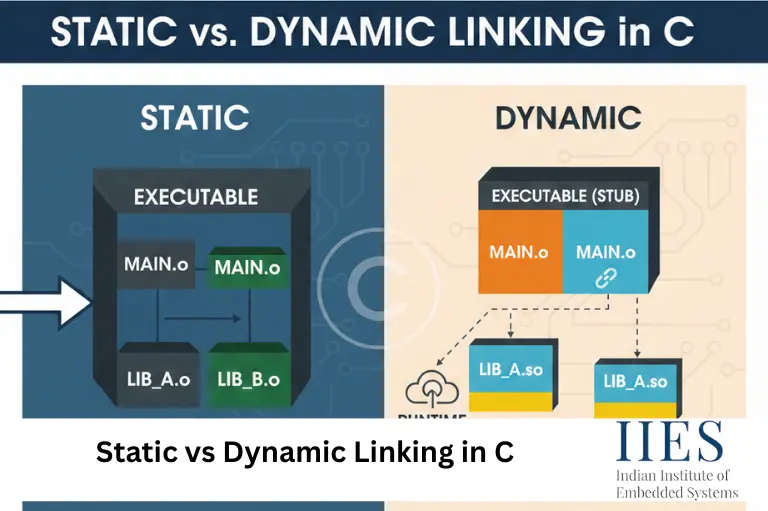
Static linking in C means that the linker copies the complete library code into the
executable at build time.
GCC Static Linking Example
gcc main.c -static -o app
This command links static libraries such as libc.a.

Key Characteristics of Static Linking
- One large standalone executable
- No runtime library dependency
- Program runs independently of system libraries
Advantages of Static Linking
- Works on minimal or unknown environments
- No “missing library” runtime errors
- Faster startup time
- Ideal for embedded systems and rescue tools
Disadvantages of Static Linking
- Very large binary size
- Duplicate library code across programs
- Library updates require recompilation
- Security vulnerabilities remain embedded
Dynamic Linking in C
Dynamic linking in C stores only references to libraries in the executable.
The actual code is loaded from shared object (.so) files at runtime.
GCC Dynamic Linking Example
gcc main.c -o app
On Linux, dynamic linking is the default behavior.
Key Characteristics of Dynamic Linking
- Smaller executable size
- Libraries loaded at runtime
- Shared memory usage across applications
Advantages of Dynamic Linking
- Reduced disk and memory usage
- One library update benefits all applications
- Faster rebuild times during development
- Preferred for desktop and server systems
Disadvantages of Dynamic Linking
- Dependency and version conflicts
- Application fails if required library is missing
- Slightly slower startup due to symbol resolution
Static vs Dynamic Linking in C
| Feature | Static Linking | Dynamic Linking |
|---|
| Binary Size | Large | Small |
| Runtime Dependency | None | Required |
| Memory Usage | High | Low (Shared) |
| Updates | Rebuild Required | Patch Library |
| Startup Time | Faster | Slightly Slower |
| Portability | High | Medium |

Difference Between .a and .so Files
| File Type | Description |
|---|
.a | Static library archive |
.so | Shared object (dynamic library) |
How Dynamic Linking Works at Runtime
- The loader reads required dependencies
- Loads
.so libraries into memory - Resolves function symbols
- Applies relocations
Inspect dependencies using:
ldd app
GCC Static vs Dynamic Linking Commands
| Command | Linking Type |
|---|
gcc main.c -static -o app | Static |
gcc main.c -o app | Dynamic |
Why Static Linking Increases Binary Size
Static linking copies entire library code into every executable.
- Static linking → Code duplicated in every program
- Dynamic linking → Code shared once in memory
When Should You Use Static or Dynamic Linking?
| Use Case | Recommended |
|---|
| Embedded systems | Static |
| Bootloaders | Static |
| Desktop applications | Dynamic |
| Linux distributions | Dynamic |
| Containers with minimal OS | Static |
| Frequently updated systems | Dynamic |
Real-World Analogy
Think of static linking as packing all tools into your backpack before a trip.
Think of dynamic linking as borrowing tools from a shared toolbox when needed.
Security Considerations
- Static binaries retain vulnerabilities until rebuilt
- Dynamic libraries can be patched centrally
- Most Linux security updates rely on dynamic linking
Performance Considerations
- Static linking offers slightly faster startup
- Runtime performance is usually identical
- Memory efficiency strongly favors dynamic linking
Final Conclusion
Dynamic linking should be the default choice for most applications due to smaller binaries,
easier updates, and better memory efficiency. Static linking is best suited for embedded systems, containers, and environments with
unpredictable dependencies. Understanding static vs dynamic linking in C is not just an interview topic — it’s a
foundational skill for building reliable and portable software.