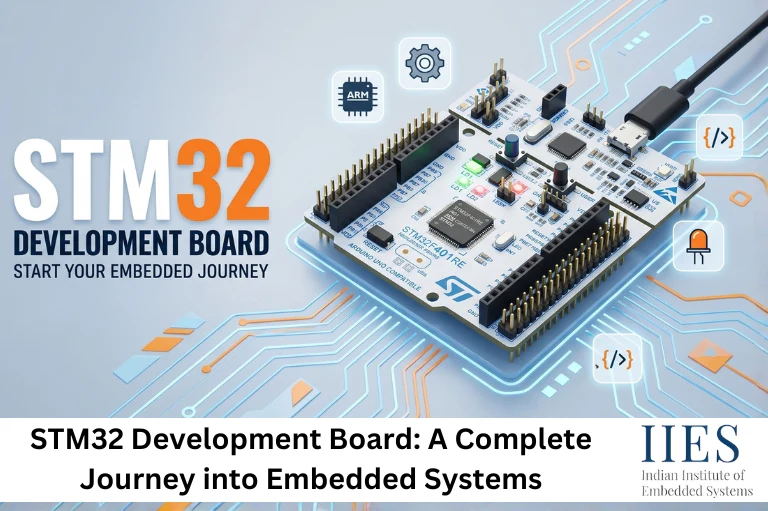
Why STM32 Development Boards Are Important in Embedded Systems
Embedded systems are everywhere. Modern electronics rely on microcontrollers to process data, control hardware, and automate operations. The STM32 family, developed by STMicroelectronics, stands out because of its:
- High processing efficiency
- Low power consumption
- Rich peripheral support
- Scalability across applications
- ARM Cortex-M architecture
- Extensive developer ecosystem
Unlike traditional 8-bit microcontrollers, STM32 boards offer advanced performance suitable for:
- IoT applications
- Industrial automation
- Consumer electronics
- Medical devices
- Automotive systems
- Smart home technologies
- Robotics and AI edge devices
The flexibility of the STM32 controller board allows developers to transition from beginner-level projects to highly advanced embedded applications without changing platforms.

What is STM32?
STM32 refers to a family of 32-bit microcontrollers based on the ARM Cortex-M processor architecture. These microcontrollers are manufactured by STMicroelectronics and are widely used in embedded product development.
The STM32 ecosystem includes multiple series such as:
STM32 Series | Purpose |
STM32F0 | Entry-level applications |
STM32F1 | General-purpose development |
STM32F4 | High-performance embedded systems |
STM32L4 | Ultra-low-power applications |
STM32H7 | Advanced processing and AI workloads |
Each STM32 dev board is designed for different use cases depending on memory requirements, processing speed, and peripheral integration.
Popular boards include:
- STM32 Nucleo boards
- STM32 Discovery boards
- Blue Pill STM32 board
- STM32 evaluation kits
The STM32 discovery board series is especially popular among beginners because it provides built-in debugging tools and peripheral modules.
Setting Up Your STM32 Development Environment
Before starting STM32 programming, setting up the correct development environment is essential.
Recommended Tools for STM32 Development
1. STM32CubeIDE
STM32CubeIDE is the official integrated development environment provided by STMicroelectronics. It combines:
- Code editor
- Compiler
- Debugger
- Peripheral configuration tools
This IDE simplifies project generation and peripheral setup significantly.
2. ST-LINK Debugger
An ST-LINK debugger enables firmware uploading and debugging directly on the board.
3. USB Drivers and SDKs
Installing proper drivers ensures stable communication between your computer and the STM32 microcontroller.
Getting Started with STM32 Programming
Creating your first STM32 project is often the most exciting part of learning embedded systems.
A basic workflow includes:
- Create a new STM32 project
- Select the target board or microcontroller
- Configure clock settings
- Initialize GPIO pins
- Write application logic
- Compile and flash the firmware
- Debug and test the system
A common beginner project is blinking an LED using GPIO.
Simple STM32 Programming Example
Typical beginner applications include:
- LED blinking
- Push-button interfacing
- UART serial communication
- LCD interfacing
- Sensor data acquisition
These foundational exercises help developers understand how embedded hardware interacts with software.
Understanding STM32 Architecture
To truly master STM32 development, understanding the underlying architecture is crucial.
The STM32 architecture is built around ARM Cortex-M cores that are optimized for real-time embedded applications.
ARM Cortex-M Processor
The processor core handles instruction execution and system control.
Flash Memory
Stores the application firmware permanently.
SRAM
Used for temporary data storage during runtime.
GPIO Peripherals
Enable communication with external hardware devices.
Timers and Counters
Used for delays, PWM generation, motor control, and scheduling tasks.
Communication Interfaces
Support protocols such as:
This modular architecture makes STM32 highly flexible for multiple embedded applications.
STM32 Programming in C/C++
The majority of embedded developers use C/C++ for STM32 programming because these languages offer:
- Direct hardware control
- High execution speed
- Efficient memory management
- Portability
Why C/C++ Dominates Embedded Development
C programming provides low-level hardware access required for microcontroller operations.
Developers can directly manipulate:
- Registers
- GPIO pins
- Timers
- Interrupts
- Communication peripherals
This level of control is essential in real-time systems.

Common STM32 Programming Tasks
GPIO Control
Used for LEDs, relays, buttons, and sensors.
PWM Generation
Required for motor control and dimming applications.
ADC Programming
Used for analog sensor interfacing.
UART Communication
Helps transfer data between devices.
Learning these concepts forms the backbone of practical STM32 development.
Interrupts and Timers in STM32
Timing plays a critical role in embedded systems. STM32 provides advanced timer modules and interrupt handling capabilities that improve system responsiveness.
What Are Interrupts?
Interrupts temporarily pause the main program execution to handle urgent events.
Examples include:
- Button press detection
- Sensor triggers
- Communication data arrival
- Timer overflows
Using STM32 interrupts efficiently helps create responsive and real-time applications.
Understanding STM32 Timers
STM32 timers are widely used for:
- Delay generation
- PWM signals
- Frequency measurement
- Real-time scheduling
- Motor control
The flexibility of STM32 timers makes them essential in robotics and automation systems.
Communication Protocols in STM32
Communication protocols enable STM32 boards to exchange data with sensors, modules, and external devices.
UART Communication
UART is one of the simplest serial communication protocols.
Common applications include:
- GPS modules
- Bluetooth communication
- Serial debugging
SPI Protocol
SPI offers high-speed communication and is commonly used with:
- Displays
- Memory cards
- Sensors
I2C Protocol
I2C allows multiple devices to communicate using only two wires.
Widely used for:
- RTC modules
- EEPROMs
- Environmental sensors
Understanding these protocols is vital for real-world embedded development.
STM32 Debugging and Testing
Debugging is one of the most important aspects of embedded programming.
Efficient STM32 debugging helps developers identify firmware issues quickly and improve application stability.
Breakpoints
Pause code execution at specific locations.
Variable Monitoring
Track variable values during runtime.
Step Execution
Execute instructions line-by-line.
Serial Debugging
Use UART output for runtime analysis.
Proper debugging significantly reduces development time and improves firmware reliability.
Real-World STM32 Beginner Projects
Theory becomes meaningful when applied to practical projects. Working on real applications accelerates learning and strengthens embedded development skills.
Popular STM32 Beginner Projects
Project | Skills Learned |
LED Blinking System | GPIO basics |
Temperature Monitoring | ADC and sensor interfacing |
Smart Home Automation | Relay and IoT integration |
Bluetooth Robot | UART communication |
Digital Clock | Timers and RTC |
Motor Speed Controller | PWM generation |
Weather Monitoring Station | Sensor integration |
These STM32 project ideas provide hands-on exposure to practical embedded systems development.
Advanced STM32 Applications in 2026
STM32 boards are evolving rapidly with the rise of AI and IoT technologies.
Edge AI Processing
STM32 boards now support lightweight machine learning applications.
Industrial IoT
Factories increasingly rely on STM32 for automation and predictive maintenance.
Smart Healthcare Devices
Wearables and monitoring systems use low-power STM32 microcontrollers.
Energy-Efficient Embedded Systems
STM32 low-power series are becoming crucial for battery-powered devices.
Robotics and Automation
Advanced PWM and real-time capabilities make STM32 ideal for robotic control systems.
These trends indicate strong future demand for STM32 developers.
Common Mistakes to Avoid in STM32 Development
Many beginners struggle with avoidable errors during embedded development.
Ignoring Clock Configuration
Incorrect clock settings can break peripheral functionality.
Poor Interrupt Management
Improper interrupt handling can create unstable applications.
Memory Mismanagement
Excessive SRAM usage can crash applications.
Lack of Modular Code
Disorganized firmware becomes difficult to maintain.
Insufficient Debugging
Skipping debugging often leads to hidden runtime issues.
Avoiding these mistakes improves project quality and development efficiency.
Best Practices for STM32 Programming
Following industry-standard practices helps create reliable embedded systems.
- Use meaningful variable names
- Separate drivers and application logic
- Comment critical sections of code
- Optimize memory usage
- Use interrupts wisely
- Test peripherals independently
- Follow modular programming principles
These habits become essential as projects scale in complexity.
Future Opportunities with STM32
The embedded systems industry continues to grow rapidly.
Developers skilled in STM32 programming can pursue careers in:
- Embedded firmware engineering
- IoT product development
- Robotics engineering
- Automotive electronics
- Consumer electronics design
- Industrial automation
As smart devices continue expanding globally, expertise in STM32 development will remain highly valuable.

Conclusion
The STM32 development board is a powerful platform for learning and building embedded systems. From STM32 architecture and programming to interrupts, timers, communication protocols, and debugging, it provides everything needed for modern IoT, robotics, and automation projects.
With growing demand for smart and connected devices, STM32 development skills remain highly valuable in 2026 and beyond. Whether you are a beginner or professional, STM32 offers the flexibility and performance to turn innovative ideas into real-world applications.