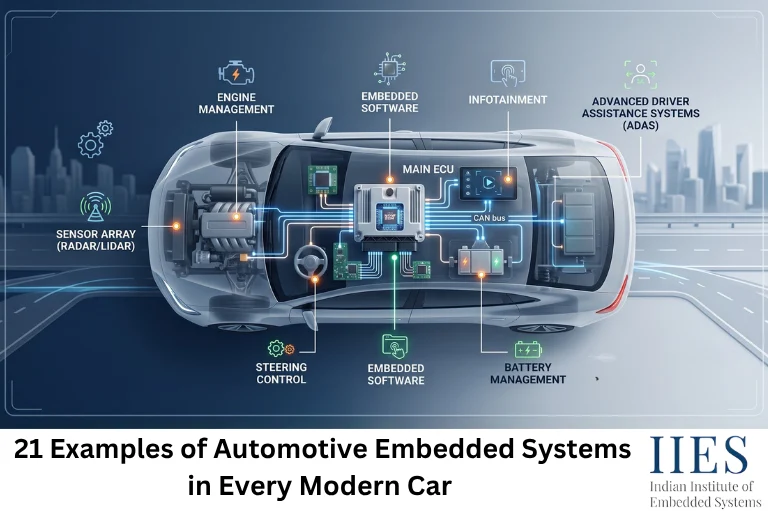
What Is an Automotive Embedded System?
An automotive embedded system is a specialized computing system designed to perform one or more dedicated functions within a vehicle.
Unlike a general-purpose computer, an automotive embedded system is designed around a particular requirement.
For example:
ABS controller
Wheel Speed Sensors

        ↓

   ECU / MCU

        ↓

Brake Control Logic

        ↓

Hydraulic Brake Actuator

        ↓

Controlled Braking
The controller continuously processes sensor data and makes decisions within strict timing requirements.
A typical automotive embedded system consists of:
Component | Purpose |
Sensors | Collect vehicle or environmental information |
Microcontroller / Processor | Executes control software |
Memory | Stores programs and data |
Communication interfaces | Exchange information with other ECUs |
Actuators | Perform physical actions |
Embedded software | Implements control logic |
Diagnostics | Detects and reports faults |
This hardware-software combination is what allows a vehicle to respond quickly and automatically to changing conditions.

What Actually Makes a System “Automotive Embedded”?
Not every computer in a car qualifies as an automotive-grade embedded system. A few things set them apart:
- Real-time response – an airbag system has roughly 30 milliseconds to detect a crash and decide whether to fire
- Safety classification – risk is graded using ASIL (Automotive Safety Integrity Level) ratings from A to D under ISO 26262
- Harsh operating conditions – engine-bay electronics survive heat beyond 150°C, constant vibration, and heavy electrical noise
- Tight resource budgets – most run on low-power microcontrollers, not full processors, so every byte of flash and RAM counts
- Long lifecycles – unlike a phone, an ECU’s firmware may need to work reliably for 15 to 20 years
With that baseline, here’s where you’ll actually find these systems at work.
Powertrain & Performance Systems
1. Engine Control Unit (ECU / ECM)
- The “brain” of the engine – reads oxygen sensors, crank/cam position sensors, and mass airflow sensors
- Calculates fuel injection timing, ignition timing, and air-fuel ratio in real time
- Typically built on 32-bit automotive microcontrollers running compiled C
Why it matters: almost every other powertrain feature – emissions control, fuel economy, torque management – depends on the ECU’s control loop running correctly, every cycle, without fail.
2. Transmission Control Unit (TCU)
- Decides gear-shift timing and clutch engagement using throttle position, speed, and engine load
- Constantly exchanges data with the ECU over CAN bus so shifts feel smooth instead of jerky
Why it matters: in modern automatics and EVs, the TCU is the difference between a transmission that feels “smart” and one that feels clunky.
3. Electronic Throttle Control (Drive-by-Wire)
- Replaces the mechanical throttle cable with a pedal sensor and a motor-driven throttle body
- Runs redundant position sensors and cross-checks them in software; a mismatch triggers limp-home mode
Why it matters: it’s one of the clearest examples of why automotive firmware needs redundancy designed in from day one, not bolted on later.
Safety-Critical Systems
4. Anti-lock Braking System (ABS)
- Wheel-speed sensors report to the ABS ECU dozens of times per second
- When a wheel is about to lock, the system pulses brake pressure through a hydraulic control unit
Why it matters: ABS was one of the first mass-market systems to prove embedded control could out-react a human driver.
5. Electronic Stability Control (ESC)
- Builds on ABS with a yaw-rate sensor and steering-angle sensor
- Detects when the car’s actual path diverges from the driver’s intended path and brakes individual wheels to correct it
Why it matters: ESC is mandatory in most markets today specifically because of how well it prevents skids and rollovers.
6. Airbag Control Unit (ACU / SRS)
- Reads accelerometers and pressure sensors to detect a crash within milliseconds
- Decides which airbags fire, in what sequence, and whether to pre-tension seatbelts
- Usually carries one of the highest ASIL-D safety ratings in the whole vehicle
Why it matters: there’s zero tolerance for a false trigger or a missed deployment – this is safety-critical embedded engineering at its sharpest edge.
7. Tire Pressure Monitoring System (TPMS)
- Battery-powered sensors inside each wheel transmit pressure and temperature wirelessly to a receiver ECU
- Runs ultra-low-power firmware, since the sensor battery has to last for years
Why it matters: it’s a great real-world lesson in low-power embedded design – a constraint most students don’t feel until they build one.

ADAS & Driver-Assistance Systems
8. Adaptive Cruise Control (ACC)
- Uses radar and/or camera input to track the vehicle ahead
- Continuously adjusts throttle and braking to hold a set following distance
Why it matters: ACC is the entry point to everything now called “autonomous driving” – the sensor-fusion logic scales up from exactly this.
9. Lane Keep Assist / Lane Departure Warning
- Camera-based system detects lane markings using embedded image-processing algorithms
- Nudges the steering (LKA) or alerts the driver (LDW) on unsignaled drift
Why it matters: it runs real-time computer vision on embedded hardware – a natural bridge between embedded systems and applied AI.
10. Automatic Emergency Braking (AEB)
- Fuses camera, radar, and sometimes LiDAR data to spot an imminent collision
- Applies the brakes automatically if the driver doesn’t react in time
Why it matters: AEB carries some of the tightest real-time deadlines in the vehicle – hesitation and false alarms are both dangerous.
11. Parking Assist (Ultrasonic / Camera-Based)
- Ultrasonic sensors around the bumpers measure distance to nearby objects
- Some systems fully automate steering during parallel or perpendicular parking
Why it matters: it’s a low-stakes, approachable way to see sensor-fusion logic working in real time.
Body, Comfort & Convenience Systems
12. Body Control Module (BCM)
- Centralized controller for lighting, wipers, power windows, and central locking
- Often acts as a gateway node, translating messages between CAN and LIN networks
Why it matters: if you want to understand vehicle networking, the BCM is ground zero – it touches almost every other module in the car.
13. HVAC / Climate Control ECU
- Reads cabin temperature, ambient temperature, and sun-load sensors
- Drives compressor clutches, blend-door actuators, and blower-motor speed
Why it matters: it’s an approachable, everyday example of closed-loop feedback control – a great one for beginners to trace end to end.
14. Electronic Power Steering (EPS)
- Replaced hydraulic power steering with a motor-assisted, sensor-driven system
- Adjusts steering effort by speed and increasingly shares its motor with LKA and parking-assist features
Why it matters: it shows how a purely mechanical system gets “softwarized” once you add a motor and a microcontroller to it.
15. Keyless Entry & Immobilizer System
- An RF or Bluetooth Low Energy (BLE) key fob talks to a receiver ECU
- The immobilizer verifies a cryptographic key exchange before the engine is allowed to start
Why it matters: it’s one of the best everyday examples of embedded cryptography and RF protocol design working together.
Infotainment & Connectivity
16. Infotainment Head Unit
- Runs a far heavier OS than most ECUs – commonly embedded Linux, QNX, or Android Automotive
- Handles the touchscreen UI, media, navigation, and phone connectivity (CarPlay/Android Auto)
Why it matters: it’s the automotive system that looks most like consumer embedded Linux and IoT development.
17. Digital Instrument Cluster
- Replaces analog gauges with a configurable digital display
- Pulls live data from the ECU, BMS, and ADAS systems over CAN and renders it in real time
Why it matters: the display can never visibly lag behind the actual vehicle state – a strict real-time embedded graphics problem.
18. Telematics Control Unit
- Provides cellular and GPS connectivity for remote diagnostics, stolen-vehicle tracking, and over-the-air (OTA) updates
- Increasingly serves as the gateway that pushes firmware updates out to other ECUs
Why it matters: OTA updates are reshaping how automotive software gets maintained long after the car leaves the factory.
EV-Specific Embedded Systems
With global EV sales having already passed 17 million units a year and still climbing, the systems below are quickly becoming standard rather than specialized.
19. Battery Management System (BMS)
- Monitors voltage, current, and temperature across individual battery cells
- Balances charge between cells and guards against overcharge, over-discharge, and thermal runaway
Why it matters: it’s arguably the single most safety-critical embedded system in an EV – a BMS failure risks fire, not just a stall.
20. Motor Control Unit / Inverter Control
- Converts DC battery power into the AC waveform that drives the traction motor
- Runs high-speed control loops, often in the tens of kilohertz, to manage torque and efficiency
Why it matters: this is real-time embedded control at its most demanding – timing errors show up instantly as vibration or lost efficiency.
21. Onboard Charger (OBC) Control
- Manages AC-to-DC conversion when charging from a wall outlet or Level 2 charger
- Talks to charging stations using standardized protocols to negotiate charge rate
Why it matters: OBC firmware bridges classic power electronics with modern automotive communication protocols.
How Automotive Embedded Systems Communicate
None of the 21 systems above work in isolation, they constantly exchange data over shared vehicle networks:
Protocol | Typical Speed | Common Use Case |
LIN (Local Interconnect Network) | Up to 20 kbps | Low-cost body electronics, mirrors, seats, window switches |
CAN / CAN-FD | 500 kbps – 8 Mbps | Powertrain, chassis, and safety systems, the automotive workhorse |
FlexRay | Up to 10 Mbps | Time-triggered, high-reliability systems like steer-by-wire |
Automotive Ethernet | 100 Mbps – 10+ Gbps | ADAS sensor data, infotainment, and zonal-architecture backbones |
AUTOSAR documentation specifically identifies CAN, LIN, FlexRay, and Ethernet among the vehicle-network technologies used in automotive ECU environments.
For example:
Engine ECU  ─── CAN ─── Transmission ECU

      │                     │

      └──── CAN ─── ESC ECU ┘

               │

          Body Controller
This networking approach allows information produced by one controller to be used by other systems.
These aren’t paperwork exercises – they show up directly in your coding rules and code reviews:
- ISO 26262 – the functional safety standard; risk is graded using ASIL levels A through D
- ISO/SAE 21434 – governs automotive cybersecurity across the entire vehicle lifecycle, working alongside ISO 26262
- AUTOSAR – a standardized software architecture (Classic and Adaptive platforms) so code from different suppliers works together on one ECU
- MISRA C / MISRA C++ – coding guidelines that eliminate undefined behavior and unsafe constructs in safety-critical code
- UN R155 / R156 (WP.29) – regulations requiring a certified cybersecurity and software-update management system before a vehicle can be type-approved in many markets
Popular Automotive-Grade Microcontroller Families
Vendor | Family | Core Architecture | Typical Use |
Infineon | AURIX (TC2xx–TC4xx) | TriCore, with an upcoming RISC-V-based AURIX family in development | Powertrain, safety, zonal gateways |
NXP | S32K (S32K1/S32K3/S32K5) | Arm Cortex-M7 | Body control, BMS, zonal control |
STMicroelectronics | SPC5 / Stellar | Power Architecture and Arm | Gateways, ADAS, electrification |
Renesas | RH850 | Proprietary Renesas core | Powertrain, chassis, motor control |
Texas Instruments | Hercules (TMS570) | Arm Cortex-R | Braking, steering, safety systems |
Worth watching: the industry is gradually shifting from dozens of small, single-function ECUs toward centralized “zonal” compute, fewer, more powerful controllers (like NXP’s S32N line) consolidating work that used to be spread across many separate modules. It won’t erase the examples above, but it will change how they’re packaged.
Why Automotive Embedded Systems Are a Smart Skill Set to Build
A few fundamentals show up again and again across every example on this list:
- Solid C programming discipline (with growing C++ usage under AUTOSAR Adaptive)
- Comfort with interrupt-driven design and basic RTOS concepts
- Hands-on exposure to CAN bus and a protocol analyzer, not just the theory
- Familiarity with Arm Cortex-M/R architectures
- Working knowledge of MISRA C and safety-critical coding habits
Demand for these skills keeps climbing as vehicles add more ADAS features and shift toward electric drivetrains. Theory alone won’t carry you far here, pairing microcontroller fundamentals with real CAN-bus lab work is what actually transfers to the job.

Wrapping Up
From the ECU quietly managing your engine to the BMS keeping an EV’s battery pack safe, automotive embedded systems are where embedded engineering meets real, physical consequences. Every example above runs on the same fundamentals: solid C, real microcontroller architecture, hard real-time constraints, and rigorous safety practices.
If you’re building your embedded systems skills, this industry is one of the richest places to put them to work.