What Makes C++ Different From C?
C++ began as “C with Classes” Bjarne Stroustrup’s attempt to add object-oriented structure to C without losing its speed or hardware access.
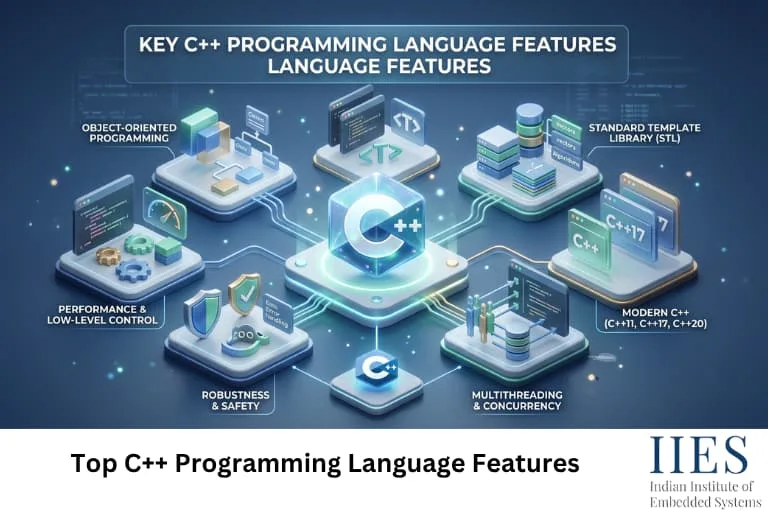
That history still shows. Almost every valid C program is valid C++, but C++ adds a whole layer on top:
- Object-oriented programming – classes, objects, inheritance
- Generic programming – templates that work across data types
- Automatic safety tools – RAII, smart pointers, exceptions
- A massive standard library – the STL, full of ready-made data structures and algorithms

Object-Oriented Programming
This is the feature most people associate with C++ — and for good reason. It changes how you structure a program, not just how you write one line of it.
Classes and Objects
A class is a blueprint. An object is what you build from it.
cpp
class Sensor {

private:

    float temperature;

public:

    Sensor(float temp) : temperature(temp) {}

    float readTemperature() const {

        return temperature;

    }

};

int main() {

    Sensor tempSensor(25.5);

    std::cout << "Reading: " << tempSensor.readTemperature() << " C";

}
One Sensor class, unlimited sensor objects – each with its own data.
Encapsulation
Keep internal state (temperature) private, and expose only what the outside world needs (readTemperature()). This is what stops some unrelated part of your code from silently corrupting a reading.
Inheritance
A DigitalSensor or AnalogSensor can inherit from a base Sensor class, reusing common logic instead of rewriting it.
Polymorphism
Different sensor types can respond differently to the same function call, so you can write generic code that works across many device types without an if-else chain for each one.
Abstraction
You don’t need to know how a sensor reads its value internally, only that calling readTemperature() gives you one. Complexity hides behind a clean interface.
Constructors, Destructors, and RAII
A constructor runs automatically when an object is created. A destructor runs automatically when it’s destroyed.
That sounds simple, but it powers one of C++’s most important ideas: RAII – Resource Acquisition Is Initialization.
- Open a file in the constructor → it closes automatically in the destructor
- Allocate memory in the constructor → it’s freed automatically in the destructor
- Lock a hardware peripheral in the constructor → it’s released automatically, even after an error
No garbage collector, no manual cleanup calls scattered everywhere, just deterministic, automatic resource management. That determinism matters enormously on devices that can’t afford a garbage collector’s unpredictable pauses.
[Internal link: connect this section to your existing “C++ constructors and destructors” post.]
References and Pointers
C++ inherits C’s pointers and adds references as a safer alternative for many everyday situations.
| | Pointer | Reference |
Can be null | Yes | No |
Can be reassigned | Yes | No |
Declared as | int* p = &x; | int& r = x; |
Best suited for | Direct memory/register access | Passing objects without copying |
In embedded work, pointers aren’t optional, they’re how you talk directly to hardware:
cpp
volatile uint32_t* gpioRegister = (uint32_t*)0x40020014;
*gpioRegister |= (1 << 5); // Set pin 5 high
[Internal link: connect this section to your existing “C pointers” post.]
Templates
Templates let you write one function or class that works with any data type, checked at compile time, with zero runtime overhead.
cpp
template <typename T>

T getMax(T a, T b) {

    return (a > b) ? a : b;

}
int result = getMax(10, 20);
float volt = getMax(3.3f, 5.0f);
Instead of writing getMaxInt(), getMaxFloat(), and getMaxDouble() separately, you write the logic once. The compiler quietly generates a type-specific version behind the scenes, which is also why templates are popular for building type-safe register wrappers in firmware.
The Standard Template Library (STL)
The STL is C++’s built-in toolbox of ready-made, tested data structures and algorithms:
- Containers – vector, array, map, set, queue
- Algorithms – sort(), find(), count_if(), accumulate()
- Iterators – a uniform way to walk through any container
cpp
#include

#include

std::vector<int> sensorReadings = {23, 45, 12, 67, 34};

std::sort(sensorReadings.begin(), sensorReadings.end());
A practical note for embedded engineers: the full STL assumes dynamic memory allocation, which many resource-constrained microcontrollers avoid entirely. That’s why embedded-focused subsets like the Embedded Template Library (ETL) exist, the same STL-style convenience, without the heap dependency.
Smart Pointers and Modern Memory Management
Manual new/delete is a classic source of memory leaks and dangling pointers. Smart pointers fix this by tying memory to an object’s lifetime, RAII-style.
cpp
#include

std::unique_ptr tempSensor = std::make_unique<Sensor>(25.5);

// Memory is released automatically when tempSensor goes out of scope
- unique_ptr – sole ownership, lightweight, effectively zero overhead
- shared_ptr – shared ownership with reference counting
- weak_ptr – a non-owning reference that helps avoid circular-reference leaks
Exception Handling
try, catch, and throw separate error-handling logic from your main code path:
cpp
try {

    if (voltage > maxSafeVoltage) {

        throw std::runtime_error("Overvoltage detected");

    }

} catch (const std::exception& e) {

    std::cerr << "Error: " << e.what();

}
Worth knowing: many embedded projects compile with exceptions disabled (-fno-exceptions), trading this convenience for smaller binaries and fully predictable timing. Knowing when to skip a feature is as much a part of embedded C++ as knowing how to use it.

Operator Overloading
C++ lets you redefine how operators like +, ==, or << behave for your own types:
cpp
struct Vector2D {

    float x, y;

    Vector2D operator+(const Vector2D& other) const {

        return {x + other.x, y + other.y};

    }

};
Now vectorA + vectorB reads naturally instead of calling an awkwardly named function.
Lambda Expressions and Modern Syntax
Since C++11, you can write small, throwaway functions inline:
cpp
auto isHighReading = [](int reading) { return reading > 50; };

int count = std::count_if(sensorReadings.begin(), sensorReadings.end(), isHighReading);
Paired with auto (compiler-deduced types) and range-based for loops, modern C++ reads far closer to plain English than it did twenty years ago.
Move Semantics
Before C++11, returning a large object from a function often meant an expensive copy. Move semantics, via rvalue references (&&), let the compiler transfer ownership instead of duplicating data:
cpp
std::vector<int> createDataset() {

    std::vector<int> data(1000, 0);

    return data;   // Moved, not copied

}
This one change quietly made huge amounts of existing C++ code faster, with no rewrites required.
constexpr and Compile-Time Computation
constexpr tells the compiler: calculate this now, not while the program is running.
cpp
constexpr int bufferSize = 1024 / sizeof(int);
On a microcontroller running at a few dozen megahertz, moving math from runtime to compile time isn’t a micro-optimization, it can be the difference between meeting a real-time deadline and missing it.
Multithreading Support
Since C++11, threading is part of the standard library itself, not a platform-specific add-on:
cpp
#include

void readSensorData() { /* ... */ }

std::thread sensorThread(readSensorData);

sensorThread.join();
The Evolution of C++: C++11 to C++26
C++ hasn’t stood still. Each standard has added features without breaking backward compatibility:
Standard | Released | Landmark Additions |
C++11 | 2011 | auto, lambdas, smart pointers, move semantics, threading |
C++14 | 2014 | Generic lambdas, relaxed constexpr |
C++17 | 2017 | Structured bindings, if constexpr, filesystem library |
C++20 | 2020 | Concepts, ranges, coroutines, modules |
C++23 | 2023 | Deducing this, if consteval, multidimensional subscript operator |
C++26 | 2026 | Compile-time reflection, contracts, memory-safety hardening |
The newest of these, C++26, was finalized by the ISO C++ standards committee in March 2026. Two additions stand out for this audience: compile-time reflection, which lets code inspect types at compile time and cuts down on repetitive boilerplate, and std::inplace_vector, a fixed-capacity, dynamically-sized container added specifically because embedded developers wanted vector-like convenience without heap allocation. When the newest C++ standard is partly shaped by embedded use cases, it says something about where the language is headed.
Why These Features Matter for Embedded Systems and IoT
Every feature above earns a different kind of trust on a microcontroller than it does on a desktop:
- OOP – models sensors, actuators, and peripherals as clean, reusable objects
- RAII – guarantees a peripheral or lock gets released, even after an error, with no manual cleanup code
- Templates – build type-safe register and driver wrappers at zero runtime cost
- Smart pointers – manage memory safely on devices where a leak isn’t a minor bug – it’s a system that quietly stops responding days after deployment
- constexpr – shifts computation off a CPU that might be running at just a few dozen megahertz on a coin-cell battery
This is exactly why C++, not only C, has become a serious option for firmware, alongside traditional embedded C.
Key Takeaways
The C++ programming language features are what make the language suitable for both high-level application development and low-level systems programming.
The most important concepts to understand are:
- C++ supports multiple programming paradigms.
- Classes and objects enable structured object-oriented design.
- Inheritance and polymorphism support reusable architectures.
- Templates provide powerful generic programming capabilities.
- STL provides reusable containers and algorithms.
- Pointers and references provide low-level control.
- RAII helps manage resources through object lifetime.
- Lambdas simplify callbacks and algorithm-based programming.
constexpr supports compile-time computation.- Concepts improve template constraints.
- Modules provide a modern alternative for some header-based code organization.
- Coroutines support suspend-and-resume programming.
- Modern C++ continues to evolve through new standards and library capabilities.
For anyone interested in embedded systems, microcontrollers, automotive software, robotics, IoT, or high-performance programming, understanding these features provides a strong foundation for writing efficient and maintainable software.
Final Thoughts
C++ is much more than a language for writing fast programs. Its real strength comes from the combination of performance, memory control, abstraction, reusable components, and multiple programming paradigms.
Once the fundamentals are clear, modern features such as templates, lambdas, RAII, concepts, ranges, modules, and coroutines become much easier to understand and apply.
For developers working toward embedded systems and C/C++ programming, learning these features step by step can build a strong foundation for developing firmware, device-level software, automotive applications, robotics systems, and other performance-sensitive products.