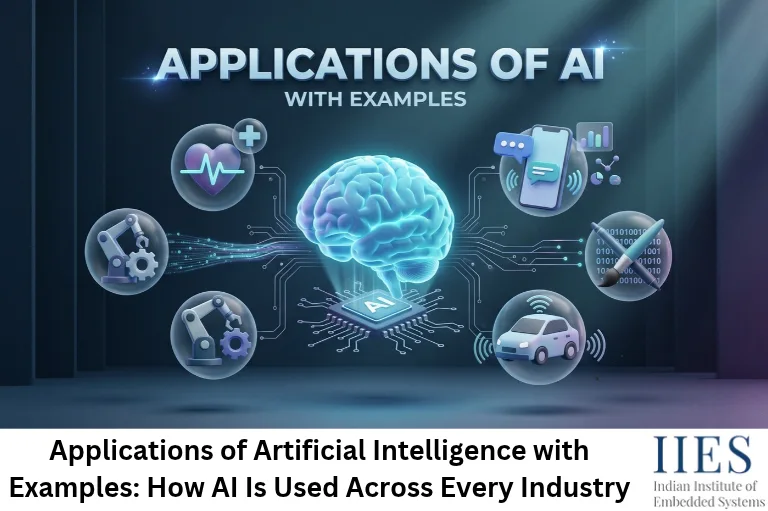
What Are AI Applications?
AI applications are software, devices and services that use artificial intelligence techniques to perform tasks that normally need human intelligence, such as understanding language, recognizing images, predicting outcomes and making decisions.
A simple way to remember it: AI is the brain, and the application is the job it does. The same technique, like image recognition, can unlock a phone, spot a defect on a factory line or scan a crop for disease.
Think of machine learning like a chef who has tasted thousands of dishes. After enough examples, the chef can guess what goes into a new dish. A trained model does the same with new data.
Core technologies behind AI applications
AI technology | What it does | Everyday example |
Machine Learning (ML) | Learns patterns from data to predict or classify | Spam filters, credit scoring |
Deep Learning | Uses multi-layer neural networks on complex data | Speech recognition, image tagging |
Natural Language Processing (NLP) | Understands and generates human language | Chatbots, translation, voice assistants |
Computer Vision | Interprets images and video | Face unlock, medical scan analysis |
Robotics | Combines sensing, planning and movement | Warehouse robots, surgical assistance |
Generative AI | Creates text, images, code and audio | Writing and coding assistants |
Types of AI at a glance
- Narrow AI (ANI): built for one task. Every real application in use today belongs here.
- General AI (AGI): a hypothetical system that matches human reasoning across tasks. It does not exist yet.
- Super AI (ASI): a hypothetical system that goes beyond human intelligence. It is still theoretical.

How AI Applications Work: The Sense, Think, Act Loop
Almost every AI application, from a Netflix suggestion to a self-driving car, runs the same five-step loop:
- Sense: collect data from sensors, apps, cameras, microphones or logs.
- Prepare: clean the data and turn it into useful features.
- Think: run a trained model to predict, classify or decide. In simple words, this step is called inference.
- Act: trigger an output such as an alert, a recommendation, a motor command or a message.
- Learn: use the results to retrain and improve the model over time.
Keep this loop in mind. When we reach embedded systems later, you will see the same steps running as firmware on a chip the size of a fingernail.
Uses of Artificial Intelligence in Every Industry
The uses of artificial intelligence now reach nearly every sector. Here is the quick comparison first, then the detail for each one.
Industry | Key AI uses | Real-world example |
Healthcare | Scan analysis, drug discovery, patient monitoring | AlphaFold protein structure prediction |
Banking and finance | Fraud detection, credit scoring, chatbots | Real-time scoring of card payments |
Retail and e-commerce | Recommendations, demand forecasting, pricing | Amazon product suggestions |
Manufacturing | Predictive maintenance, visual inspection, cobots | Vibration-based failure prediction |
Automotive | Driver assistance, autonomous driving, battery management | Waymo driverless rides |
Agriculture | Precision spraying, crop monitoring, irrigation | John Deere See & Spray |
Energy and utilities | Load forecasting, smart grids, cooling control | DeepMind data-center cooling |
Education and media | Adaptive learning paths, recommendations, content tagging | Netflix and Spotify |
Transport and public services | Route prediction, biometrics, citizen chatbots | Google Maps, Digi Yatra, IRCTC AskDISHA |
AI in Healthcare
- Medical imaging: models flag tumors, fractures and eye disease in scans. The FDA’s public list of AI-enabled medical devices passed 1,200 entries in 2025, and about 77% of them are in radiology.
- Drug discovery: DeepMind’s AlphaFold predicts 3D protein structures, and it earned its creators a share of the 2024 Nobel Prize in Chemistry.
- Wearables: smartwatches analyze heart-rate and ECG signals on the device to flag irregular rhythms.
- Clinical paperwork: speech-to-text tools draft notes so doctors spend less time typing.
angle: ECG patches and smartwatches run compact models on low-power microcontrollers, which keeps the battery alive for days.
AI in Banking and Finance
- Fraud detection: models score each card or digital payment in milliseconds against your normal behavior.
- Credit scoring: lenders combine many data signals instead of relying on a single score.
- Chatbots and voice banking: handle balance checks, card blocking and basic queries 24/7.
- Risk and compliance: pattern detection helps spot money laundering and market risk.
AI in Retail and E-Commerce
- Recommendation engines: suggest products based on what you and similar shoppers browse and buy.
- Demand forecasting: predicts what will sell, where and when, so shelves stay stocked.
- Dynamic pricing: adjusts prices using demand, stock levels and competition.
- Visual search: finds products from a photo you upload.
AI in Manufacturing and Industry 4.0
- Predictive maintenance: vibration, current and temperature sensors feed models that warn you before a motor or bearing fails.
- Visual quality inspection: cameras with deep learning catch defects faster and more consistently than manual checks.
- Collaborative robots (cobots): work next to people and adapt to the task.
- Digital twins: virtual copies of machines used to test changes safely.
Embedded angle: most of this starts with a microcontroller reading a sensor over SPI or I2C, which is why firmware skills matter.
AI in Automotive and Transportation
- Driver assistance (ADAS): lane keeping, automatic emergency braking and driver-monitoring cameras.
- Autonomous driving: Waymo operates driverless ride-hailing in several US cities.
- EV battery management: models estimate state of charge and state of health from voltage, current and temperature.
- Route and ETA prediction: Google Maps predicts traffic and reroutes you in real time.
Embedded angle: ADAS and battery management run on automotive-grade MCUs and SoCs with strict real-time and functional-safety requirements such as ISO 26262.
AI in Agriculture
- Precision spraying: John Deere’s See & Spray uses cameras to target weeds instead of spraying the whole field.
- Crop monitoring: drones and satellites spot disease and water stress early.
- Smart irrigation: soil-moisture nodes decide when to water.
- Yield prediction: models combine weather, soil and crop data.
Embedded angle: a battery-powered node can read soil sensors, run a small model and report over LoRa while sipping power.
AI in Energy, Utilities and Smart Cities
- Load forecasting: utilities predict demand to balance the grid.
- Renewables forecasting: models predict solar and wind output hours ahead.
- Cooling optimization: DeepMind reported cutting data-center cooling energy by up to 40% in 2016.
- Public services in India: Digi Yatra uses facial recognition for paperless airport boarding, and IRCTC’s AskDISHA chatbot answers rail queries.
AI in Education and Media
- Adaptive learning paths: platforms adjust difficulty based on how you perform.
- Automated assessment: instant evaluation of objective answers and code submissions.
- Recommendations: Netflix, YouTube and Spotify rank content using your viewing and listening patterns.
- Content creation: generative AI drafts scripts, images, music and code.

Artificial Intelligence in Business
Artificial intelligence in business means using AI to cut repetitive work, improve decisions and personalize customer experiences across departments. Here is where companies apply it most.
Business function | AI application | Example |
Marketing | Personalization, segmentation, content generation | Product emails tailored to browsing history |
Sales | Lead scoring, forecasting, call analysis | CRM tools that flag deals at risk |
Customer support | Chatbots, voice bots, ticket routing, sentiment analysis | 24/7 support assistants |
HR | Resume screening, skills matching, attrition prediction | Shortlisting tools (audit them for bias) |
Finance and accounting | Invoice reading, anomaly detection, forecasting | Automated expense checks |
Supply chain | Demand planning, route optimization, warehouse robots | Delivery time prediction |
Operations | Predictive maintenance, quality inspection | Factory sensor analytics |
IT and software | Code assistants, log anomaly detection | Auto-suggested code and bug fixes |
Rule of thumb: if a task is repetitive, high-volume and has clear right answers, it is a strong AI candidate.
The reality check
- 88% of organizations use AI in at least one function, but only about 7% have fully scaled it across the company (McKinsey, 2025).
- 39% report any enterprise-level profit impact, while 64% say AI improved innovation.
- The gap is usually workflow design and data quality, not the model itself.
How to start with AI in your business: 6 steps
- Pick one repetitive, high-volume task with a clear metric, such as ticket handling time.
- Check your data: is it available, clean and legal to use?
- Run a small pilot with a ready-made tool or API before building anything custom.
- Keep a human in the loop for decisions that affect customers or compliance.
- Measure against a baseline: time saved, errors reduced, revenue gained.
- Scale what works and set rules for privacy, bias checks and audit logs.
Everyday AI Examples You Already Use
- Smartphones: face unlock, camera scene detection, voice typing and keyboard prediction.
- Voice assistants: Siri, Alexa and Google Assistant convert speech to text and act on it.
- Navigation: Google Maps predicts traffic and travel time.
- Streaming: Netflix, YouTube and Spotify recommendations.
- Email: Gmail spam filtering and smart replies.
- Shopping: product suggestions and visual search.
- Smart homes: thermostats that learn your schedule and robot vacuums that map rooms.
- Banking apps: instant fraud alerts.
AI in Embedded Systems and IoT: Where AI Meets Microcontrollers
Edge AI means running a trained model directly on a device instead of sending data to the cloud. When it runs on a microcontroller, it is often called TinyML.
Why edge AI matters
- Low latency: decisions in milliseconds with no network round trip.
- Privacy: raw audio and video stay on the device.
- Offline operation: works on farms, factory floors and basements with poor connectivity.
- Lower cost: less bandwidth and cloud usage.
- Low power: battery devices can run for a long time.
How a model fits on a microcontroller
- Train offline on a PC or in the cloud, then deploy only inference to the device.
- Shrink the model with quantization (float32 to int8 gives roughly 4x smaller weights), pruning and distillation.
- Store weights in flash and reserve a fixed tensor arena in SRAM, so there is no malloc in the hot path.
- Use an optimized runtime such as TensorFlow Lite for Microcontrollers, CMSIS-NN or vendor tools like ST Edge AI Suite.
- Wrap it in firmware: timers for sampling, DMA for data movement, RTOS tasks and low-power sleep.
Real edge AI applications
Application | Sensor | What the model does | Typical hardware |
Predictive maintenance | Accelerometer, current sensor | Detects abnormal vibration | Cortex-M4 or M7 MCUs |
Voice commands and wake word | MEMS microphone | Keyword spotting | Cortex-M4F or M33, ESP32-S3 |
Gesture and activity recognition | IMU | Classifies motion patterns | Arduino Nano 33 BLE Sense, Cortex-M4 |
Smart camera and people counting | Image sensor | Detects objects on the device | STM32N6, Raspberry Pi, Jetson |
Wearable health monitoring | ECG or PPG sensor | Flags irregular rhythms | Low-power wearable MCUs |
Smart agriculture node | Soil moisture, temperature | Predicts irrigation need | ESP32 with LoRa |
EV battery management | Voltage, current, temperature | Estimates charge and health | Automotive-grade MCUs |
Hardware is catching up. Microcontrollers with built-in AI accelerators are now available. STMicroelectronics’ STM32N6 pairs an 800 MHz Arm Cortex-M55 core with its Neural-ART NPU (rated at 600 GOPS) and 4.2 MB of RAM, and its Edge AI Suite accepts models in TensorFlow Lite, Keras and ONNX formats. NXP’s MCX N series integrates an NPU, and Infineon’s PSOC Edge family is built around Cortex-M55 cores.
Benefits of AI Applications
- Automation: removes repetitive manual work.
- Accuracy and consistency: models do not get tired.
- 24/7 availability: support, monitoring and security never sleep.
- Personalization at scale: every user gets a tailored experience.
- Faster decisions: large datasets are analyzed in seconds.
- Safety: machines take on dangerous inspection and handling tasks.
Challenges and Ethical Concerns
- Data quality and bias: poor or skewed data leads to unfair or wrong outputs.
- Privacy and consent: personal data needs lawful handling, and India’s DPDP Act, 2023 sets the rules for it.
- Explainability: many models cannot clearly say why they made a decision.
- Hallucinations: generative models can produce confident but wrong answers, so always verify.
- Security: adversarial inputs, data poisoning and model theft are real risks.
- Energy use and cost: large models consume significant compute.
- Workforce change: roles shift, which makes reskilling important.
For a deeper look, read our guide on the limitations of artificial intelligence.
The Future of AI Applications
- Agentic AI: systems that plan and complete multi-step tasks using tools. McKinsey’s 2025 survey found 62% of organizations at least experimenting with AI agents, and 23% scaling them in one or two functions.
- Multimodal AI: one model handling text, images, audio and video together.
- On-device AI: NPUs are now arriving in phones, laptops and microcontrollers.
- Physical AI and robotics: AI that senses and acts in the real world, with embedded systems at its core.
- Smaller specialized models: cheaper to run and easier to deploy at the edge.
- Governance standards: frameworks such as ISO/IEC 42001 and the NIST AI Risk Management Framework are shaping responsible deployment.
Skills You Need to Build AI-Powered Products
- C, C++ and Python: C and C++ for firmware, Python for training and prototyping.
- Embedded fundamentals: MCU architecture, interrupts, DMA, timers and RTOS.
- Sensors and data acquisition: ADC, I2C, SPI and signal conditioning.
- ML basics: data preparation, training, evaluation and quantization.
- IoT connectivity: MQTT, BLE, Wi-Fi and LoRa.
If you want to build AI into real devices, strong embedded systems fundamentals are your edge. Explore embedded systems and IoT training at the Indian Institute of Embedded Systems (IIES), Bangalore.

Conclusion
The applications of artificial intelligence with examples above show a clear pattern: AI works best when it solves a specific problem with good data and a human checking the results. From scan analysis in hospitals to a vibration sensor on a factory motor, the same sense, think, act loop does the work.
Remember these points:
- AI is already part of healthcare, finance, retail, manufacturing, automotive, agriculture and everyday business operations.
- Adoption is broad (88%) but scaling is rare (about 7%), so a clear use case matters more than hype.
- Edge AI is turning microcontrollers into decision makers, which is where embedded skills pay off.
Ready to build the devices behind these applications? Learn embedded systems, C and C++ and IoT at IIES, Bangalore.