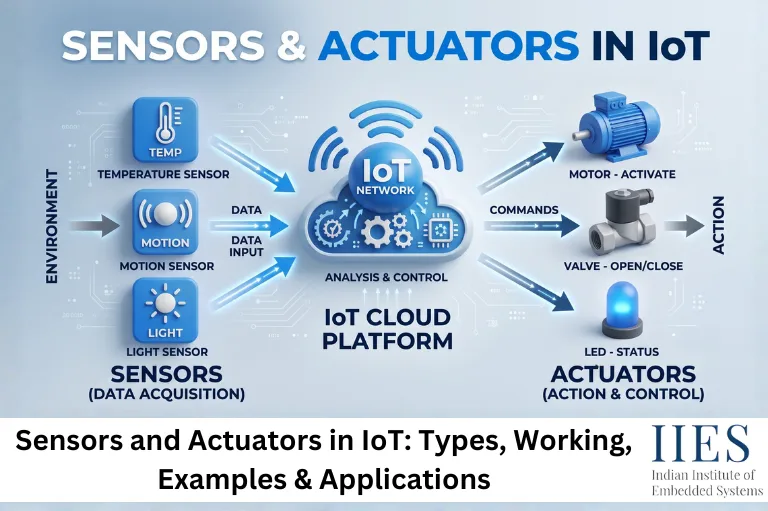
What Are Sensors and Actuators in IoT?
Sensors and actuators are two essential hardware components of an IoT system.
Component | Purpose |
Sensor | Collects information from the environment |
Actuator | Performs an action based on received commands |
A typical IoT workflow follows these steps:
- Sensor collects data.
- Microcontroller processes the data.
- Data may be sent to a cloud platform.
- Decision is made automatically or by the user.
- Actuator performs the required action.
What Are IoT Sensors?
An IoT sensor is an electronic device that detects physical or environmental changes and converts them into electrical signals that can be processed by a microcontroller or processor.
Sensors continuously monitor the environment and provide accurate data for analysis and automation.
How Do IoT Sensors Work?
Most IoT sensors follow a simple process:
- Detect a physical parameter.
- Convert it into an electrical signal.
- Send the signal to a microcontroller.
- The controller processes the data.
- The processed data is displayed, stored, or transmitted to the cloud.
Example: Smart Weather Station
- Temperature sensor measures air temperature.
- ESP32 collects sensor readings.
- Data is sent to the cloud using Wi-Fi.
- Users monitor weather conditions through a mobile application.
What Are Actuators in IoT?
An IoT actuator is an output device that receives commands from a controller and converts electrical energy into physical movement or action.
Actuators allow IoT systems to respond automatically to changing environmental conditions.
Common Examples of IoT Actuators
Actuator | Action Performed | Example Application |
DC Motor | Rotational movement | Robot wheels |
Servo Motor | Precise angle control | Robotic arm |
Stepper Motor | Controlled rotation | CNC machines |
Relay | Switch electrical loads | Home automation |
Solenoid Valve | Opens or closes fluid flow | Smart irrigation |
Water Pump | Pumps water | Automatic irrigation |
Buzzer | Produces sound | Security alarms |
LED | Visual indication | Status indicators |
Electric Door Lock | Locks or unlocks doors | Smart door systems |
Linear Actuator | Linear motion | Industrial automation |
How Do IoT Actuators Work?
The operation of an actuator generally follows these steps:
- Controller receives sensor data.
- Software decides whether an action is required.
- A control signal is sent to the actuator.
- The actuator performs the physical action.
Example: Smart Irrigation System
- Soil moisture sensor detects dry soil.
- ESP32 processes the data.
- Relay module turns ON the water pump.
- Pump irrigates the field.
- When moisture reaches the desired level, the relay turns OFF the pump.

How Do Sensors and Actuators Work in IoT Systems?
Sensors and actuators work together through a controller to automate tasks.
Workflow
Physical Environment

        ↓

      Sensor

        ↓

Microcontroller (STM32 / ESP32 / Arduino)

        ↓

Decision Logic

        ↓

Actuator

        ↓

Physical Action
Example 1: Smart Home
- Motion sensor detects movement.
- ESP32 processes the signal.
- Relay switches ON the room light.
Example 2: Smart Agriculture
- Soil moisture sensor measures soil condition.
- Controller checks moisture level.
- Water pump starts automatically.
- Irrigation stops when sufficient moisture is detected.
Example 3: Smart Parking
- Ultrasonic sensor detects vehicle presence.
- IoT gateway updates parking availability.
- LED indicator changes to red or green.
Example 4: Industrial Automation
- Temperature sensor monitors machine temperature.
- Controller compares it with the threshold.
- Cooling fan starts automatically.
- Alarm activates if overheating continues.
Classification of Sensors in IoT
Sensors can be classified in different ways depending on their working principle and application.
1. Based on Power Requirement
Active Sensors
- Require an external power supply.
- Generate output using supplied power.
Examples
- Ultrasonic sensor
- Hall Effect sensor
- Gas sensor
Passive Sensors
- Detect naturally available energy.
- Consume very little power.
Examples
- Thermocouple
- LDR
- Photodiode
2. Based on Output Signal
Analog Sensors
Produce continuous voltage values.
Examples
Digital Sensors
Produce digital HIGH or LOW outputs or communicate digitally.
Examples
- DHT11
- DHT22
- DS18B20
- PIR sensor
3. Based on Measured Quantity
Sensors can also be classified by what they measure.
- Temperature sensors
- Pressure sensors
- Motion sensors
- Humidity sensors
- Gas sensors
- Light sensors
- Proximity sensors
- Distance sensors
- Vibration sensors
- Magnetic sensors
Types of Sensors in IoT
Some of the most widely used IoT sensors include:
Temperature Sensor
Measures temperature in industrial machines, HVAC systems, refrigerators, and weather stations.
Examples: LM35, DS18B20, TMP36
Humidity Sensor
Measures moisture present in the air.
Examples: DHT11, DHT22, SHT31
Motion Sensor
Detects movement of people or objects.
Examples: PIR Sensor, Microwave Motion Sensor
Light Sensor
Measures light intensity.
Examples: LDR, BH1750
Gas Sensor
Detects harmful or combustible gases.
Examples: MQ-2, MQ-135, MQ-7
Pressure Sensor
Measures air or liquid pressure.
Examples: BMP280, BMP180
Soil Moisture Sensor
Measures moisture content in soil.
Applications
- Smart farming
- Automated irrigation
Ultrasonic Sensor
Measures distance using ultrasonic waves.
Example: HC-SR04
Applications
- Obstacle detection
- Water level monitoring
- Smart parking
Accelerometer
Measures acceleration and tilt.
Applications
- Smartphones
- Fitness bands
- Vehicle monitoring
Gyroscope
Measures angular velocity and orientation.
Applications
- Drones
- Robotics
- Navigation systems

Types of Actuators in IoT
Actuators are classified based on the type of energy they use and the action they perform. Choosing the right actuator depends on factors such as speed, accuracy, load capacity, power consumption, and application requirements.
1. Electrical Actuators
Electrical actuators convert electrical energy into mechanical motion. They are widely used because they are easy to control and integrate with microcontrollers.
Examples
- DC Motor
- Servo Motor
- Stepper Motor
- Relay
- Solenoid
Applications
- Robotics
- Home automation
- Conveyor systems
- Smart locks
2. Hydraulic Actuators
Hydraulic actuators use pressurized fluid to generate high force.
Features
- High load capacity
- Suitable for heavy-duty applications
- Precise movement under large loads
Applications
- Excavators
- Industrial machinery
- Aircraft control systems
3. Pneumatic Actuators
Pneumatic actuators operate using compressed air.
Features
- Fast response
- Lightweight
- Simple construction
Applications
- Factory automation
- Packaging machines
- Pick-and-place robots
4. Thermal Actuators
Thermal actuators produce movement through temperature changes.
Applications
- Smart thermostats
- HVAC systems
- Temperature-controlled valves
5. Magnetic Actuators
These actuators use electromagnetic force to produce motion.
Examples
- Electromagnetic relays
- Solenoids
Applications
- Door locking systems
- Industrial automation
- Switching circuits
Difference Between Sensors and Actuators in IoT
Feature | Sensor | Actuator |
Purpose | Detects physical parameters | Performs physical actions |
Role | Input device | Output device |
Energy Conversion | Physical → Electrical | Electrical → Mechanical/Physical |
Data Flow | Sends data to controller | Receives commands from controller |
Function | Monitoring | Controlling |
Examples | DHT22, PIR, MQ-2, LDR | Relay, Servo Motor, Pump, Solenoid |
Advantages & Disadvantages of Sensors, Actuators, and Devices in IoT
Advantages of Sensors
- High accuracy
- Real-time monitoring
- Low power consumption
- Easy integration with microcontrollers
- Supports automation
- Compact size
- Reliable operation
- Wide range of applications
Disadvantages of Sensors
- Accuracy may reduce over time
- Environmental conditions can affect readings
- Some sensors require periodic calibration
- Electrical noise may introduce errors
- Limited sensing range in certain applications
- Low-cost sensors may provide less precise measurements
Advantages of Actuators
- Automate physical operations
- Fast response time
- High precision in control systems
- Reduce manual effort
- Improve productivity
- Enable remote device control
Disadvantages of Actuators
- Require power to operate
- Mechanical parts can wear out
- Maintenance may be required
- Incorrect control signals can cause unwanted operation
- Heavy-duty actuators can be expensive

Applications of Sensors and Actuators in IoT
Sensors and actuators are used across many industries to automate monitoring and control tasks.
Industry | Sensors | Actuators |
Smart Home | Motion, Temperature, Smoke | Relay, Smart Lock, LED |
Agriculture | Soil Moisture, Humidity | Water Pump, Solenoid Valve |
Healthcare | Heart Rate, Temperature | Drug Pump, Alarm |
Automotive | Pressure, Speed, Proximity | Fuel Injector, Electric Motor |
Industrial Automation | Vibration, Temperature | Conveyor Motor, Pneumatic Cylinder |
Smart City | Air Quality, Light | Traffic Signals, Street Lights |
Robotics | Ultrasonic, IMU | Servo Motor, DC Motor |
Wearables | Accelerometer, Gyroscope | Vibration Motor |
Conclusion
Sensors and actuators in IoT are the core building blocks that connect the digital and physical worlds. Sensors collect real-time information from the environment, while actuators execute actions based on processed data or user commands. Together with microcontrollers and communication technologies, they enable intelligent automation across smart homes, healthcare, agriculture, industrial automation, robotics, and many other IoT applications.
Understanding their types, working principles, advantages, limitations, and practical applications provides a strong foundation for designing reliable and efficient IoT systems. For students and professionals entering embedded systems or IoT development, mastering these components is an essential step toward building real-world connected solutions.