What Are Antennas and Wave Propagation?
An antenna is an electrical device that converts electrical energy into electromagnetic waves for transmission, and electromagnetic waves back into electrical signals during reception.
Wave propagation refers to how those electromagnetic waves travel through space from one antenna to another.
Together, antennas and electromagnetic wave propagation make wireless communication possible.
In practical wireless systems, antennas are carefully tuned to specific frequencies. If an antenna is not properly matched to its operating frequency, part of the signal reflects back toward the transmitter. This causes power loss and reduces communication efficiency. That is why frequency tuning and impedance matching are fundamental aspects of antenna design basics.
Without proper antenna design and efficient propagation, signals would not travel far, data rates would drop, and communication systems would fail.

How Antennas Work (Step-by-Step Explanation)
Understanding how antennas work becomes easier when broken into transmission and reception processes.
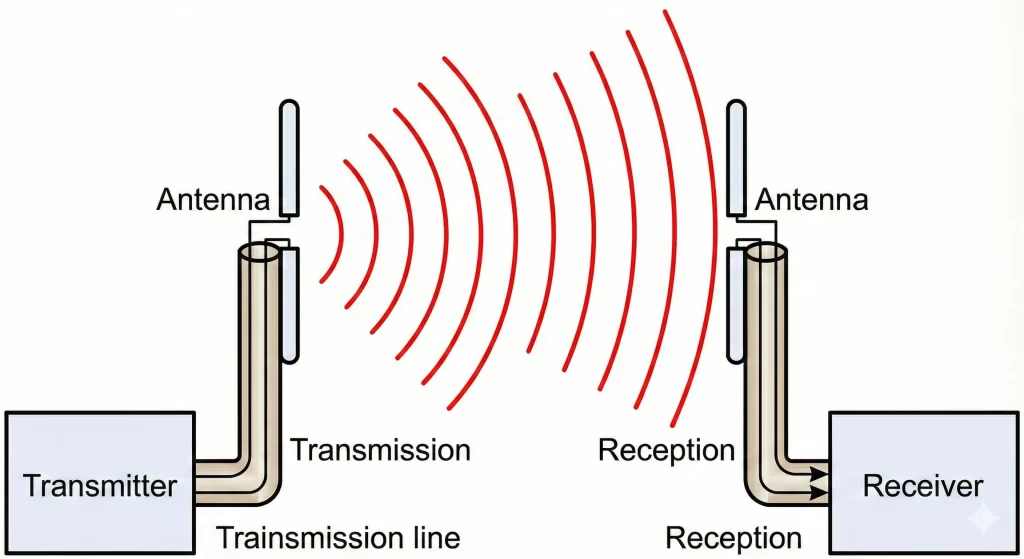
The diagram below illustrates the complete transmission and reception process in an antenna system
Transmission Process
- A signal (voice, data, or video) is generated.
- The transmitter converts this signal into high-frequency alternating current (AC).
- This AC flows through the antenna.
- The antenna radiates electromagnetic waves into space.
Reception Process
- Electromagnetic waves reach the receiving antenna.
- The waves induce a small alternating current in the antenna.
- The receiver amplifies and decodes the signal.
- The original information is reconstructed.
It is important to understand that antennas themselves do not amplify signals. They only convert electrical energy into electromagnetic energy and vice versa. Signal amplification occurs in the transmitter or receiver circuitry. The antenna’s efficiency determines how effectively energy is radiated or captured.
Types of Antennas and Their Applications
There are many types of antennas, each designed for specific communication needs.
Type of Antenna | Description | Common Applications |
Dipole | Two conductive elements | Radio, TV broadcasting |
Monopole | Single vertical conductor with ground plane | Car radios, base stations |
Patch (Microstrip) | Flat, compact antenna | Smartphones, GPS, drones |
Horn | Flared waveguide antenna | Radar, microwave systems |
Parabolic (Dish) | Reflector antenna focusing signals | Satellite communication antennas |
Helical | Spiral-shaped antenna | Space and satellite systems |
Types of Antennas Used in Mobile Phones
Modern smartphones contain multiple compact antennas inside a very limited space. The most common types of antennas used in mobile phones include:
- Patch antennas
- Planar Inverted-F Antennas (PIFA)
- MIMO antenna arrays
These antennas operate across multiple frequency bands simultaneously, supporting Wi-Fi, Bluetooth, GPS, 4G, and 5G connectivity. Advanced isolation techniques are used to prevent signal interference between closely placed antennas.
Antenna Design Basics
Effective antenna design basics focus on matching antenna characteristics to operating frequency and intended application.
Key antenna parameters include:
Gain
Measures how effectively the antenna directs energy in a specific direction.
Directivity
Indicates how concentrated radiation is in one direction.
Bandwidth
The range of frequencies over which the antenna operates efficiently.
Polarization
Orientation of the electric field (horizontal, vertical, or circular).
Radiation Pattern

Graphical representation of how energy is distributed in space.
Another critical factor in antenna design basics is impedance matching, typically standardized at 50 ohms in RF systems. Proper impedance matching ensures maximum power transfer between the transmitter and antenna while minimizing signal reflection.
Optimizing antenna parameters directly improves signal strength, coverage area, and overall system reliability.

Modes of Wave Propagation
The behavior of electromagnetic wave propagation changes depending on frequency, atmospheric conditions, and environmental obstacles. Engineers must select the appropriate propagation model to ensure reliable communication.
Ground Wave Propagation
- Travels along the Earth’s surface
- Effective for low frequencies
- Used in AM radio broadcasting
Sky Wave Propagation
- Reflects off the ionosphere
- Enables long-distance communication
- Common in shortwave and amateur radion
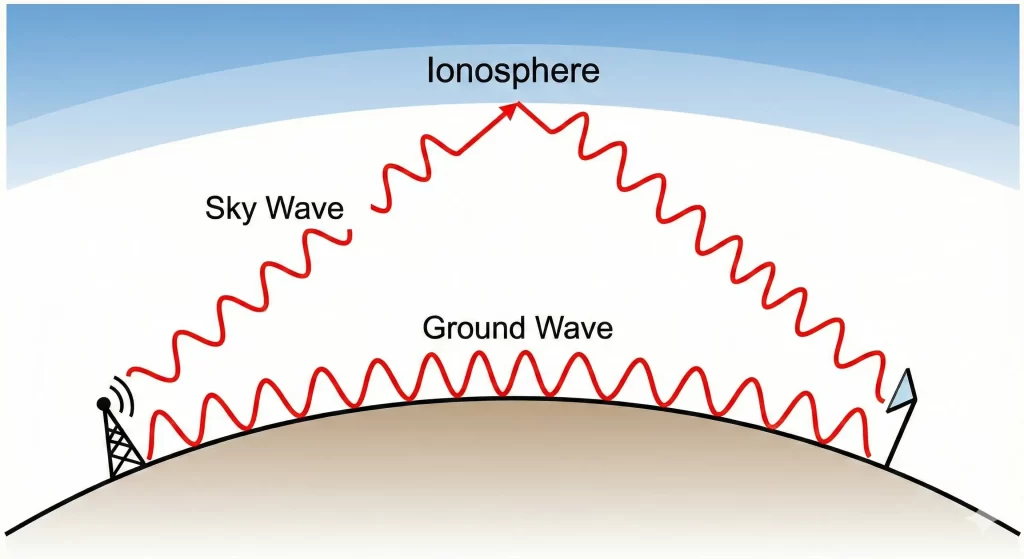
Difference Between Ground Wave and Sky Wave Propagation
Feature | Ground Wave | Sky Wave |
Path | Along Earth surface | Reflected from ionosphere |
Frequency Range | Low frequencies | High frequencies (HF) |
Coverage | Medium range | Long-distance |
Application | AM radio | International broadcasting |
Line-of-Sight (LOS) Propagation
- Travels in a straight path
- Requires clear path between antennas
- Used in mobile networks, TV transmission, and satellite links
Obstacles such as buildings, hills, and dense vegetation can block or weaken line-of-sight signals.
Electromagnetic Wave Propagation and Frequency Bands
Electromagnetic wave propagation behavior varies significantly across frequency bands.
Frequency Band | Range | Applications |
LF / MF | < 3 MHz | Navigation, AM radio |
HF | 3–30 MHz | Shortwave communication |
VHF / UHF | 30–3000 MHz | TV, FM, mobile phones |
Microwave | 3–300 GHz | Radar, Wi-Fi, satellite |
Millimeter Wave Technology | 30–300 GHz | 5G, advanced radar |
Why Millimeter Wave Technology Matters
Millimeter wave technology enables extremely high data speeds and low latency communication. However, it experiences higher path loss and is more easily blocked by physical obstacles. This is why 5G networks require dense deployment of small cells and beamforming techniques to maintain consistent performance.
Satellite Communication Antennas
Satellite communication antennas use highly directional parabolic reflectors to focus signals toward orbiting satellites.
Key characteristics:
- High gain
- Narrow beamwidth
- Long-distance transmission
Because satellite links span thousands of kilometers, even slight misalignment of a dish antenna can significantly reduce signal strength. Precision alignment systems are often used to maintain stable communication.
Real-World Applications of Antennas and Wave Propagation
Industry | Application |
Telecom | Mobile towers, 5G networks |
Aerospace | Aircraft radar systems |
Defense | Surveillance and tracking systems |
IoT | Smart home and industrial connectivity |
Automotive | GPS and vehicle communication |
Healthcare | Medical telemetry devices |
Modern Trends in Antenna Technology
Wireless systems continue evolving rapidly.
5G and Beyond
- Massive MIMO systems
- Beam steering
- High-frequency spectrum utilization
6G Research
- Terahertz communication
- Ultra-low latency systems
Researchers are also exploring intelligent reflecting surfaces (IRS) that dynamically redirect electromagnetic waves to improve coverage in dense urban environments.
Nano and Biomedical Antennas
- Implantable medical devices
- Advanced biomedical sensing
Why Antennas and Wave Propagation Are Core to Future Technologies
Emerging technologies such as IoT ecosystems, smart cities, autonomous vehicles, and edge computing rely heavily on optimized antenna parameters and accurate propagation modeling.
As device density increases worldwide, managing interference, maximizing spectral efficiency, and ensuring reliable electromagnetic wave propagation will become even more critical.
Why Understanding Antennas Matters
Strong knowledge of antennas and wave propagation helps in:
Designing reliable wireless systems
Improving network coverage
Reducing signal interference
Optimizing 5G and IoT deployments
Without proper antenna design and propagation analysis, even the most advanced communication protocols cannot perform effectively.

Final Thoughts
Antennas and wave propagation form the engineering backbone of wireless communication. From smartphones and Wi-Fi routers to satellite communication antennas and millimeter wave technology in 5G networks, everything depends on efficient antenna design and correct propagation modeling.
Understanding how antennas work, learning the different types of antennas, mastering antenna design fundamentals, and analyzing the modes of wave propagation are essential skills for modern communication engineers.
At IIES Bangalore, practical training focuses on building strong fundamentals in antennas and electromagnetic wave propagation, helping learners bridge theory with real-world communication system applications.
As wireless technology advances toward 6G and beyond, expertise in antennas and electromagnetic wave propagation will continue to shape the future of global connectivity.