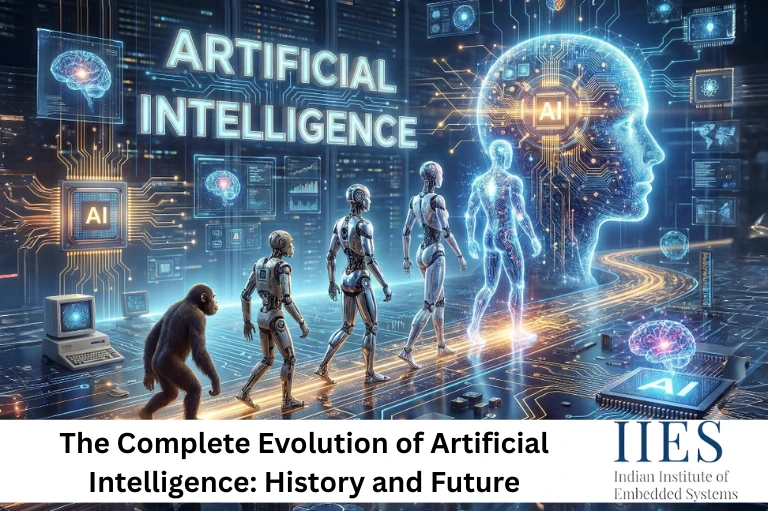
The Origins: The Birth of Artificial Intelligence
The formal foundation of modern AI research began at the Dartmouth Conference in 1956. Researchers proposed that machines could simulate aspects of human intelligence using symbolic reasoning and logical rules.
Early AI systems operated through predefined instructions. Programs could solve mathematical theorems and logical puzzles, but they lacked flexibility and adaptability. Despite technological limitations, this era established the theoretical framework for modern AI technologies.

Symbolic AI and Early Artificial Intelligence Development
The first phase of artificial intelligence development focused on symbolic AI. These systems relied heavily on logic-based programming. While effective in structured tasks, they struggled in unpredictable environments.
The challenges faced during the 1970s and 1980s highlighted a critical realization: intelligence requires learning from experience, not just following fixed rules. This understanding paved the way for the next breakthrough.
The Rise of Machine Learning
The rise of machine learning marked a major turning point in the evolution of artificial intelligence. Instead of explicitly programming rules, researchers designed systems that could learn from data.
Machine learning enabled AI systems to:
- Detect patterns in massive datasets
- Make predictions based on probability
- Improve accuracy over time
- Adapt to new information
This data-driven approach significantly expanded AI’s practical applications.
Neural Networks and Deep Learning Technology
The resurgence of neural networks transformed AI research. Inspired by biological neurons, these computational models process data through interconnected layers.
With advances in hardware and access to large-scale datasets, neural networks evolved into deep learning technology. Deep learning systems contain multiple hidden layers that extract complex features automatically.
This breakthrough improved:
- Image recognition
- Speech processing
- Autonomous systems
- Medical diagnostics
Deep learning reduced the need for manual feature engineering and allowed machines to learn directly from raw data.
The key milestones in the evolution of artificial intelligence can be summarized as follows:
Year | Milestone | Impact |
1956 | Dartmouth Conference | Formal birth of AI |
1990s | Rise of Machine Learning | Data-driven systems |
2012 | Deep Learning Breakthrough | Image recognition surge |
2018+ | Transformer Models | Language understanding |
Among these milestones, transformer models significantly reshaped natural language processing…

Natural Language Processing and AI Language Models
A major advancement in the evolution of artificial intelligence has been in natural language processing (NLP). NLP allows machines to interpret, analyze, and generate human language.
A significant milestone occurred when Google introduced BERT, improving contextual understanding in language processing. Unlike earlier systems, BERT analyzes the full context of words within sentences.
Later, advanced AI language models such as GPT-3 developed by OpenAI demonstrated large-scale text generation and reasoning capabilities. These systems support conversational agents, research tools, and automated content systems.
Artificial Intelligence Development Workflow
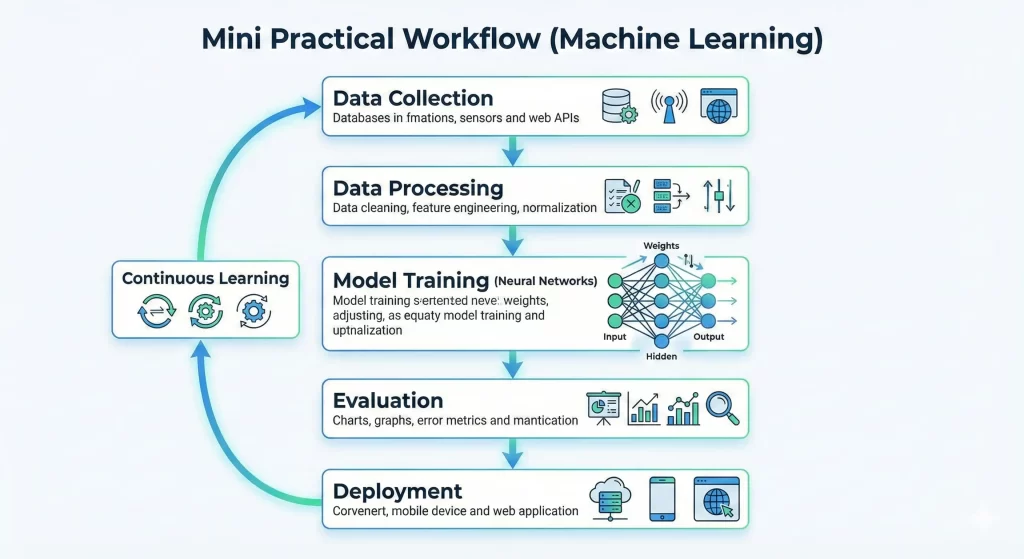
AI in Healthcare
One of the most impactful applications of AI is in AI in healthcare. Deep learning systems are widely used in medical imaging to detect diseases such as cancer and cardiovascular conditions.
A simplified diagnostic workflow includes:
- Collecting patient imaging data.
- Preprocessing images for clarity and consistency.
- Applying trained neural network models.
- Generating probability-based predictions for clinicians.
AI systems assist doctors by providing faster analysis and highlighting patterns that may be difficult to detect manually.
AI in Finance and Robotics
The growth of AI in finance and AI in robotics demonstrates how artificial intelligence development extends beyond research environments.
In finance, AI supports:
- Fraud detection
- Risk modeling
- Automated trading
- Customer behavior analysis
In robotics, AI enables:
- Warehouse automation
- Industrial precision tasks
- Autonomous navigation
- Smart manufacturing systems
Reinforcement learning allows robotic systems to improve performance through feedback from their environment.
AI and IoT Integration
AI and IoT integration connects intelligent algorithms with real-time sensor data. IoT devices collect continuous streams of information, while AI analyzes this data to make autonomous decisions.
Applications include:
- Smart cities
- Energy-efficient buildings
- Industrial predictive maintenance
- Intelligent transportation systems
This integration enhances efficiency, reduces operational costs, and improves system reliability.
Global Growth and Economic Impact
The evolution of artificial intelligence is supported by measurable global statistics:
- PwC estimates that AI could contribute up to $15.7 trillion to the global economy by 2030.
- McKinsey & Company reports that more than 50% of organizations worldwide have adopted AI in at least one business function.
- Gartner projects continued double-digit annual growth in AI software markets.
- Stanford University’s AI Index Report consistently shows year-over-year increases in AI research publications, investment, and enterprise adoption.
These data points confirm that AI is not experimental, it is a central component of global economic and technological systems.
Ethical Issues in Artificial Intelligence and Responsible AI Development
As AI systems become more powerful, ethical issues in artificial intelligence require serious consideration. These concerns include:
- Algorithmic bias
- Data privacy risks
- Security vulnerabilities
- Workforce transformation
To address these challenges, organizations focus on responsible AI development, emphasizing transparency, fairness, accountability, and regulatory compliance. Responsible governance ensures AI systems operate safely and equitably.
The Future of Artificial Intelligence
The future of artificial intelligence development is expected to evolve across several dimensions:
1. Explainable AI
Systems that clearly explain how decisions are made, increasing trust and transparency.
2. Advanced AI Language Models
More sophisticated reasoning, improved contextual understanding, and multimodal capabilities integrating text, image, and audio processing.
3. Edge AI
Running AI models directly on devices for faster processing and improved data privacy.
4. Expanded AI and IoT Integration
Greater adoption in smart infrastructure, healthcare monitoring, and industrial automation.
5. Human-AI Collaboration
AI systems increasingly functioning as collaborative tools that enhance human productivity rather than replace it.
As computing power, data availability, and research innovation continue to expand, AI technologies will likely become more autonomous, adaptive, and integrated into everyday systems.
Conclusion
The evolution of artificial intelligence reflects decades of scientific progress, from symbolic reasoning systems introduced at the Dartmouth Conference to today’s neural networks, deep learning technology, and advanced AI language models. The history of AI demonstrates how persistence, computational growth, and data-driven innovation transformed theoretical ideas into practical systems embedded across healthcare, finance, robotics, and connected environments.
Artificial intelligence development has now reached a stage where AI is no longer simply a technological tool, it is becoming critical digital infrastructure. It powers decision-making systems, supports economic growth, enhances industrial efficiency, and influences how societies function. From AI and IoT integration in smart cities to intelligent automation in global enterprises, AI technologies are shaping the foundation of modern digital ecosystems.
However, progress must be guided carefully. Addressing ethical issues in artificial intelligence and ensuring responsible AI development are essential to maintaining trust, fairness, and long-term sustainability. Innovation and responsibility must advance together.
The future of artificial intelligence will not be defined solely by how powerful these systems become, but by how wisely they are designed, governed, and integrated into human society. When developed thoughtfully, artificial intelligence has the potential to become not just a transformative technology, but a foundational pillar of global progress.