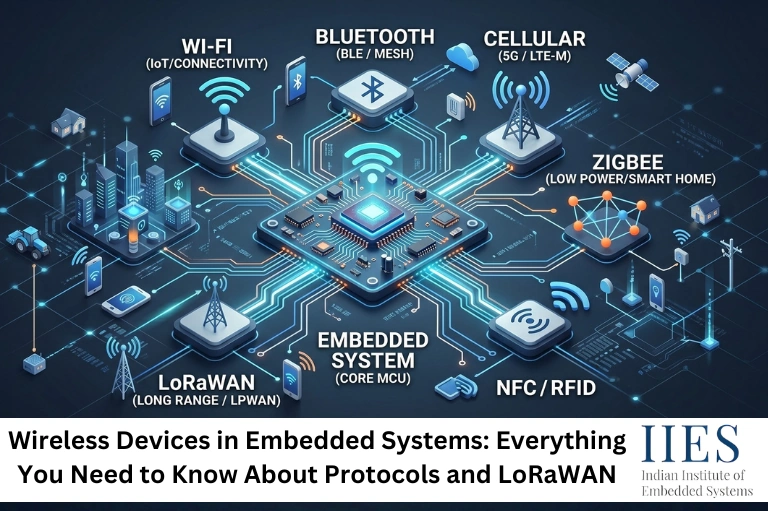
Why Wireless Devices Matter in Embedded Systems
The transition from wired to wireless embedded systems addresses several critical limitations of traditional designs.
Key Benefits
- Flexibility and Scalability
Wireless systems eliminate physical wiring, making it easier to expand and modify systems. - Remote Accessibility
Devices can be monitored and controlled from anywhere, improving operational efficiency. - Cost Efficiency
Reduces installation and maintenance costs associated with cables. - Real-Time Communication
Enables instant data transfer for time-sensitive applications like healthcare and automation. - Enhanced Mobility
Ideal for wearable devices, vehicles, and portable systems.
These benefits highlight why understanding what is wireless communication and its types is essential for modern embedded system design.

Fundamentals of Wireless Communication
At its core, wireless communication involves transmitting data over electromagnetic waves without physical connections.
Types of Wireless Communication System
Wireless systems can be broadly categorized based on range and power consumption:
Type | Range | Examples | Use Case |
Short-range wireless communication | Few meters to ~100m | Bluetooth, Zigbee | Wearables, smart homes |
Long range wireless communication | Several kilometers | LoRaWAN, cellular | Smart cities, agriculture |
Medium range | Up to a few hundred meters | Wi-Fi | Home/office networks |
Understanding these categories helps in selecting the right protocol for specific embedded applications.
Wireless Communication Protocols in Embedded Systems
A critical component of wireless devices in embedded systems is the communication protocol. Each protocol is designed for specific use cases.
1. Wi-Fi
Wi-Fi provides high-speed connectivity and is widely used in applications requiring internet access and real-time data streaming.
Use case: Smart home cameras, industrial dashboards
2. Bluetooth (Short Range)
Bluetooth enables short range wireless communication between devices with low power consumption.
Use case: Wearables, smartphones, medical devices
3. Zigbee
Zigbee is optimized for low-power, low-data-rate communication and supports mesh networking.
Use case: Home automation, sensor networks
4. RFID (Radio-Frequency Identification)
RFID is used for identification and tracking via radio signals.
Use case: Inventory management, access control
Wireless vs Wired Embedded Systems
As embedded systems continue to evolve, one of the most important design decisions is choosing between wired and wireless communication. While both approaches have their advantages, modern applications increasingly favor wireless solutions due to flexibility and scalability.
Comparison: Wireless vs Wired Embedded Systems
Feature | Wireless Embedded System | Wired Embedded System |
Installation | Easy and quick, no physical cabling required | Complex due to wiring infrastructure |
Cost | Lower long-term (reduced maintenance and installation) | Higher due to cabling and labor |
Reliability | Moderate (can be affected by interference) | High (stable and consistent connection) |
Scalability | Highly scalable and flexible | Limited scalability |
Mobility | Supports mobile and remote devices | Restricted to fixed locations |
Maintenance | Easier to upgrade and modify | Difficult to reconfigure |
When to Use Wireless vs Wired Systems
- Choose wireless embedded systems when:
- You need remote monitoring or control
- Mobility and flexibility are important
- The system needs to scale over time
- Deployment is in large or hard-to-wire areas
- Choose wired embedded systems when:
- Ultra-high reliability is required
- The environment has heavy interference
- Security is a critical concern
- Real-time deterministic communication is needed
What is LoRaWAN Technology and How Does it Work
LoRaWAN is a key innovation in long range wireless communication designed for low-power devices.
What is LoRaWAN
LoRaWAN (Long Range Wide Area Network) is a protocol built on LPWAN technology that enables devices to communicate over long distances with minimal power usage.
How LoRaWAN Works (Step-by-Step)
- End Devices (Sensors) collect and transmit data
- Data is sent to LoRa Gateways via radio signals
- Gateways forward data to a Network Server
- The server processes and sends it to applications
- Users access data through dashboards or cloud platforms
Key Features
- Long-range communication (up to 15 km in rural areas)
- Ultra-low power consumption
- Secure data transmission
- Scalable network architecture

Applications of Wireless Devices in Embedded Systems
Wireless technology has enabled diverse applications across industries.
1. Smart Home Automation
Wireless embedded systems control lighting, security, and appliances remotely.
Example: Smart thermostats adjusting temperature based on user preferences.
2. Healthcare Systems
Wearable devices monitor vital signs and transmit data in real time.
Mini Case Study:
Remote patient monitoring systems reduce hospital visits by enabling doctors to track patient health continuously.
3. Industrial IoT (IIoT)
Wireless sensors monitor machinery, enabling predictive maintenance.
Example: Detecting equipment failure before breakdown.
4. Automotive Systems
Wireless communication enhances safety and user experience.
Example: Vehicle-to-vehicle communication for collision prevention.
Wireless Communication Challenges in Embedded Systems
Despite the advantages, there are several wireless communication challenges developers must address.
1. Security Risks
Wireless data transmission is vulnerable to attacks.
Solution: Use encryption and authentication protocols.
2. Power Consumption
Battery-powered devices require efficient energy usage.
Solution: Adopt low-power protocols like Zigbee and LoRaWAN.
3. Interference and Reliability
Signal interference can disrupt communication.
Solution: Use robust error-handling and redundancy mechanisms.
4. Interoperability Issues
Different protocols may not work seamlessly together.
Solution: Follow industry standards and modular design approaches.
Role of AI in Embedded Systems
The integration of AI in embedded systems is transforming how wireless devices operate.
Key Advantages
- Real-time data analysis at the edge
- Predictive maintenance
- Intelligent automation
- Reduced latency
Example
An AI-powered industrial system can analyze sensor data locally and detect anomalies without relying on cloud processing.
Comparison of Wireless Protocols
Protocol | Range | Power Usage | Speed | Best Use Case |
Wi-Fi | Medium | High | High | Streaming, internet |
Bluetooth | Short | Low | Medium | Wearables |
Zigbee | Short | Very Low | Low | Smart homes |
LoRaWAN | Long | Very Low | Low | IoT, agriculture |
Future Trends and Innovations (2026 and Beyond)
The evolution of wireless embedded systems continues rapidly.
1. 5G Integration
Ultra-low latency and high-speed connectivity will enable advanced applications like autonomous vehicles.
2. Edge Computing
Processing data closer to devices reduces latency and bandwidth usage.
3. AI Integration
Smarter systems capable of autonomous decision-making.
4. Enhanced Security
Blockchain and advanced encryption techniques will strengthen data protection.
Best Practices for Designing Wireless Embedded Systems
- Choose the right protocol based on range and power needs
- Optimize power consumption early in design
- Implement strong security measures
- Ensure scalability for future expansion
- Test for real-world interference scenarios
Common Mistakes to Avoid
- Ignoring power constraints
- Overusing high-bandwidth protocols unnecessarily
- Neglecting security implementation
- Poor network planning
- Lack of scalability considerations
Conclusion
The integration of wireless devices in embedded systems has fundamentally changed how modern technology operates. From smart homes and healthcare to industrial automation, wireless communication enables seamless connectivity, efficiency, and innovation.
As advancements like AI in embedded systems, 5G, and edge computing continue to evolve, the future promises even more intelligent and autonomous systems. Businesses and developers who understand and leverage these technologies will be better positioned to build scalable and future-ready solutions.