What is LoRaWAN?
LoRaWAN (Long Range Wide Area Network) is a low-power, wide-area networking protocol designed to wirelessly connect battery-operated devices over long distances. It operates in unlicensed frequency bands and supports large-scale IoT deployments.
Unlike traditional wireless systems, LoRaWAN is specifically optimized for:
- Low power consumption
- Long communication range
- Secure data transmission
- Massive device connectivity
This makes it ideal for applications where devices need to operate for years without maintenance.

How LoRaWAN Works
Understanding how LoRaWAN works is key to appreciating its efficiency.
LoRaWAN follows a star-of-stars topology, where devices communicate with gateways, and gateways relay data to a central network server.
Data Flow:
- End Devices (Sensors) collect data
- Data is transmitted via LoRa radio signals
- Gateways receive and forward the data
- Network Server processes and routes it
- Application Server delivers usable insights
This architecture minimizes power usage while ensuring reliable communication across long distances.
LoRaWAN Architecture Explained
The LoRaWAN architecture is simple yet highly scalable. It consists of four key components:
1. End Devices
These include IoT sensors such as temperature monitors, GPS trackers, and smart meters.
2. Gateways
Gateways act as bridges, receiving data from devices and sending it to the network server via IP networks.
3. Network Server
Handles device authentication, data routing, and network management.
4. Application Server
Processes data and converts it into actionable insights for end users.
Key LoRaWAN Advantages
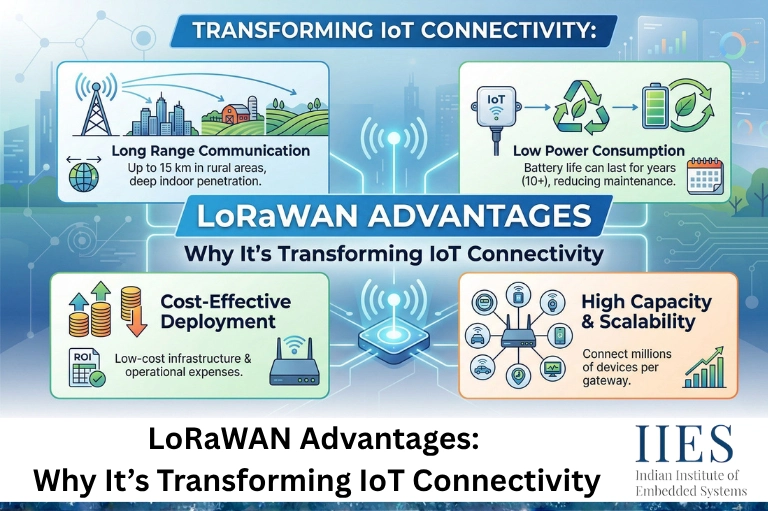
1. Long-Range Communication
LoRaWAN can cover:
- 2–5 km in urban areas
- 10–15 km in rural environments
This makes it ideal for wide-area deployments like agriculture and smart cities.
2. Ultra-Low Power Consumption
Devices can operate for 5 to 10 years on a single battery, depending on usage. This significantly reduces maintenance costs and enables remote deployments.
3. High Scalability
A single LoRaWAN network can support thousands to millions of devices, making it suitable for large-scale IoT ecosystems.
4. Cost-Effective Deployment
- No need for licensed spectrum
- Lower infrastructure costs compared to cellular IoT
- Reduced operational expenses
5. Strong Security
LoRaWAN uses end-to-end encryption (AES-128) and secure device authentication to ensure data integrity and privacy.
6. Deep Indoor Penetration
LoRaWAN signals can penetrate buildings, basements, and underground areas more effectively than many other wireless technologies.

LoRaWAN Advantages and Disadvantages
Aspect | Advantages | Disadvantages |
Range | Long-distance communication | Lower data rate |
Power | Extremely low consumption | Not suitable for high-speed applications |
Cost | Affordable deployment | Limited bandwidth |
Scalability | Supports massive IoT networks | Network congestion in dense areas |
Security | Strong encryption | Requires proper configuration |
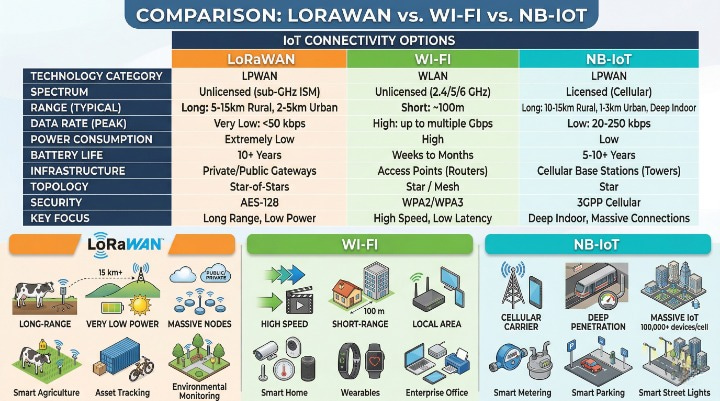
LoRaWAN vs Wi-Fi vs NB-IoT
The above comparison clearly shows that LoRaWAN is ideal for long-range, low-power IoT applications, while Wi-Fi and NB-IoT serve different use cases.
LoRaWAN Benefits in Real-World Applications
Smart Cities
- Smart street lighting
- Waste management systems
- Air quality monitoring
Agriculture
- Soil moisture monitoring
- Crop health tracking
- Weather data collection
Studies indicate that IoT-based smart farming can improve agricultural productivity by up to 20–30 percent.
Industrial IoT (IIoT)
- Predictive maintenance
- Equipment monitoring
- Asset tracking
Logistics and Supply Chain
- Real-time tracking of goods
- Fleet management
- Cold chain monitoring
Smart Buildings
- Energy management
- Occupancy detection
- Security systems
LoRaWAN Specification Overview
The LoRaWAN specification defines how devices communicate within the network. Key features include:
- Device Classes:
- Class A (lowest power consumption)
- Class B (scheduled communication)
- Class C (continuous listening)
- Adaptive Data Rate (ADR)
- Bi-directional communication
- Network capacity optimization
These specifications ensure flexibility across various IoT use cases.
Real Data and Market Trends
- The global LPWAN market is projected to exceed 65 billion USD by 2030
- LoRaWAN is among the fastest-growing IoT connectivity technologies
- More than 300 network operators worldwide support LoRaWAN deployments
This growth reflects increasing adoption across industries and regions.
Future Trends in LoRaWAN Technology
Integration with AI and Data Analytics
LoRaWAN networks are increasingly integrated with:
- Predictive analytics
- Edge computing
- Intelligent automation systems
Expansion of Smart Infrastructure
Governments and enterprises are investing in:
- Smart cities
- Environmental monitoring
- Sustainable energy solutions
Satellite-Based LoRaWAN
New advancements are enabling LoRaWAN connectivity via satellites, expanding coverage to remote and underserved areas.

Conclusion
LoRaWAN is redefining IoT connectivity with its combination of long-range communication, low power consumption, and cost efficiency. Understanding LoRaWAN advantages helps businesses and developers select the right technology for scalable and sustainable IoT solutions.
While it may not be suitable for high-speed data applications, its strengths make it ideal for large-scale, low-power deployments. As IoT continues to evolve, LoRaWAN technology will play a significant role in building smarter and more connected systems.