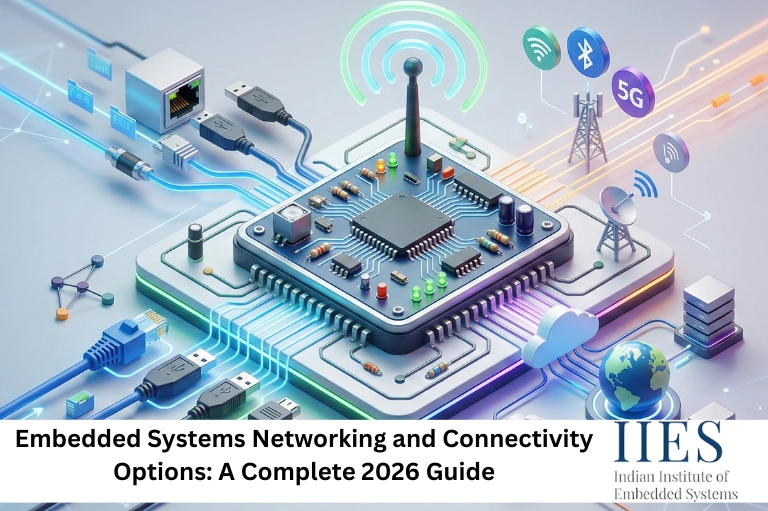
Understanding Embedded Systems in a Connected World
An embedded system is a dedicated computing system designed to perform specific real-time tasks with optimized hardware and software. Unlike general-purpose computers, embedded systems prioritize:
- Low power consumption
- Deterministic performance
- Compact hardware design
- Task-specific firmware
Common application areas include:
- Consumer electronics
- Automotive ECUs
- Industrial PLC systems
- Medical monitoring devices
- Smart agriculture systems
The shift toward networked intelligence has transformed embedded systems from standalone controllers into interconnected nodes within distributed architectures.
Types of Network Connectivity Options in Embedded Systems
Connectivity options can be broadly classified into Wired and Wireless technologies.

1. Wired Connectivity Options
Wired communication is preferred in industrial and mission-critical environments where reliability and low latency are essential.
Ethernet
- Supports TCP/IP networking
- High data throughput (10/100/1000 Mbps)
- Used in industrial automation and smart factories
CAN Bus (Controller Area Network)
- Widely used in automotive systems
- Real-time deterministic communication
- High fault tolerance
UART / SPI / I2C
- Short-distance communication
- Used for sensor and peripheral integration
- Common in microcontroller-based systems
Modbus (RTU/TCP)
- Industrial communication standard
- Simple and robust for PLC-based systems
2. Wireless Connectivity Options
Wireless networking enables flexibility, scalability, and remote access.
Technology | Range | Power Usage | Data Rate | Common Use Case |
Wi-Fi | Medium | High | High | Smart home devices |
Bluetooth/BLE | Short | Low | Medium | Wearables |
Zigbee | Medium | Low | Low | Smart lighting |
LoRaWAN | Long | Very Low | Low | Smart agriculture |
Cellular (4G/5G/NB-IoT) | Very Long | Medium | Medium | Fleet tracking |
Wi-Fi
Ideal for high-bandwidth applications such as IP cameras and smart TVs.
Bluetooth Low Energy (BLE)
Optimized for battery-powered devices like fitness trackers.
LoRaWAN
Supports long-range communication (up to 15 km in rural areas) with minimal power consumption.
NB-IoT
Designed for low data rate, deep coverage IoT deployments.
Communication Protocols in Embedded Systems
Connectivity hardware alone is insufficient – devices must communicate using standardized protocols.
MQTT (Message Queuing Telemetry Transport)
- Lightweight publish-subscribe protocol
- Ideal for constrained devices
- Low bandwidth consumption
CoAP (Constrained Application Protocol)
- REST-based protocol for IoT
- Efficient for low-power environments
HTTP/HTTPS
- Widely supported
- Suitable for web-integrated systems
TCP vs UDP
- TCP ensures reliability
- UDP supports low-latency applications
Sample MQTT Workflow
// Pseudo workflow

Connect to WiFi

Initialize MQTT client

Subscribe to topic "sensor/data"

Publish temperature value every 5 seconds
This simple workflow enables remote monitoring of IoT sensors in real time.
Growth of Connected Embedded Devices
- According to industry reports, over 15 billion IoT devices were active globally in 2023, projected to exceed 29 billion by 2030.
- Industrial IoT alone contributes significantly to predictive maintenance systems, reducing downtime by up to 30–40%.
- LPWAN technologies are expected to account for nearly 45% of IoT connectivity deployments in low-power applications.
These numbers highlight why embedded networking is no longer optional – it is foundational.
Advantages of Networking Embedded Devices
1. Real-Time Monitoring
Industrial equipment performance can be monitored remotely, reducing operational risk.
2. Remote Firmware Updates (OTA)
Security patches and feature upgrades can be deployed without physical access.
3. Data-Driven Insights
Aggregated sensor data enables predictive analytics and optimization.
4. Scalability
Connected nodes can scale from tens to thousands with proper architecture.
5. Automation and AI Integration
Connected embedded systems feed data to AI models for intelligent decision-making.

Security and Design Challenges
While the benefits are substantial, networking introduces complexity:
Security Risks
- Unauthorized access
- Firmware tampering
- Man-in-the-middle attacks
Mitigation includes:
- TLS encryption
- Secure boot
- Hardware security modules
Resource Constraints
Embedded systems often have:
- Limited RAM
- Low CPU frequency
- Restricted storage
Protocol selection must align with hardware limitations.
Latency Sensitivity
Applications like healthcare monitoring or automotive braking systems require millisecond-level responsiveness.
Real-World Case Example
Smart Agriculture Deployment
A farm integrates:
- Soil moisture sensors (LoRaWAN)
- Weather stations (Cellular NB-IoT)
- Cloud analytics platform
Workflow:
- Sensors collect environmental data.
- Data transmitted via LoRa gateway.
- Cloud processes and triggers irrigation automatically.
- Farmer monitors dashboard remotely.
Result:
- 25% water savings
- Improved crop yield consistency
This demonstrates practical embedded systems networking in action.
Advantages of Networking Embedded Devices
Networking enhances embedded systems by enabling data visibility, scalability, and automation. The most significant advantages include:
Remote monitoring and diagnostics
Over-the-air (OTA) firmware updates
Centralized data analytics
Improved operational efficiency
AI integration for predictive decision-making
When devices are connected, organizations can analyze aggregated data to optimize performance and reduce maintenance costs. This is particularly valuable in manufacturing and smart infrastructure.
Future of Embedded Systems Networking
The future of embedded systems networking will be shaped by:
Edge Computing
Processing data closer to devices to reduce latency.
AI-Enabled Microcontrollers
TinyML enabling neural networks directly on microcontrollers.
5G and Ultra-Reliable Low-Latency Communication (URLLC)
Critical for autonomous systems.
IPv6 Expansion
Supporting billions of addressable devices.
Standardization Efforts
Improving interoperability across vendors.
Embedded systems are transitioning from isolated controllers to intelligent distributed nodes in AI-powered ecosystems.
Mini Project Idea for Students
IoT-Based Temperature Monitoring System
Components:
Learning Outcomes:
- Network stack integration
- Protocol implementation
- Real-time data streaming
- Power optimization
Conclusion
Embedded Systems Networking and Connectivity Options are transforming industries by enabling real-time communication, remote intelligence, and scalable automation. From wired industrial Ethernet to low-power LoRaWAN networks, connectivity choices must align with application requirements, power constraints, and security needs.
Understanding communication protocols in embedded systems, selecting the right connectivity method, and implementing secure architecture are critical steps toward building future-ready embedded solutions.
As IoT ecosystems expand and AI capabilities integrate at the edge, the future of embedded systems networking promises smarter, faster, and more efficient connected devices across every industry.