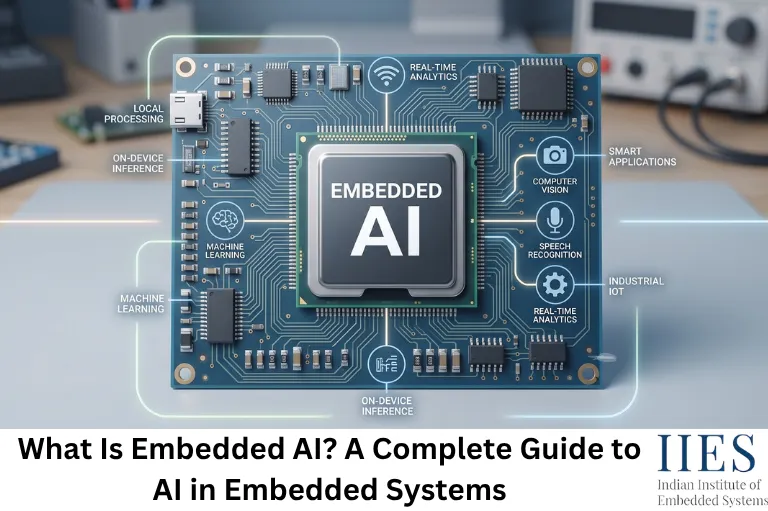
Embedded AI is what happens when you take an artificial intelligence model usually a compact, purpose-built neural network and run it directly on the same chip that already controls sensors, motors, and displays in a device, instead of shipping data out to a remote server for processing. The word “embedded” is doing real work in that sentence: this isn’t AI that a device calls out to, it’s AI that lives inside the device, subject to the same power, memory, and real-time constraints as everything else on that board.
It’s really the meeting point of two engineering disciplines that used to live in separate departments. Embedded systems engineering contributes the hardware-software co-design skills real-time operating systems, interrupt handling, power budgets, memory maps. Machine learning contributes the models trained neural networks that can recognize a spoken word, classify a vibration pattern, or spot an object in a camera frame. Embedded AI is what you get when those two skill sets are aimed at the same problem at the same time.
A Simple Way to Picture It
Think about the difference between phoning a friend for an answer and already knowing it yourself. Cloud AI is the phone call, often very capable, but it only works if the line is up, and there’s always a small delay while you wait for a reply. Embedded AI is knowing the answer yourself, in the moment, because you already learned it. You lose access to your friend’s much bigger knowledge, but you gain speed, reliability, and the ability to answer even when you’re somewhere with no signal at all. Neither one is strictly “better” ; a good engineer, like a good student, learns when to rely on which.
Traditional AI vs. Embedded AI
Before going further, it helps to be precise about what embedded AI is being compared against. “Traditional AI” here means the AI most people have already interacted with a chatbot, a recommendation engine, an image generator all running as a service on powerful servers, usually built around GPUs or TPUs, that you reach over the internet. Embedded AI takes many of the same underlying ideas and rebuilds them to run inside the resource budget of a single device.
Aspect | Traditional / Cloud AI | Embedded AI |
Where inference runs | Remote data center (GPU/TPU clusters) | On the device itself (MCU, SoC, or NPU) |
Connectivity needed | Requires internet access | Can run fully offline |
Latency | Milliseconds to seconds, plus a network round-trip | Milliseconds, no network hop |
Compute & memory | Virtually unlimited, scaled on demand | Tightly constrained, often kilobytes to a few megabytes of RAM |
Power draw | High at the server, off the device’s power budget | Must fit within the device’s battery or power supply |
Data privacy | Raw data typically leaves the device | Raw data can stay on the device |
Updating the model | Instant, centralized redeploy | Requires an OTA firmware update to every device |
Typical hardware | GPU/TPU server racks | MCUs, edge SoCs, NPUs (e.g., STM32N6, TinyEngine-based MCUs) |
Cost structure | Ongoing cloud compute + bandwidth costs | Mostly a one-time hardware cost per unit |
The trade-off in that table isn’t a flaw to be fixed, it’s a design choice. A recommendation engine serving millions of users benefits enormously from the cloud’s scale. A pacemaker or an industrial safety sensor cannot afford to wait on a network connection to decide whether something is wrong. Traditional AI and embedded AI aren’t competing for the same job; they’re built for different jobs that happen to use similar underlying math.
How Does Embedded AI Work?
Every embedded AI system, simple or sophisticated, moves through the same basic pipeline. Here’s what that looks like in practice, using a factory vibration sensor as a running example.
Step 1: Sensing
It starts with a sensor turning a physical quantity, vibration, sound, light, temperature, into an electrical signal. If the sensor is analog, an analog-to-digital converter (ADC) turns it into a stream of digital values the processor can work with.
Step 2: Preprocessing
Raw sensor data rarely goes straight into a model. It’s usually filtered to remove noise, normalized to a consistent range, and sometimes transformed, a vibration signal, for instance, is often converted into the frequency domain with an FFT before a model ever sees it, because patterns that are hard to spot in a raw waveform become obvious once you’re looking at frequency content.
Step 3: Inference
This is the step most people picture when they hear “AI” the model runs a forward pass on the preprocessed data and produces an output: a classification (“normal” vs. “anomalous”), a detection (“person present”), or a value (estimated remaining useful life). On embedded hardware, this happens through a lightweight inference engine TensorFlow Lite for Microcontrollers and Arm’s CMSIS-NN are two of the most common calling into a model that’s already been quantized down to 8-bit integers so it fits the chip’s memory and runs fast enough to matter in real time.
Step 4: Action
The output only matters if something happens because of it flipping a GPIO pin to sound an alarm, sending a short alert over a low-power radio, or simply logging the event locally. Crucially, this entire loop sense, preprocess, infer, act typically completes in single-digit milliseconds, entirely on-device.
Some systems add a fifth, optional step: periodically syncing a summary, rather than raw data, back to the cloud, so a plant manager can see trends across a hundred machines without every one of them streaming data all day. That hybrid pattern is where more and more embedded AI products are settling.
Essential Elements of Embedded AI Systems
Hardware Building Blocks
The foundation of any embedded AI system is silicon chosen to match the job. At the lighter end, you’ll find microcontrollers with an integrated neural processing unit (NPU) STMicroelectronics’ STM32N6, for instance, pairs an 800 MHz Arm Cortex-M55 core with a 600 GOPS Neural-ART NPU and up to 4.2 MB of on-chip SRAM, enough for real-time vision and audio workloads. At the leaner end sits something like Texas Instruments’ MSPM0G5187, which tucks a TinyEngine NPU into a modest 80 MHz Cortex-M0+ core with just 128 KB of flash TI’s own benchmarks put the improvement at up to 90x lower latency and 120x lower energy per inference compared with running the same model without an accelerator, which is proof you don’t need a powerful chip to add real intelligence to a design. For heavier workloads multi-camera vision, larger models engineers reach for edge SoCs like the NVIDIA Jetson family, trading battery life for raw compute. Around that core silicon sit the sensors that give the system something to reason about accelerometers, microphones, image sensors, gas and temperature sensors and the actuators that let it respond: motors, relays, displays, and radios.
Software and the Model Pipeline
Hardware alone doesn’t make a device intelligent; it needs a model and a way to run it. That model is almost never trained on the device itself training happens offline, on a workstation or in the cloud, using frameworks like TensorFlow or PyTorch, on a dataset the engineering team has collected and labeled. The trained model is then compressed to fit its target hardware through quantization (shrinking 32-bit floating-point weights down to 8-bit integers, or smaller), pruning (removing weights that barely affect the output), and sometimes knowledge distillation (training a small “student” model to mimic a larger “teacher”). Tools like TensorFlow Lite for Microcontrollers, Edge Impulse, Arm’s CMSIS-NN kernels, or a vendor’s own SDK then convert that compressed model into something the target chip can run efficiently, alongside firmware usually bare-metal C or an RTOS that handles sensor drivers, the inference call itself, and whatever the device does with the result.
Power, Thermal, and Security Considerations
None of this happens in a vacuum. Most embedded AI devices are power- or thermally-constrained in ways a cloud server never is, so engineers lean on sleep modes, duty cycling, and event-triggered inference running the model only when a sensor trips a threshold, rather than continuously. Security matters just as much: a device deployed in the field needs secure boot and encrypted firmware updates, and as regulation catches up with the technology compliance too. The EU’s Cyber Resilience Act, which enters into operational force in September 2026, is a good example of “essential element” increasingly meaning a documented security posture, not just a working model.
Benefits and Advantages of Embedded AI
Benefits of AI in Embedded Systems
The practical, day-to-day benefits of putting AI inside an embedded system come down to five things: speed, independence, cost, privacy, and efficiency.
- Real-time response. Without a network round-trip, decisions happen in milliseconds the difference that matters when a system exists to prevent an accident, not just report one after the fact.
- Works without connectivity. A device doesn’t stop being intelligent the moment it loses signal, which matters enormously for remote agricultural sensors, industrial sites with poor Wi-Fi coverage, or wearables with no cellular reception.
- Lower bandwidth and cloud costs. A camera that only sends an alert when it detects a person, instead of streaming continuous video, uses a tiny fraction of the bandwidth and the cloud bill that comes with it.
- Better data privacy by default. Raw audio, video, or biometric data can be processed and discarded locally, never leaving the device, which matters both for user trust and regulatory compliance.
- Real energy savings. It sounds counterintuitive, but running a small model locally is often more energy-efficient than transmitting raw data over a radio, Nordic Semiconductor’s own testing on a keyword-spotting task found on-device NPU inference used roughly a tenth of the energy the same task took on a general-purpose CPU.
Advantages of Embedded AI
Zoom out from any single device, and a few strategic advantages come into focus.
- Reliability that doesn’t depend on infrastructure. A fleet of embedded AI devices keeps working during a network outage or in a location that was never going to have good connectivity in the first place.
- Costs that don’t scale with usage. Cloud inference is billed per call; embedded AI’s cost is mostly paid once, in the hardware, which makes the economics far more predictable for large device fleets.
- A genuine product differentiator. A device that’s smart out of the box, without a subscription or a dependency on someone else’s server staying online, is a meaningfully different pitch than “smart, as long as our servers are up.”
- Less raw data in transit. Fewer sensitive data streams crossing a network is a smaller target for interception though it’s worth being honest that a physical device in the field introduces its own security considerations a data center doesn’t have.
Challenges and Disadvantages of Embedded AI
Challenges of Embedded AI
None of the benefits above come free, and a good engineer goes in with eyes open about what makes this hard.
- Severe resource constraints. Fitting a useful model into kilobytes of RAM and running it on a chip clocked in megahertz, not gigahertz, is a genuinely different discipline from training a model with cloud-scale compute in mind.
- A cross-disciplinary skill gap. Quantizing, pruning, and validating a model takes ML knowledge most embedded engineers weren’t trained in and most ML engineers have never had to think about flash wear, interrupt latency, or a milliwatt power budget. Closing that gap is arguably the single biggest bottleneck in the field right now.
- Debugging is harder. There’s no convenient print statement when your “computer” has 32 KB of RAM. Diagnosing why a model misclassifies something on real hardware, in real conditions, takes specialized tools and patience cloud ML debugging doesn’t require.
- Fragmented tooling. Between TensorFlow Lite Micro, Edge Impulse, CMSIS-NN, and half a dozen vendor-specific SDKs, there’s no single dominant toolchain the way there is for cloud ML, which means more time spent evaluating options before you can start building.
- Updating models at scale is operationally heavy. Pushing a firmware update that changes a model on ten thousand deployed devices is a project in itself, with version tracking, rollback plans, and the reality that some devices may never successfully update at all.
Disadvantages of Embedded AI
Some of embedded AI’s limitations aren’t challenges to be solved with better tooling, they’re inherent trade-offs of the approach itself.
- Reduced accuracy compared to cloud models. A quantized, pruned model running on a microcontroller generally won’t match the accuracy of its full-size counterpart running on a GPU, you’re trading some capability for speed, privacy, and independence.
- Higher upfront hardware cost per unit. An MCU with a built-in NPU costs more than a basic one without it, and that difference multiplies across a large production run, though the gap has been narrowing quickly as NPUs become standard rather than premium features.
- Fixed capability once shipped. A cloud model can be swapped for a bigger, better one overnight, for every user at once. A device already in a customer’s hands is limited by the silicon it shipped with, you can improve the software, but you can’t add more RAM after the fact.
- Not every “AI” feature actually needs to be one. It’s worth saying plainly, as an engineer and not a marketer: a lot of what gets labeled AI in a product brief is really a filtered sensor reading with a hysteresis band. If a closed-form algorithm in a few kilobytes of C solves the problem and never needs retraining, reaching for a neural network and a whole model lifecycle is added cost and complexity, not a feature.
Applications of Embedded AI in the Real World
This is where the concept stops being abstract. Applications of embedded AI now show up in categories most engineering students already recognize.
Consumer and Wearable Devices
Fitness trackers and smartwatches that flag an irregular heart rhythm or detect a fall do it with a model running locally, not by streaming your heart rate to a server around the clock. Wake-word detection, the “Hey Siri” or “Alexa” that lets a device respond without sending every sound in the room to the cloud, works the same way: only after the wake word is recognized locally does the device start listening for a full command.
Industrial and Predictive Maintenance
A vibration or acoustic sensor bolted to a factory motor can learn what “normal” sounds like and flag a bearing starting to fail, days before it would otherwise seize, without streaming continuous raw sensor data off the factory floor. This is one of the more mature applications of embedded AI, precisely because it plays to the technology’s strengths: real-time response, no dependency on network uptime, and no need to ship enormous volumes of raw data anywhere.
Automotive and Mobility
Advanced Driver Assistance Systems (ADAS), lane-departure warnings, automatic emergency braking, driver-drowsiness detection, depend on embedded AI because a cloud round-trip is simply too slow when a decision has to be made in milliseconds.
Agriculture and Healthcare
In a field with no reliable connectivity, a soil-moisture sensor or pest-detecting camera has to make its own decisions locally. In healthcare, wearable patches that continuously monitor for arrhythmias benefit twice over, from the low latency of on-device inference, and from keeping sensitive health data off the network by default.
Security and Surveillance
Smart cameras that detect a person or vehicle on-device, rather than streaming continuous video to a server, save enormous bandwidth and respond to genuine events, sending an alert, not raw footage, the moment they happen.
Embedded AI and Edge AI
Students often confuse Embedded AI with Edge AI.
They are closely related, but the terms are not always identical.
Embedded AI focuses on integrating AI into embedded devices.
Edge AI refers more broadly to performing AI computation near the source of data instead of relying entirely on centralized cloud infrastructure.
An Embedded AI device can therefore be considered part of an edge computing architecture.
For example:
Sensor → Embedded AI Device → Local Decision → Optional Cloud Communication
This architecture can reduce unnecessary cloud processing.
The Future of Embedded AI
A few trends are worth tracking if you’re building a career around this.
First, NPUs are quickly becoming standard equipment rather than a premium option, the same way Wi-Fi went from a differentiator to an expectation. Silicon vendors are folding neural accelerators directly into their mainstream microcontroller lines, not just their flagship parts, steadily lowering the barrier to adding embedded AI to a design.
Second, the industry appears to be settling into a hybrid pattern rather than a winner-take-all one: local models handle the routine, latency-sensitive, and privacy-sensitive work, while genuinely hard or rare cases still escalate to larger models in the cloud. Expect fewer arguments about “edge versus cloud” and more architectures that quietly use both.
Third, keep an eye on tiny language models, compact, on-device successors to today’s TinyML classifiers that can hold a basic conversation or summarize text with no network connection at all. It’s early, but the direction is clear: the line between “a microcontroller that classifies sensor data” and “a device that understands language” is starting to blur.
The market numbers back up the momentum: TinyML alone is projected to grow from roughly $2.49 billion in 2026 toward well over $18 billion by 2035. For an embedded systems engineer, that’s less a statistic to memorize and more a signal about where the next decade of job postings are headed.
Bringing It All Together
If there’s one thing to take from all of this, it’s that embedded AI isn’t a separate discipline bolted onto embedded systems – it’s becoming part of the core skill set. The engineers best positioned for what’s coming aren’t necessarily the ones who know the most neural network theory; they’re the ones who understand both sides well enough to make good trade-offs, knowing when a task genuinely needs a model, and when a simple threshold in C will do the job just as well, for a fraction of the cost and complexity. That judgment only comes with practice, so the best next step is the obvious one: pick a board with an NPU, pick a small problem, and build something.