Why Is M2M Important in IoT?
The Internet of Things connects billions of devices worldwide. Without M2M communication, these devices would not be able to exchange data efficiently or operate automatically.
M2M serves as the communication backbone of IoT by enabling devices to collect information, send it to other systems, and respond to changing conditions without manual intervention.
Key benefits include:
- Enables real-time communication between devices
- Supports remote monitoring and management
- Reduces manual intervention and operational costs
- Improves efficiency and productivity
- Enables predictive maintenance
- Enhances data-driven decision-making
- Supports large-scale IoT deployments
Example:
A smart water meter automatically records water usage every hour and sends the readings to the utility company’s server. The entire process occurs without requiring a technician to visit the location.
What Is Machine-to-Machine Communication?
Machine-to-Machine (M2M) communication is the process in which two or more devices exchange information automatically through communication networks.
An M2M system generally consists of sensors that collect data, communication modules that transmit information, a processing platform, and applications that analyze or act on the received data.
For example, a temperature sensor in an industrial machine continuously monitors equipment temperature. If the temperature exceeds a predefined limit, it automatically sends an alert to the monitoring system, which can notify maintenance personnel or shut down the machine to prevent damage.
Because devices communicate independently, M2M significantly improves speed, accuracy, and operational efficiency.

how m2m works in iot?
M2M communication follows a structured process where devices continuously collect, transmit, process, and respond to data.
Step 1: Data Collection
Sensors monitor physical parameters such as:
- Temperature
- Pressure
- Humidity
- Motion
- Location
- Voltage
- Current
Step 2: Data Transmission
The collected data is transmitted using communication technologies such as:
- Wi-Fi
- Bluetooth
- Zigbee
- Cellular (4G/5G)
- NB-IoT
- LoRaWAN
- Ethernet
Step 3: Data Processing
The received data is processed by:
- IoT gateways
- Edge devices
- Cloud servers
The system analyzes the data and determines whether any action is required.
Step 4: Decision Making
Based on predefined rules or AI algorithms, the system decides how to respond.
Examples include:
- Sending notifications
- Turning equipment ON/OFF
- Adjusting machine settings
- Triggering alarms
- Scheduling maintenance
Step 5: Action Execution
The command is sent back to the connected device or actuator, completing the communication cycle automatically.
This continuous exchange enables smart systems to operate with minimal human intervention.
How Does M2M in IoT Enable Connectivity?
M2M enables connectivity by integrating sensors, communication networks, gateways, cloud platforms, and applications into a unified system.
The typical communication flow is:
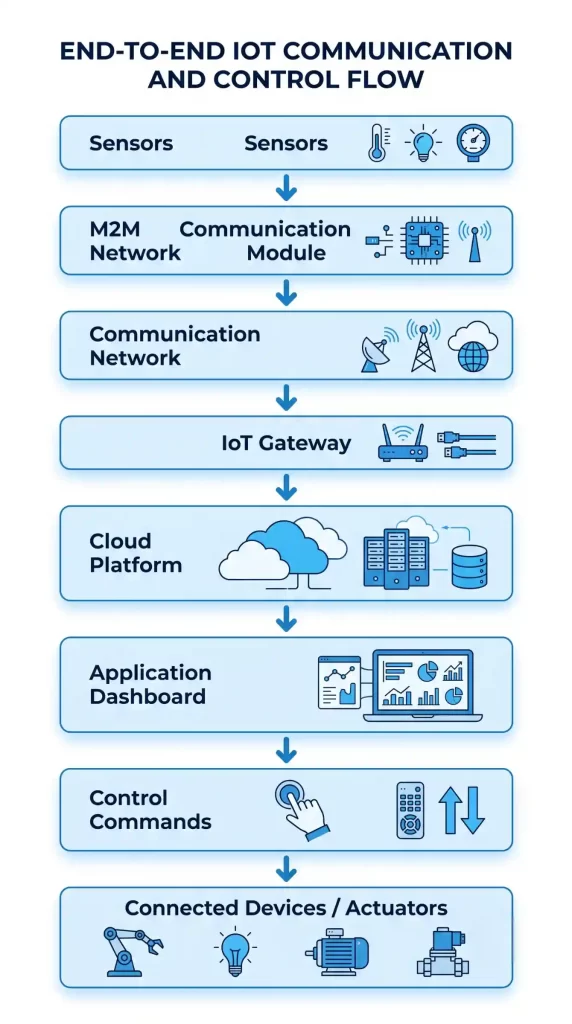 IoT End-to-End Flow Chart
Each layer performs a specific function:
Component | Purpose |
Sensors | Collect real-world data |
M2M Module | Converts sensor data into transmittable information |
Communication Network | Transfers data between devices and servers |
IoT Gateway | Filters, aggregates, and forwards data |
Cloud Platform | Stores and analyzes collected data |
Dashboard/Application | Displays information to users |
Actuator | Executes commands based on processed data |
What Is M2M Architecture in IoT?
M2M architecture is the framework that defines how devices communicate, exchange data, and perform automated actions within an IoT ecosystem.
Although implementations vary across industries, most M2M systems follow a layered architecture that ensures secure and efficient communication.
The four main layers are:
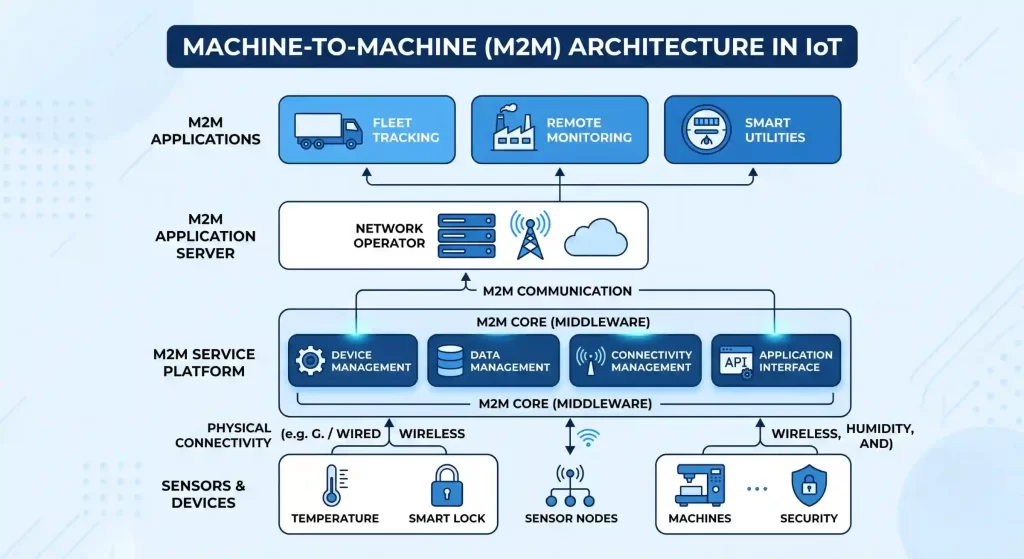
Understanding Machine-to-Machine (M2M) Architecture in IoT
Components of M2M Architecture in IoT
Every M2M system consists of several components that work together to collect, transmit, process, and act on data. Understanding these components helps in designing reliable and scalable IoT solutions.
Component | Function |
Sensors | Capture physical data such as temperature, humidity, pressure, motion, or light. |
M2M Module | Enables devices to communicate over wired or wireless networks. |
Communication Network | Transfers data between devices, gateways, and cloud platforms. |
IoT Gateway | Aggregates data, filters unnecessary information, and connects local devices to the cloud. |
Cloud Platform | Stores, analyzes, and manages data collected from connected devices. |
Application | Displays insights, sends alerts, and allows users to monitor or control devices remotely. |
Actuator | Performs physical actions based on received commands, such as opening a valve or switching on a motor. |
Each component has a specific role, and together they enable seamless communication between machines without human intervention.
Types of M2M Modules
Different M2M modules are designed for different communication requirements. The right module depends on factors such as range, bandwidth, power consumption, and deployment environment.
Module Type | Communication | Common Applications |
Cellular Module | 4G, LTE, 5G | Vehicle tracking, smart meters |
NB-IoT Module | Narrowband IoT | Smart cities, utility monitoring |
LTE-M Module | LTE Cat-M1 | Wearables, asset tracking |
Wi-Fi Module | IEEE 802.11 | Smart homes, consumer electronics |
Bluetooth Module | Bluetooth/BLE | Fitness devices, healthcare products |
Zigbee Module | IEEE 802.15.4 | Home automation, industrial sensors |
LoRa Module | LoRaWAN | Agriculture, environmental monitoring |
Ethernet Module | Wired LAN | Industrial automation and factory systems |
Communication Technologies Used in M2M
M2M communication supports multiple wired and wireless technologies. Each offers different advantages depending on the application.
Technology | Range | Power Consumption | Best For |
Wi-Fi | Medium | High | Smart homes, offices |
Bluetooth Low Energy (BLE) | Short | Very Low | Wearables, healthcare devices |
Zigbee | Medium | Low | Smart lighting, home automation |
LoRaWAN | Long | Very Low | Agriculture, smart cities |
NB-IoT | Long | Very Low | Utility meters, industrial monitoring |
LTE-M | Long | Low | Asset tracking, logistics |
4G/5G Cellular | Very Long | Medium | Connected vehicles, remote monitoring |
Ethernet | Local | Stable | Industrial equipment |
When selecting a communication technology, engineers typically consider:
- Data rate
- Network coverage
- Device mobility
- Battery life
- Deployment cost
- Security requirements
M2M Communication Protocols
Communication protocols define how devices exchange information reliably and securely.
Some of the most widely used protocols include:
Protocol | Purpose | Typical Applications |
MQTT | Lightweight publish-subscribe messaging | IoT sensors, remote monitoring |
CoAP | REST-based communication for constrained devices | Smart homes, embedded devices |
HTTP/HTTPS | Web communication | Cloud services, dashboards |
AMQP | Enterprise messaging | Industrial applications |
Modbus | Industrial communication | PLCs, manufacturing systems |
CAN Bus | Automotive communication | Vehicles and transportation |
OPC UA | Industrial interoperability | Industry 4.0 and smart factories |
Among these, MQTT is one of the most popular protocols because it consumes minimal bandwidth and performs efficiently on unreliable networks.
Features of M2M in IoT
M2M communication offers several capabilities that make IoT systems more efficient and reliable.
Key Features
- Automatic device-to-device communication
- Real-time data exchange
- Remote monitoring and management
- Continuous data collection
- Low human intervention
- Scalable device connectivity
- Secure communication
- High reliability
- Predictive maintenance support
- Cloud integration
These features enable organizations to automate operations while improving productivity and reducing operational costs.
Advantages of M2M in IoT
Organizations across industries adopt M2M communication because it improves operational efficiency and enables intelligent automation.
- Faster communication between devices
- Reduced manual intervention
- Improved operational efficiency
- Better resource utilization
- Lower maintenance costs
- Real-time monitoring
- Increased system reliability
- Predictive maintenance capabilities
- Enhanced customer experience
- Scalable IoT deployments
Example:
In a manufacturing plant, vibration sensors continuously monitor machine health. When abnormal vibration is detected, the M2M system automatically generates a maintenance alert before equipment failure occurs, reducing downtime and repair costs.
Limitations of M2M in IoT
Despite its benefits, M2M communication also presents several technical and operational challenges.
Limitation | Description |
Security Risks | Connected devices may become targets for cyberattacks. |
High Initial Investment | Large-scale deployments require significant infrastructure costs. |
Network Dependency | Communication depends on stable network availability. |
Device Compatibility | Devices from different manufacturers may use different standards. |
Scalability Challenges | Managing thousands of connected devices can become complex. |
Data Privacy Issues | Sensitive data requires strong encryption and access control. |
Maintenance Complexity | Firmware updates and device management require ongoing monitoring. |
Proper planning and standardized communication protocols help reduce these challenges.
Difference Between M2M and IoT
Although the terms M2M and IoT are often used interchangeably, they are not the same. M2M focuses on direct communication between machines, while IoT creates a broader ecosystem by connecting devices, cloud platforms, applications, and users.
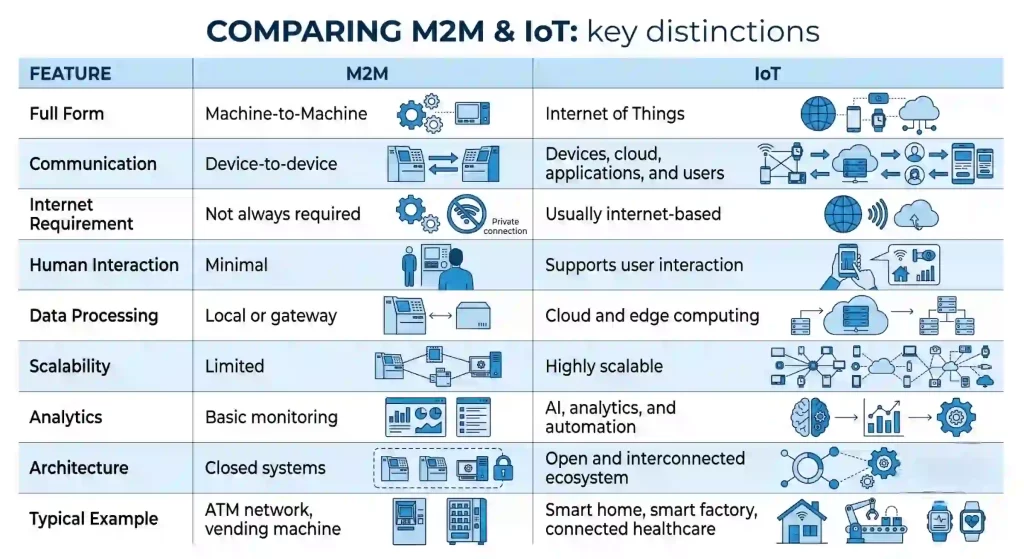
M2M vs. IoT Comparison
M2M vs IoT: Which Should You Choose?
- Choose M2M when devices need reliable point-to-point communication with minimal complexity.
- Choose IoT when applications require cloud connectivity, advanced analytics, remote access, and integration with multiple systems.
In many modern deployments, M2M acts as the communication foundation, while IoT extends its capabilities by adding cloud computing, artificial intelligence, and centralized device management.

M2M Applications in IoT
M2M communication powers many of the smart systems we use every day. It enables devices to collect, exchange, and act on data automatically, improving efficiency, reducing manual effort, and supporting real-time decision-making.
Below are some of the most common M2M applications across different industries.
1. Smart Manufacturing
Modern factories use M2M communication to monitor machines, optimize production, and reduce downtime.
Applications include:
- Predictive maintenance
- Machine health monitoring
- Automated production lines
- Quality inspection
- Inventory management
Example:
A vibration sensor detects abnormal motor behavior and sends data to the monitoring system. If a fault is identified, maintenance is scheduled before the machine fails.
2. Smart Healthcare
Healthcare organizations use M2M-enabled devices to improve patient care and hospital operations.
Common applications:
- Remote patient monitoring
- Wearable health devices
- Smart infusion pumps
- Connected medical equipment
- Emergency alert systems
Example:
A wearable heart-rate monitor continuously sends patient data to a hospital dashboard. Doctors receive alerts immediately if abnormal readings are detected.
3. Smart Cities
M2M communication helps cities manage public infrastructure more efficiently.
Applications include:
- Smart street lighting
- Traffic management
- Waste collection monitoring
- Parking management
- Environmental monitoring
These systems reduce energy consumption while improving public services.
4. Connected Vehicles
The automotive industry relies heavily on M2M technology for vehicle monitoring and fleet management.
Applications include:
- GPS tracking
- Vehicle diagnostics
- Fuel monitoring
- Driver behavior analysis
- Predictive vehicle maintenance
Fleet operators can monitor hundreds of vehicles in real time from a centralized dashboard.
5. Smart Agriculture
Agriculture increasingly depends on connected sensors to improve crop production and conserve resources.
Applications include:
- Soil moisture monitoring
- Weather stations
- Automated irrigation
- Livestock tracking
- Greenhouse automation
Farmers receive accurate field data and can automate irrigation based on soil conditions instead of fixed schedules.
6. Energy and Utilities
Utility companies use M2M communication for continuous monitoring and efficient resource management.
Applications include:
- Smart electricity meters
- Water meters
- Gas monitoring
- Grid management
- Energy consumption analysis
Automatic meter readings eliminate manual inspections and improve billing accuracy.
7. Smart Homes
Consumer IoT devices use M2M communication to automate everyday tasks.
Examples include:
- Smart thermostats
- Security cameras
- Smart lighting
- Video doorbells
- Smart locks
- Home appliances
Users can monitor and control devices remotely using mobile applications.
M2M Examples
Understanding real-world examples makes it easier to visualize how M2M communication works.
Industry | M2M Example |
Manufacturing | Machines automatically report faults to maintenance systems. |
Healthcare | Wearable devices transmit patient health data to hospitals. |
Transportation | GPS trackers continuously report vehicle locations. |
Agriculture | Soil moisture sensors trigger irrigation systems. |
Smart Home | Smart thermostats adjust temperature automatically. |
Retail | Vending machines notify suppliers when stock is low. |
Utilities | Smart meters automatically send electricity usage data. |
Banking | ATMs communicate with banking servers for transactions. |
These examples demonstrate how M2M technology reduces manual intervention while improving efficiency and reliability.
Challenges Associated with M2M and IoT Applications
Although M2M communication offers significant advantages, deploying large-scale connected systems also introduces technical and operational challenges.
Security Risks
Unauthorized access to connected devices can lead to data breaches, service disruption, or device manipulation.
Potential threats include:
- Malware attacks
- Device hijacking
- Unauthorized access
- Data theft
- Denial-of-Service (DoS) attacks
Interoperability
Devices from different manufacturers often use different communication protocols and standards.
Without proper compatibility, integrating multiple devices into a single IoT ecosystem becomes challenging.
Scalability
As organizations deploy thousands of connected devices, managing communication, firmware updates, and network performance becomes increasingly complex.
Large-scale deployments require careful planning to maintain performance and reliability.
Network Reliability
Most M2M systems rely on continuous network connectivity.
Poor network coverage or unstable communication can result in:
- Delayed alerts
- Lost data
- Interrupted automation
- Reduced system performance
Power Consumption
Battery-powered IoT devices must operate for months or even years without frequent maintenance.
Selecting low-power communication technologies is essential for extending battery life.
Data Privacy
M2M systems often collect sensitive operational or personal information.
Organizations must ensure:
- Secure data storage
- Access control
- Encryption
- Compliance with privacy regulations
M2M in IoT: Security Challenges
As the number of connected devices grows, cybersecurity becomes one of the most important aspects of M2M communication.
Common security challenges include:
- Weak authentication mechanisms
- Unencrypted communication
- Outdated firmware
- Insecure APIs
- Default passwords
- Unauthorized device access
- Physical tampering
- Malware and ransomware attacks
A single vulnerable device can compromise the security of an entire IoT network.
Best Practices for Secure M2M Communication
Following established security practices helps improve the reliability and safety of M2M deployments.
Recommended practices:
- Use strong device authentication.
- Encrypt data during transmission and storage.
- Regularly update device firmware.
- Disable unused communication ports.
- Monitor device activity continuously.
- Use secure communication protocols such as MQTT over TLS or HTTPS.
- Apply role-based access control.
- Maintain regular security audits.
Implementing these measures significantly reduces the risk of cyberattacks.
Common Mistakes to Avoid
Many M2M deployment issues arise from avoidable design mistakes.
Mistake | Impact |
Choosing the wrong communication technology | Reduced performance and higher operational costs |
Ignoring device security | Increased risk of cyberattacks |
Skipping firmware updates | Devices remain vulnerable to known security issues |
Poor network planning | Frequent communication failures |
Sending unnecessary data | Increased bandwidth usage and cloud costs |
Not planning for scalability | Difficult system expansion in the future |
Proper planning during the design phase helps prevent these problems.
Future Trends in M2M and IoT
M2M communication continues to evolve alongside IoT technologies. Several emerging trends are shaping the future of connected systems.
1. AI-Powered Device Intelligence
Artificial Intelligence enables devices to analyze data locally, detect anomalies, and make faster decisions with minimal human involvement.
2. Edge Computing
Instead of sending all data to the cloud, edge devices process information closer to the source.
Benefits include:
- Lower latency
- Reduced bandwidth usage
- Faster response times
- Improved reliability
3. 5G Connectivity
5G networks provide:
- Higher data speeds
- Lower latency
- Better reliability
- Support for massive IoT deployments
This makes them ideal for connected vehicles, smart factories, and remote healthcare.
4. Digital Twins
Digital twins create virtual models of physical assets using real-time sensor data.
Industries use them for:
- Equipment monitoring
- Predictive maintenance
- Performance optimization
- Simulation and testing
5. Edge AI
Modern IoT devices increasingly combine artificial intelligence with edge computing.
This enables:
- Faster decision-making
- Improved privacy
- Reduced cloud dependency
- Lower communication costs
6. Sustainable IoT Solutions
Manufacturers are focusing on:
- Energy-efficient communication modules
- Low-power sensors
- Longer battery life
- Eco-friendly device design
These improvements support environmentally sustainable IoT deployments.

Conclusion
Machine-to-Machine (M2M) communication is one of the fundamental technologies that powers the Internet of Things. By enabling devices to exchange information automatically, M2M helps organizations improve efficiency, automate operations, reduce maintenance costs, and make faster, data-driven decisions.
From smart factories and connected vehicles to healthcare systems and smart cities, M2M communication has become an essential part of modern digital infrastructure. Combined with technologies such as edge computing, artificial intelligence, and 5G, it continues to expand the capabilities of IoT applications across industries.
For engineering students and embedded professionals, understanding M2M in IoT, its architecture, communication protocols, security considerations, and real-world applications is an important step toward building reliable and scalable connected systems.