What Is SoC in Embedded Systems?
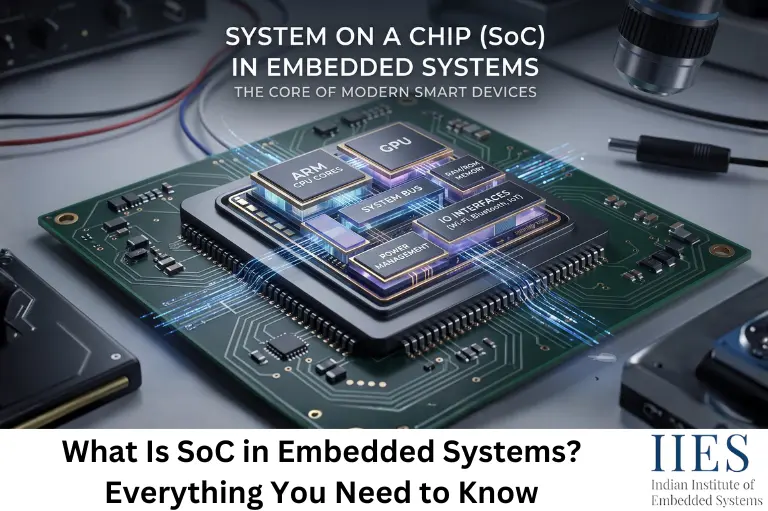
A SoC in embedded systems is an integrated circuit that combines the essential hardware blocks required to operate an embedded device on a single semiconductor chip.
Instead of placing multiple ICs on a PCB, designers integrate them into one chip, enabling faster communication and more efficient system operation.
A Typical SoC Includes
- CPU (Processor)
- GPU (Graphics Processing Unit)
- Memory Controller
- SRAM Cache
- DMA Controller
- Interrupt Controller
- Timers
- UART
- SPI
- I2C
- CAN
- USB Controller
- Ethernet MAC
- ADC
- DAC
- PWM
- Watchdog Timer
- Security Engine
- Clock Management
- Power Management Unit (PMU)
- AI/ML Accelerator (in modern SoCs)
Not every SoC contains all these components. The exact configuration depends on the target application.
Example: ESP32
An ESP32 SoC integrates:
- Dual-core processor
- Wi-Fi
- Bluetooth
- GPIO
- ADC
- DAC
- SPI
- UART
- I2C
- Timers
- PWM
- RTC
- Security hardware
This allows developers to build an IoT product using a single chip instead of multiple external ICs.

What Does SoC Stand for in Embedded Systems?
SoC stands for System on Chip. The name describes its architecture.
| Term | Meaning |
|---|
| System | Complete computing hardware required to perform a task |
| on | Integrated onto |
| Chip | A single semiconductor integrated circuit |
Unlike traditional designs where components are distributed across multiple ICs, an SoC places them on one chip to function as a complete embedded computing platform.
Simple Analogy
Think of a traditional embedded board as a small office. Each employee works in a separate building:
- CPU
- Memory
- Communication
- Graphics
- Security
An SoC is like moving every department into one modern office building, allowing faster communication, lower operating costs, and better efficiency.
What Is an Embedded Processor?
An embedded processor is a processor designed to perform dedicated tasks within an embedded system rather than general-purpose computing.
Unlike desktop CPUs, embedded processors are optimized for:
- Low power consumption
- Real-time operation
- High reliability
- Cost efficiency
- Compact hardware
- Long operational life
What Is a System on a Chip?
A System on a Chip (SoC) is a complete computing platform implemented on a single integrated circuit. It combines several hardware blocks that traditionally required multiple chips.
Typical SoC Integration
               +----------------------+
               |         CPU          |
               +----------------------+
                          |
---------------------------------------------------------
| GPU | Memory | UART | SPI | I2C | USB | CAN | Ethernet |
---------------------------------------------------------
| ADC | DAC | PWM | Timers | DMA | Security | Wi-Fi     |
---------------------------------------------------------
       Power Management | Clock | Interrupt Controller
This high level of integration enables:
- Faster communication
- Lower latency
- Smaller PCB
- Reduced EMI
- Better reliability
- Lower manufacturing cost
How Does SoC Work in Embedded Systems?
An SoC allows all major hardware blocks to communicate through high-speed internal buses, reducing delays compared to external chip-to-chip communication.
Basic Workflow
- Power is applied to the device.
- The bootloader initializes the hardware.
- The CPU starts executing firmware.
- Memory controllers configure RAM.
- Peripheral drivers initialize interfaces.
- Sensors and external devices begin communication.
- The application performs its intended function.
- The PMU continuously manages power based on system activity.
Features of SoC in Embedded Systems
Modern SoCs combine multiple hardware functions into a single chip while balancing performance, power efficiency, and cost. The exact feature set varies depending on whether the SoC is designed for IoT devices, automotive systems, industrial controllers, or consumer electronics.
Key Features of an SoC
- Single-chip integrated design
- Multi-core CPU support
- High-speed internal communication bus
- Built-in memory controllers
- Multiple communication interfaces
- Hardware security features
- Power management capabilities
- Graphics and multimedia support (application SoCs)
- AI/ML acceleration in modern SoCs
- Support for real-time and general-purpose operating systems
Common Features Explained
| Feature | Purpose |
|---|
| Multi-core Processor | Improves multitasking and parallel processing |
| Memory Controller | Enables efficient communication with RAM and Flash |
| GPIO | Interfaces with external sensors and devices |
| UART, SPI, I2C | Supports serial communication |
| ADC/DAC | Handles analog-to-digital and digital-to-analog conversion |
| DMA Controller | Transfers data without continuously using the CPU |
| Security Engine | Protects firmware and sensitive data |
| Power Management Unit | Optimizes battery life and energy consumption |
| Clock Controller | Generates and manages system clocks |
Types of SoC in Embedded Systems
Different embedded applications require different types of SoCs. Some prioritize ultra-low power, while others focus on graphics, AI, or real-time performance.
1. Microcontroller-Based SoC
Designed for dedicated embedded applications.
Characteristics
- Low power consumption
- Integrated Flash and SRAM
- Built-in peripherals
- Real-time operation
- Cost-effective
Common Examples
- STM32
- ESP32
- NXP LPC Series
- Microchip SAM Series
Applications
- Smart home devices
- Industrial controllers
- Consumer electronics
- Medical devices
2. Application Processor SoC
Provides high computing performance and supports advanced operating systems.
Characteristics
- Multi-core CPUs
- GPU support
- External DDR memory
- Multimedia processing
- Linux or Android support
Common Examples
- NXP i.MX Series
- TI Sitara
- Raspberry Pi SoC (Broadcom)
- Qualcomm Snapdragon
- Samsung Exynos
Applications
- Smartphones
- Tablets
- Smart TVs
- Human Machine Interface (HMI)
- Industrial gateways
3. Automotive SoC
Built for reliability and functional safety in vehicles.
Features
- CAN and CAN FD
- Automotive Ethernet
- Functional Safety support
- Hardware Security Module (HSM)
- High-temperature operation
Applications
- Engine Control Unit (ECU)
- Advanced Driver Assistance Systems (ADAS)
- Infotainment
- Digital instrument clusters
- Battery Management Systems (BMS)
4. IoT SoC
Optimized for wireless communication and battery-powered devices.
Built-in Technologies
- Wi-Fi
- Bluetooth
- Zigbee
- Thread
- LoRa (selected devices)
Applications
- Smart locks
- Wearables
- Smart lighting
- Asset tracking
- Environmental monitoring
5. AI-Enabled SoC
Includes dedicated hardware for AI and machine learning workloads.
Integrated Components
- Neural Processing Unit (NPU)
- AI accelerator
- DSP
- GPU
Applications
- Edge AI
- Computer vision
- Face recognition
- Voice assistants
- Industrial inspection

Comparison of Popular Embedded SoCs and Processors
Choosing the right embedded SoC or processor depends on your application requirements, including processing power, operating system support, real-time performance, power consumption, and available peripherals. The table below compares some of the most widely used embedded processors and SoCs in industry.
| SoC / CPU Family | CPU Architecture | Core Type | OS Support | Best For | Key Features |
|---|
| STM32H7 | ARM Cortex-M7 | Single/Dual Core | Bare Metal, FreeRTOS | Industrial Control, Robotics | High-speed MCU, DSP, FPU, rich peripherals |
| ESP32 | Xtensa LX6/LX7 / RISC-V (newer models) | Dual Core | FreeRTOS | IoT, Smart Home | Built-in Wi-Fi, Bluetooth, low power |
| NXP i.MX RT Series | ARM Cortex-M7 | Single Core | Bare Metal, FreeRTOS | Industrial HMI, Audio | MCU performance with external DDR support |
| NXP i.MX 8 Series | ARM Cortex-A53 + Cortex-M4 | Multi-Core | Linux, Android | HMI, Medical, Industrial Gateway | Multimedia, GPU, dual-core architecture |
| TI Sitara AM62x | ARM Cortex-A53 + Cortex-M4F | Multi-Core | Linux, RTOS | Industrial Automation | Gigabit Ethernet, industrial protocols |
| Raspberry Pi BCM2712 | ARM Cortex-A76 | Quad Core | Linux | Edge Computing, AI Projects | High performance, multimedia, PCIe |
| Qualcomm Snapdragon | ARM Cortex-based | Octa Core | Android, Linux | Smartphones, AI Edge | Powerful CPU, GPU, AI Engine, 5G |
| Microchip SAM E70 | ARM Cortex-M7 | Single Core | Bare Metal, FreeRTOS | Automotive, Industrial | High reliability, Ethernet, CAN |
| Renesas RZ/G2L | ARM Cortex-A55 + Cortex-M33 | Multi-Core | Linux | Industrial HMI | Low power, graphics support |
| Texas Instruments Jacinto Series | ARM Cortex-A72 + Cortex-R5F | Multi-Core | Linux, RTOS | ADAS, Automotive | AI acceleration, vision processing |
Quick Comparison
| Requirement | Recommended SoC/CPU |
|---|
| Beginner Embedded Programming | STM32F4 / STM32H7 |
| IoT Development | ESP32 |
| FreeRTOS Projects | STM32, ESP32, SAM E70 |
| Linux Embedded Development | NXP i.MX 8, TI Sitara, Raspberry Pi |
| Industrial Automation | STM32H7, TI Sitara, Renesas RZ |
| Automotive Systems | TI Jacinto, Renesas, NXP S32 |
| Smart Display/HMI | NXP i.MX 8, Renesas RZ |
| AI at the Edge | Snapdragon, TI Jacinto, Raspberry Pi 5 |
| Battery-Powered Devices | ESP32, STM32L Series |
| Robotics | STM32H7, NXP i.MX RT |
Performance Comparison
| Feature | Cortex-M MCU (STM32H7) | ESP32 | Cortex-A SoC (i.MX 8, Sitara) | Snapdragon |
|---|
| Processing Power | ★★★☆☆ | ★★☆☆☆ | ★★★★☆ | ★★★★★ |
| Power Efficiency | ★★★★★ | ★★★★★ | ★★★☆☆ | ★★★☆☆ |
| Real-Time Capability | ★★★★★ | ★★★★☆ | ★★★☆☆ | ★★☆☆☆ |
| Graphics Performance | ★☆☆☆☆ | ★☆☆☆☆ | ★★★★☆ | ★★★★★ |
| AI Processing | ★☆☆☆☆ | ★☆☆☆☆ | ★★★☆☆ | ★★★★★ |
| Multimedia Support | ★☆☆☆☆ | ★☆☆☆☆ | ★★★★☆ | ★★★★★ |
| Cost | Low | Very Low | Medium | High |
Which SoC Should You Choose?
Choose STM32H7 If You Need:
- Industrial automation
- Motor control
- Robotics
- Medical devices
- Deterministic real-time performance
Choose ESP32 If You Need:
- Wi-Fi and Bluetooth connectivity
- Low-cost IoT products
- Smart home devices
- Wearables
- Battery-powered applications
Choose NXP i.MX 8 If You Need:
- Linux-based embedded systems
- Human Machine Interfaces (HMI)
- Smart displays
- Multimedia applications
- Industrial gateways
Choose TI Sitara If You Need:
- Industrial communication
- PLCs
- Factory automation
- Ethernet-based control systems
Choose Qualcomm Snapdragon If You Need:
- AI-enabled edge devices
- Smartphones
- High-resolution displays
- Advanced multimedia
- Computer vision applications
Advantages of SoC in Embedded Systems
SoCs are widely adopted because they simplify hardware design while improving overall system performance.
| Advantage | Benefit |
|---|
| Compact Design | Requires less PCB space |
| Lower Power Consumption | Extends battery life |
| Faster Internal Communication | Reduces latency |
| Reduced Manufacturing Cost | Fewer external ICs |
| Higher Reliability | Fewer inter-chip connections |
| Simplified PCB Design | Easier routing and assembly |
| Better Thermal Efficiency | Generates less heat than multiple chips |
| Improved Performance | Optimized hardware integration |
| Built-in Security | Protects firmware and data |
Why SoCs Perform Better
Instead of sending signals between several external chips, most communication occurs inside the silicon chip. This reduces:
- Signal delay
- PCB trace length
- Electromagnetic interference (EMI)
- Power consumption
As a result, the system responds faster and operates more efficiently.
Limitations of SoC in Embedded Systems
While SoCs offer strong advantages, they also come with trade-offs that engineers should evaluate before committing to a design.
| Limitation | Description |
|---|
| Limited Upgradeability | Individual hardware blocks cannot be replaced |
| Higher Initial Design Cost | Developing an SoC requires significant investment |
| Complex Verification | More integrated modules increase testing effort |
| Thermal Challenges | High-performance SoCs may require advanced cooling |
| Vendor Dependency | Software and tools often depend on the SoC manufacturer |
| Fixed Hardware Resources | CPU, memory, and peripherals cannot usually be expanded |
SoC vs Microcontroller vs Microprocessor
| Feature | SoC | Microcontroller (MCU) | Microprocessor (MPU) |
|---|
| CPU | Yes | Yes | Yes |
| RAM | Internal/External | Usually Internal | External |
| Flash Memory | Internal/External | Usually Internal | External |
| GPU | Often Available | Rare | Usually External |
| Communication Interfaces | Extensive | Moderate | Limited |
| Operating System | RTOS/Linux/Android | Bare Metal or RTOS | Linux/Android |
| Power Consumption | Low to Moderate | Very Low | Higher |
| Performance | High | Moderate | Very High |
| Typical Applications | Smartphones, IoT, Automotive | Sensors, Home Appliances | PCs, Industrial Computers |
Which One Should You Choose?
| Requirement | Recommended Choice |
|---|
| Battery-powered sensor | MCU |
| Smart camera | SoC |
| Linux gateway | SoC |
| Industrial HMI | SoC |
| Washing machine | MCU |
| Desktop computer | MPU |
Real-World Applications of SoC in Embedded Systems
Consumer Electronics
Modern consumer devices rely heavily on SoCs to deliver high performance while keeping products compact.
Examples
- Smartphones
- Smart TVs
- Tablets
- Gaming consoles
- Smart speakers
Automotive Electronics
Vehicles contain multiple embedded systems that require reliable and efficient processing.
Applications
- Engine control
- Digital dashboards
- Infotainment systems
- ADAS
- Battery management in electric vehicles
Industrial Automation
Factories use SoCs to control machinery, monitor production, and collect operational data.
Applications
- PLCs
- Industrial gateways
- Machine vision systems
- Human Machine Interfaces
- Robotics controllers
Medical Devices
Medical equipment requires accurate processing, reliable operation, and efficient power management.
Applications
- Patient monitoring systems
- Portable ECG machines
- Ultrasound equipment
- Infusion pumps
- Wearable health devices
IoT Devices
IoT products combine sensing, processing, and wireless communication in a compact design.
Applications
- Smart thermostats
- Smart door locks
- Air quality monitors
- Smart agriculture systems
- Asset tracking devices
Aerospace and Defense
Embedded SoCs are used where reliability, deterministic performance, and secure operation are critical.
Applications
- Flight control systems
- Radar equipment
- Navigation systems
- Communication modules
- Satellite electronics
Best Practices for Working with SoCs in Embedded Systems
Following good design and development practices improves system stability, performance, and long-term maintainability.
Hardware Best Practices
- Choose an SoC that matches your application’s processing and peripheral requirements.
- Follow the manufacturer’s reference design for power, clock, and memory circuits.
- Keep high-speed signal traces as short as possible.
- Use proper decoupling capacitors near power pins.
- Separate analog and digital sections where applicable.
- Design with thermal management in mind for high-performance SoCs.
Firmware Best Practices
- Initialize peripherals only when required.
- Use interrupts instead of continuous polling where appropriate.
- Use DMA for high-speed data transfers.
- Handle errors and exceptions gracefully.
- Keep boot time as short as possible.
- Optimize memory usage, especially SRAM.
- Document register configurations clearly.
- Follow coding standards such as MISRA C where required.
Security Best Practices
- Enable Secure Boot if supported.
- Protect firmware with encryption and authentication.
- Disable unused interfaces in production.
- Keep firmware updated with security patches.
- Store sensitive keys in secure hardware when available.
Future Trends in SoC (2025–2026)
Embedded SoCs continue to evolve as applications demand more intelligence, security, and energy efficiency.
AI Acceleration
Modern SoCs increasingly integrate NPUs to perform AI inference directly on the device, reducing latency and cloud dependency.
Edge AI
Industrial equipment, cameras, and IoT devices are processing data locally instead of sending everything to cloud servers. Benefits include:
- Faster response
- Improved privacy
- Reduced bandwidth usage
Improved Security
Newer SoCs include stronger hardware security features such as:
- Secure Boot
- Hardware Root of Trust
- Secure Key Storage
- Cryptographic Accelerators
These capabilities are becoming standard in connected embedded devices.
Greater Energy Efficiency
Manufacturers continue to optimize:
- Low-power sleep modes
- Dynamic voltage and frequency scaling (DVFS)
- Intelligent power domains
These improvements extend battery life in portable and IoT products.
Heterogeneous Computing
Many modern SoCs combine multiple processing elements, including:
Each processor handles the tasks it performs most efficiently, improving overall system performance and power efficiency.
Conclusion
A SoC in embedded systems integrates processing, communication, memory interfaces, security, and peripheral functions into a single integrated circuit. This level of integration enables smaller hardware designs, lower power consumption, faster communication, and improved reliability.
From wearable devices and industrial automation to automotive electronics and edge AI systems, SoCs form the foundation of modern embedded products. As AI acceleration, advanced security, and low-power computing continue to evolve, understanding SoC architecture and development will remain an essential skill for embedded engineers and students preparing for future technologies.