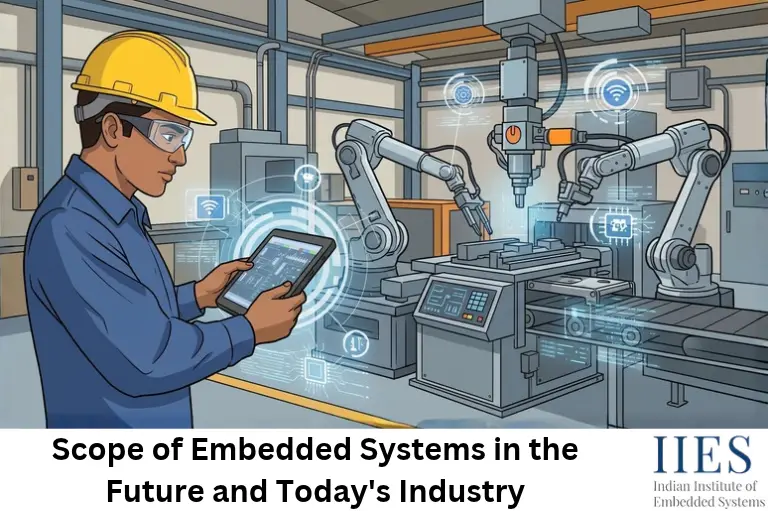
What Is an Embedded System? (In Simple Words)
An embedded system is a small, dedicated computer built into a product to perform a specific job reliably, often in real time. Think of a laptop as a Swiss Army knife and an embedded system as a purpose-built tool. The controller inside a washing machine never browses the internet. It manages water level, drum speed and timing, correctly, for years.
The building blocks
- Microcontroller or SoC: the brain (ARM Cortex-M, STM32, ESP32, AVR, PIC, RISC-V)
- Memory: Flash for code, RAM for runtime data
- Sensors: read the real world (temperature, motion, current, pressure)
- Actuators: act on it (motors, relays, valves, displays)
- Firmware: the C/C++ code that ties everything together
- Communication: UART, SPI, I²C, CAN, BLE, Wi-Fi, LoRa
- Power management: lets a device run for months on a small battery
What makes embedded engineering different
- Real-time behaviour: responses must meet strict deadlines
- Tiny resources: kilobytes of RAM, not gigabytes
- High reliability: products may run for 10+ years without a restart
- Low power and low cost: every milliamp and every rupee counts

Why Embedded Systems Matter More Every Year
Embedded systems matter because most computing now happens inside products, not on desks.
- Chips by the billions: microcontrollers ship in the billions every year, far more than PC processors.
- Everything is getting smart: even bulbs, locks, meters and tractors now need firmware, sensors and connectivity.
- Computing is moving to the edge: devices decide locally to save time, bandwidth and privacy instead of sending everything to the cloud.
Scope of Embedded Systems in Today’s Industry
Embedded engineers are hired in almost every product-making sector. Here is where the work actually is.
1. Automotive and electric vehicles
- Where: motor control, battery management systems (BMS), ADAS, airbags, infotainment, telematics. A modern car carries dozens of ECUs, sometimes over a hundred.
- Work: BMS and motor-controller firmware, CAN/LIN, AUTOSAR, functional safety (ISO 26262)
2. Consumer electronics and wearables
- Where: smartphones, smartwatches, earbuds, TVs, cameras, home appliances
- Work: low-power firmware, BLE connectivity, sensor fusion, display and touch drivers
3. Industrial automation and Industry 4.0
- Where: PLCs, motor drives, robots, CNC machines, smart sensors, condition monitoring
- Work: real-time control loops, Modbus and EtherCAT, predictive maintenance
4. Healthcare and medical devices
- Where: patient monitors, glucose meters, infusion pumps, ECG patches, portable diagnostics
- Work: safety-critical, ultra-low-power firmware and compliance work (IEC 62304)
5. Aerospace, defence and space
- Where: avionics, flight controllers, drones, satellites, radar
- Work: RTOS-based, fault-tolerant software under strict standards (DO-178C)
6. IoT, smart homes and smart cities
- Where: smart meters, street lighting, asset trackers, home automation, environment monitoring
- Work: Wi-Fi, BLE, LoRaWAN and NB-IoT, MQTT, OTA updates, cloud integration
7. Telecom and networking
- Where: routers, modems, base stations, 5G modules
- Work: embedded Linux, device drivers, protocol stacks
8. Agriculture and energy
- Where: smart irrigation, solar inverters, smart grids, EV charging stations
- Work: sensor networks, power-electronics control, remote monitoring
Pro tip: pick one sector early and learn its standards and protocols. A firmware engineer who knows CAN and AUTOSAR is valued very differently from one who only knows Arduino.
Future Scope of Embedded Systems: 8 Trends to Watch
The future scope of embedded systems is shaped by intelligence, connectivity and security moving into smaller and cheaper devices.
- Machine-learning models now run on microcontrollers: voice keywords, anomaly detection, predictive maintenance
- Why it wins: low latency, better privacy, longer battery life
- Learn: TensorFlow Lite for Microcontrollers, model quantization, MCUs with built-in NPUs
2. Software-defined vehicles
- Cars are moving to centralised compute, over-the-air updates and software-first design
- Learn: AUTOSAR Adaptive, embedded Linux, automotive cybersecurity
3. IoT at massive scale
- 5G, low-power wide-area networks and interoperability standards such as Matter are widening the market
- Learn: MQTT, BLE, secure provisioning, OTA update design
4. RISC-V
- An open, customisable architecture gaining ground in cost-sensitive and specialised chips; India has its own efforts such as SHAKTI and VEGA
- Learn: RISC-V toolchains, assembly basics, SoC architecture
5. Embedded security
- Regulations such as the EU Cyber Resilience Act and rising attacks make secure boot, encryption and signed updates a baseline, not a bonus
- Learn: secure bootloaders, crypto accelerators, threat modelling
6. Modern tooling: Rust, Zephyr and CI/CD
- Rust brings memory safety, Zephyr is a growing RTOS ecosystem, and hardware-in-the-loop testing is moving into automated pipelines
- Learn: Rust basics, Zephyr, test automation
7. Digital health and wearables
- Continuous monitoring and remote patient care need tiny, accurate, ultra-low-power devices
- Learn: biomedical signal acquisition, low-power design, BLE
8. Robotics, drones and autonomous machines
- Real-time perception and control loops need tight, deterministic firmware
- Learn: motor control (BLDC, FOC), sensor fusion, RTOS scheduling

Scope of Embedded Systems in India
India offers strong scope for embedded careers because product design, not only assembly, is growing.
- Policy push: national programmes for electronics manufacturing and semiconductor design are increasing local product development
- Hiring hubs: Bangalore, Hyderabad, Pune, Chennai and NCR host semiconductor, automotive and IoT teams and global capability centres
- Startups: EV, drone, medical-device and IoT startups need firmware talent from day one
- Opportunity: engineers who can design and debug, not just configure, are in short supply
- Embedded firmware engineer: drivers, peripherals, bootloaders
- Embedded software engineer (C/C++): application logic, middleware, RTOS tasks
- IoT engineer: device-to-cloud connectivity
- Embedded Linux / BSP engineer: kernel, device tree, drivers
- Automotive embedded engineer: AUTOSAR, CAN, diagnostics (UDS)
- Validation and test engineer: HIL/SIL setups, automation
- Embedded security engineer: secure boot, cryptography, device security testing
- Edge AI engineer: model optimisation for microcontrollers
Indicative salary snapshot in India
Pay varies by city, company and skills, so treat these as rough ranges and check current job portals before you plan around them.
- Freshers: roughly ₹3 to 6 LPA
- 3 to 6 years of experience: roughly ₹8 to 18 LPA
- Specialists (automotive safety, embedded Linux, security, Edge AI): can go well above this
Skills Roadmap: How to Start, Step by Step
Follow this order. Each step makes the next one easier.
- Electronics basics: voltage, current, Ohm’s law, ADC/DAC, transistors
- C programming: pointers, bit manipulation, structures, memory layout
- Microcontroller fundamentals: GPIO, timers, interrupts, ADC, PWM on an STM32 or ESP32 board
- Communication protocols: UART, SPI, I²C, CAN
- RTOS: tasks, queues, semaphores, scheduling with FreeRTOS or Zephyr
- Debugging tools: SWD/JTAG, logic analyser, oscilloscope
- Embedded Linux basics: useful for gateways, automotive and industrial roles
- IoT stack: MQTT, BLE, Wi-Fi, cloud basics
- Engineering habits: Git, unit testing, MISRA C, clear documentation
- Specialise: automotive, medical, industrial, consumer or Edge AI
Will AI Replace Embedded Engineers?
No. AI changes how embedded engineers work, not whether they are needed.
- AI assistants speed up boilerplate and documentation, but they cannot see your oscilloscope. Timing bugs, noisy sensors, power problems and silicon quirks need an engineer at the bench.
- Safety-critical industries need accountable humans for design and certification.
- Engineers who combine embedded skills with TinyML will be among the most in demand.
Honest Challenges to Expect
- A steep start: you need hardware and software thinking together
- Debugging with limited visibility into the running device
- Needing a dev board, tools and patience for hands-on practice
- Standards and certification in regulated domains
- Constant change as chips, toolchains and protocols evolve
8 Portfolio Projects That Employers Notice
- Beginner: button-debounce LED patterns; temperature logger with LCD; ultrasonic parking sensor
- Intermediate: multi-sensor hub over I²C with FreeRTOS; BLE heart-rate monitor; MQTT weather station on ESP32
- Advanced: battery management system prototype; TinyML sound or gesture recognizer
Pro tip: publish every project on GitHub with a clear README, circuit diagram and short demo video. Recruiters read these before they read your resume.

Conclusion: Your Next Step
The scope of embedded systems in today’s industry is wide and growing, and the future adds Edge AI, EVs, RISC-V and security on top of it.
- Start with C and one microcontroller board
- Build and publish small projects
- Add an RTOS, protocols and one specialisation
- Keep an eye on the trends above
If you want structured, hands-on guidance with real boards and industry-style projects, explore embedded systems and IoT training at the Indian Institute of Embedded Systems (IIES), Bangalore.