What is the 8051 Microcontroller?
Before exploring technical details, it is worth addressing the foundational question: what is 8051?
The 8051 is an 8-bit microcontroller developed by Intel and introduced in 1980 as part of the MCS-51 family. It was designed to be a single-chip solution for embedded control applications – integrating CPU, memory, I/O, and timers onto one piece of silicon. Unlike early processors that required external chips for each of these functions, the 8051 brought everything together, establishing the modern definition of a microcontroller.
Over the decades, manufacturers including Atmel, NXP (formerly Philips), Infineon (formerly Siemens), and Silicon Labs have produced their own 8051-compatible variants, often adding Flash memory, extra I/O pins, enhanced timers, and faster clock speeds. This ecosystem of compatible chips has expanded the platform far beyond what Intel originally envisioned.
In practical terms, the 8051 is often described as the foundation of embedded systems education. Its architecture is clean, thoroughly documented, and structured in a way that teaches concepts transferable to virtually every embedded platform in existence today.

Features of 8051 Microcontroller: A Complete Breakdown
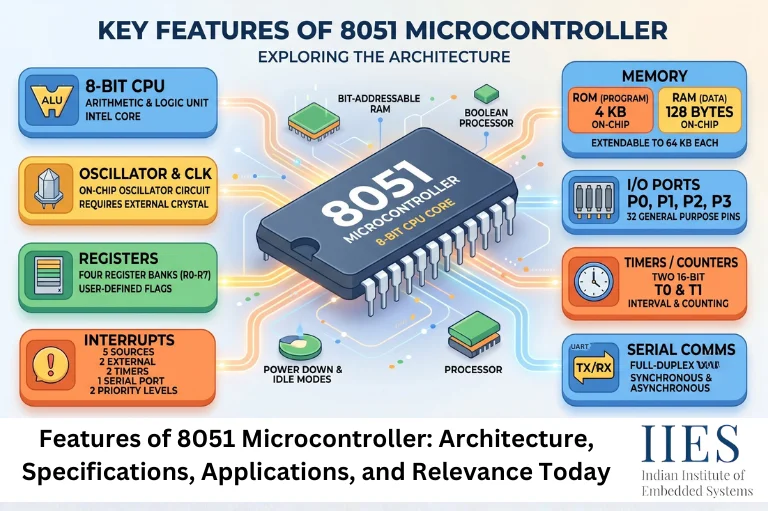
When developers and students ask what are the features of 8051 microcontroller, the answer spans both hardware capability and design philosophy. Below is a comprehensive list of the features of 8051 microcontroller that define its architecture and practical utility.
1. 8-Bit CPU Architecture
The 8051 processes 8 bits of data per instruction cycle using its 8-bit central processing unit. While modest by modern standards, this is entirely adequate for control-oriented tasks that prioritize responsiveness and predictability over raw computational throughput.
2. On-Chip ROM and RAM
The standard 8051 includes 4 KB of on-chip ROM for program storage and 128 bytes of on-chip RAM for runtime data. Enhanced variants extend this significantly. The internal memory structure also includes a bit-addressable area, which enables highly efficient boolean logic operations.
3. Four Parallel 8-Bit I/O Ports
One of the most recognized features of microcontroller designs based on the 8051 is its four bidirectional parallel I/O ports: P0, P1, P2, and P3. Each port has 8 pins, providing 32 programmable I/O lines in total. This density makes interfacing with sensors, relays, displays, and keypads straightforward without requiring external port expanders in most applications.
4. Two 16-Bit Programmable Timers/Counters
Timer 0 and Timer 1 are 16-bit programmable timer/counter units supporting four operating modes each. These handle time delays, event counting, baud rate generation for serial communication, and pulse measurement. Many 8051 variants add a Timer 2 for additional flexibility.
5. Full-Duplex UART Serial Communication
The built-in serial port supports full-duplex UART communication in four programmable modes. This allows the 8051 to exchange data simultaneously in both directions with computers, sensors, GSM modules, and other microcontrollers – a feature that was groundbreaking at launch and remains highly practical today.
6. Boolean Processing Capability
The 8051 has a dedicated Boolean processing unit and a bit-addressable memory segment (20H to 2FH in RAM). It supports direct bit-set, bit-clear, and bit-test operations, making it unusually efficient for control logic that manipulates individual status flags.
7. 64 KB External Memory Expandability
While the chip includes 4 KB of internal ROM, the 8051 architecture supports up to 64 KB of external program memory and a separate 64 KB of external data memory through dedicated control signals (ALE, PSEN, RD, WR). This allows deployment of larger applications without switching platforms.
8. Five-Source Interrupt System
The 8051 supports five interrupt sources: two external hardware interrupts (INT0, INT1), two timer overflow interrupts (TF0, TF1), and one serial communication interrupt (RI/TI). Each source has a programmable priority level, enabling efficient event-driven programming without constant polling.
9. 12 MHz Maximum Clock Speed (Standard)
The standard 8051 runs at up to 12 MHz using a crystal oscillator. Most instructions execute in one machine cycle – equivalent to 12 oscillator pulses – yielding approximately one million instruction executions per second at 12 MHz. Modern enhanced variants operate at 24 MHz, 40 MHz, and beyond.
10. Idle and Power-Down Modes
Many 8051 variants include power-saving modes that significantly reduce current consumption. Power-down mode halts the oscillator and reduces supply current to microampere levels, making it suitable for battery-powered applications. The chip wakes from an external interrupt, restoring normal operation without losing register contents.
The 8051 architecture follows the Harvard model, which uses separate address spaces for program code and data. This contrasts with the Von Neumann architecture – where program and data share a single bus – and provides a speed advantage since instruction fetches and data accesses can occur simultaneously.
Key architectural components and their roles:
ALU (Arithmetic Logic Unit): Performs 8-bit arithmetic, logical, shift, and boolean operations. Supports addition, subtraction, multiplication, and division natively.
Special Function Registers (SFRs): Located from address 80H to FFH in the internal data memory map, SFRs control every peripheral function – ports, timers, the serial interface, and interrupt management. Proficiency with SFRs is the core skill in 8051 programming.
Program Counter (PC): A 16-bit register that always holds the address of the next instruction to fetch. It increments automatically after each fetch or loads a new value during jumps and calls.
Stack Pointer (SP): An 8-bit register initialized to 07H on reset. It points to the top of the stack in internal RAM, growing upward as return addresses and register values are pushed during subroutine calls and interrupts.
Accumulator (A) and B Register: The accumulator is the primary working register for all arithmetic and data movement operations. The B register is used as a secondary operand in multiplication and division instructions.
Data Pointer (DPTR): A 16-bit register formed from the DPH and DPL register pair. DPTR is the primary tool for accessing external memory and reading lookup tables stored in program ROM using the MOVC instruction.
The clarity and logical consistency of the 8051 architecture is the central reason it continues to be taught in engineering programs worldwide. Engineers who learn it develop intuitions about memory maps, peripheral control registers, and interrupt-driven design that carry forward to every other microcontroller platform they encounter.
The following table summarizes the 8051 microcontroller specifications for the standard device alongside a representative enhanced variant:
Specification | Standard 8051 | Enhanced Variant (e.g., AT89S52) |
Architecture | 8-bit Harvard | 8-bit Harvard |
Internal ROM | 4 KB | 8 KB Flash |
Internal RAM | 128 bytes | 256 bytes |
I/O Ports | 4 x 8-bit (32 lines) | 4 x 8-bit (32 lines) |
Timers/Counters | 2 x 16-bit | 3 x 16-bit |
Serial Communication | Full-duplex UART | Full-duplex UART |
Interrupt Sources | 5 | 6 |
External Memory | Up to 64 KB | Up to 64 KB |
Clock Frequency | Up to 12 MHz | Up to 24 MHz |
Supply Voltage | 5V | 4.0V to 5.5V |
Package | DIP-40 | DIP-40, PLCC-44, TQFP-44 |
This comparison highlights how enhanced 8051 variants maintain backward compatibility while adding capabilities that address the original chip’s constraints.
What Are the Applications of 8051 Microcontroller?
The applications of 8051 microcontroller span a wide range of industries. Understanding these use cases helps clarify why the platform has sustained demand for over four decades.
Industrial Automation: The 8051 handles motor control, sensor interfacing, relay driving, and process monitoring in factory environments. Its deterministic behavior and reliable interrupt handling suit real-time control tasks where timing accuracy matters.
Home Automation: Controlling lighting systems, appliances, and security sensors using 8051-based boards is common in budget-conscious smart home implementations. Low component cost and simple programming make it accessible for small-scale deployments.
Medical Devices: Basic patient monitoring equipment, glucose meters, digital thermometers, and portable diagnostic tools use 8051-based controllers. The platform’s predictable execution and low cost make it attractive for entry-level medical electronics.
Automotive Electronics: Older and mid-range vehicles use 8051 derivatives in dashboard controls, power window management, wiper control systems, and ECU subsystems. Legacy vehicle systems maintain significant 8051 deployments.
Consumer Electronics: Remote controls, electronic toys, calculators, and display controllers frequently use 8051-based microcontrollers where low cost and simple I/O management are the primary design requirements.
Educational Robotics: Entry-level robotics kits and college lab boards – such as the popular AT89S52-based trainer boards – use the 8051 to teach embedded programming and hardware interfacing fundamentals.
Telecommunication Equipment: Some serial communication modules and legacy telephony equipment still run on 8051 cores, requiring ongoing support from engineers familiar with the platform.

Why 8051 Microcontroller is Mostly Used
A question frequently raised by students and new engineers is: why is 8051 microcontroller mostly used when far more powerful options exist?
The answer involves several factors that go beyond raw performance metrics.
Ease of Entry: The instruction set has only 111 instructions. The architecture is thoroughly documented in freely available datasheets and textbooks. A student can go from zero to running a first program in a single afternoon using freely available tools.
Mature Ecosystem: Decades of community development have produced compilers, simulators, IDEs, and libraries that make 8051 development accessible and efficient. Keil uVision, SDCC, and various online simulators all support the 8051 with no license cost for educational use.
Cost Advantage at Scale: A standard AT89S52 costs well under one US dollar in volume. For high-quantity production runs where a 32-bit processor would be underutilized, this cost difference directly affects product margins.
Legacy System Support: Existing 8051-based installations in manufacturing, infrastructure, and consumer products continue to require firmware updates, debugging, and hardware replacement. Companies maintain 8051 expertise specifically to service these deployments.
Sufficient Capability for the Task: The majority of embedded control operations – reading an ADC, toggling a GPIO, sending a UART byte, triggering a relay – do not require a 32-bit processor. The 8051 handles these efficiently while consuming less power and requiring simpler power supply design.
What Makes the 8051 Relevant in Today’s Technology: The Enduring Legacy
The 8051 microcontroller, born in the early 1980s, holds a special place in the history of embedded systems. Its 8-bit architecture and compact design made it a versatile and cost-effective solution from its very first year of availability, and that characteristic has never changed.
Its small footprint and low power consumption make it ideal for industrial control systems, automotive electronics, and home automation. Legacy systems built around the 8051 still operate in many industrial environments, and maintaining these systems requires active, current knowledge of the platform. This is not a niche requirement – entire sectors of manufacturing and process control continue to depend on 8051-based controllers.
The microcontroller’s ability to adapt to modern development workflows has been a critical factor in its survival. Contemporary versions incorporate Flash memory for in-system programmability, increased clock speeds, and additional peripheral support. Developers write firmware in C rather than assembly language, making codebases faster to develop and easier to maintain. The availability of open-source tools and shared code libraries continues to lower the barrier for new developers entering the platform.
From a security perspective, the simplicity of the 8051 architecture offers a modest but genuine advantage. For applications where a minimalist attack surface is preferred over feature richness, the 8051’s limited peripheral set reduces exposure to certain vulnerability classes. Advanced cryptographic operations or secure boot processes are better served by modern controllers, but for basic control tasks in trusted environments, the 8051’s simplicity is a practical asset.
8051 in 2026 and Beyond: Future Trends and Outlook
The 8051 will not disappear. Its trajectory through 2026 and beyond points clearly toward continued relevance in three areas.
Education will remain the platform’s strongest anchor. Engineering programs that introduce embedded systems with the 8051 benefit from its conceptual clarity. Students who learn the 8051 first can adopt any other embedded platform with far less friction.
Cost-sensitive production in volume applications will continue to favor 8051-based chips where 32-bit processing power remains unnecessary. In markets where device bill-of-materials costs determine product viability, the price gap between an 8051-compatible chip and a modern ARM Cortex-M0 is commercially meaningful.
IoT edge nodes with minimal data-processing requirements represent a growing application space. The 8051’s low power modes and compact firmware footprint pair effectively with dedicated wireless chips in simple sensor-to-cloud deployments, keeping the platform relevant in modern connected device architectures.
Modern C toolchain support ensures the 8051 remains accessible to developers who have never written assembly language, removing a historical barrier that once limited adoption among new engineers.

Conclusion
The features of 8051 microcontroller – its Harvard architecture, dual-memory model, four flexible I/O ports, 16-bit timers, full-duplex UART, boolean processing engine, and expandable memory interface – form a complete, coherent embedded control platform that has demonstrated its value across more than four decades of real-world deployments.
Understanding what is 8051, how 8051 architecture functions internally, and what are the applications of 8051 microcontroller gives any engineer or student a reliable, proven foundation in embedded systems design. Whether the goal is building a cost-sensitive product, maintaining legacy industrial infrastructure, or learning embedded programming from first principles, the 8051 microcontroller delivers with a consistency and reliability that newer, more complex platforms often struggle to match at its price point.
Its continued presence in 2026 is not sentiment, it is a practical endorsement from the engineering community that clarity, reliability, and affordability remain genuinely valuable design criteria regardless of how fast the technology landscape evolves.