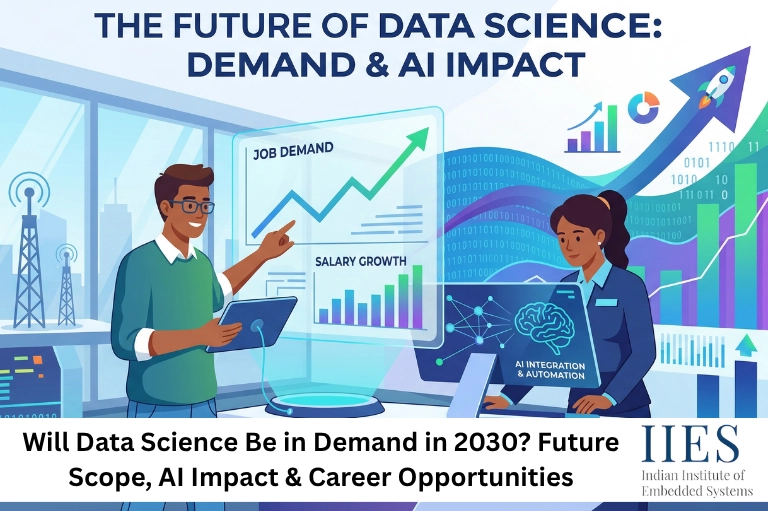
Why Data Science Will Still Be in Demand in 2030
The demand for data scientists continues to rise because every modern industry depends on data-backed decisions.
Companies are moving away from guesswork and toward predictive systems powered by machine learning, analytics, and automation. Whether it’s customer behavior analysis, fraud detection, recommendation systems, or supply chain forecasting, data science remains central.
Here’s why the demand stays strong:
- Massive growth of big data ecosystems
- Rise of generative AI and intelligent automation
- Business need for predictive analytics
- Personalized digital experiences
- Real-time decision systems
- Increased use of cloud data platforms
- Data privacy and governance requirements
The AI and data science future is deeply interconnected. AI needs clean, structured, and well-labeled data to perform effectively—and data scientists make that possible.

The Future Scope of Data Science Across Industries
The future scope of data science is expanding far beyond traditional tech companies.
1) Healthcare
Hospitals use predictive models for disease detection, patient risk scoring, and drug research.
2) Finance
Banks rely on data science for fraud detection, risk analysis, and algorithmic trading.
3) Retail & E-commerce
Recommendation engines, pricing optimization, and customer segmentation depend on data science.
4) Manufacturing
Predictive maintenance and IoT analytics are driving smart factories.
5) Cybersecurity
Threat detection increasingly uses anomaly detection and behavioral analytics.
These cross-industry use cases ensure data science career opportunities remain strong for the next decade.
Will Data Science Be Replaced by AI?
One of the biggest fears people have is: will data science be replaced by AI?
The reality is more nuanced.
AI will replace repetitive tasks, not the strategic thinking behind data science.
Tasks AI may automate
- Data cleaning scripts
- Basic dashboard generation
- SQL query generation
- Automated feature selection
- Routine reporting
Tasks humans will still lead
- Problem framing
- Business understanding
- Experiment design
- Ethical model decisions
- Interpreting edge cases
- Cross-team collaboration
- Model validation in real-world context
So if you’re wondering can AI replace data scientists in future, the answer is: AI will augment them, not eliminate them.
The role shifts from “number cruncher” to decision architect.
Data Scientist vs AI Engineer: Which Has Better Future?
A common comparison in 2026 career searches is data scientist vs AI engineer.
Role | Core Focus | Future Demand |
Data Scientist | Insights, analytics, experimentation | Very High |
AI Engineer | Deploying ML/GenAI systems | Extremely High |
Data Engineer | Data pipelines, ETL, warehousing | Extremely High |
Key insight:
The future belongs to professionals who understand all three layers:
- data collection
- model building
- deployment
This is why data engineering vs data science is no longer a rivalry. They are complementary career paths.
The best professionals in 2030 will likely have hybrid skills.
Real-World Career Opportunities in Data Science
The best part about this field is its career flexibility.
Top data science career opportunities by 2030
- Machine Learning Engineer
- Applied AI Specialist
- Business Intelligence Analyst
- Data Product Manager
- NLP Engineer
- Computer Vision Scientist
- MLOps Engineer
- Decision Intelligence Consultant
- Risk Analytics Expert
- Healthcare Data Scientist
These roles align with growing enterprise adoption of automation and AI.
Data Scientist Salary: Will It Stay High?
Yes, data scientist salary levels are expected to remain highly competitive because the work directly impacts revenue and efficiency.
Estimated salary outlook by 2030
Experience | India (₹ LPA) | Global ($) |
Fresher | 8–15 | 80k–110k |
Mid-Level | 18–35 | 120k–170k |
Senior / AI Specialist | 40+ | 180k–300k+ |
Salaries rise significantly when professionals combine:
Data Science Future Trends for 2026 and Beyond
The strongest data science future trends are already shaping the 2030 job market.
1) Generative AI + Analytics
LLMs are now being used for analytics copilots and automated decision support.
2) Explainable AI
Companies need transparent models for compliance and trust.
3) Edge Analytics
IoT devices now process data locally in real time.
4) Data-Centric AI
Better datasets matter more than bigger models.
5) Decision Intelligence
Analytics is moving from reporting to automated action systems.
These trends prove that data science transformation is happening, not decline.
Will Data Science Die in Future? The Honest Reality
Many students ask: will data science die in future?
No—but outdated data science skills will.
What becomes obsolete:
- only using Excel
- dashboard-only profiles
- no deployment knowledge
- weak coding
- no cloud exposure
- ignoring AI tools
What stays valuable:
- statistical reasoning
- experimentation
- feature engineering
- domain understanding
- storytelling with data
- business decision support
So the field won’t die. It will simply reward adaptability.
Will Data Science Exist in 10 Years and Even 2050?
Yes, and likely in more advanced forms.
If your question is will data science exist in 10 years, the answer is clearly yes.
Even will data science be in demand in 2050 is likely to remain true because:
- data volume keeps growing
- AI systems require continuous retraining
- ethics and governance will become stricter
- personalized systems need behavioral insights
- robotics and autonomous systems depend on real-time analytics
The role may evolve into:
- AI strategist
- autonomous systems analyst
- synthetic data architect
- decision intelligence expert
But the core logic of data science remains permanent.
Best Practices to Stay Relevant as a Data Scientist
To future-proof your career:
Learn beyond model building
Understand deployment, APIs, monitoring, and pipelines.
Build domain expertise
Finance, healthcare, marketing, and manufacturing all reward specialization.
Work on practical projects
Examples:
- churn prediction
- fraud detection
- recommendation engine
- sentiment analysis
- forecasting dashboards
- LLM-powered analytics bots
Use AI tools productively
Leverage copilots for code generation and faster experimentation.
Master data storytelling
Insights matter only when stakeholders understand them.
Common Mistakes to Avoid
Many professionals slow their growth by making these mistakes:
- focusing only on theory
- avoiding SQL
- ignoring cloud tools
- not learning data engineering basics
- no Git or version control
- weak communication skills
- relying fully on AutoML tools
- no business understanding
Avoiding these can dramatically improve your data science career opportunities.
Will data science be in demand in 2050?
Very likely yes, especially in AI governance, autonomous systems, and real-time decision intelligence.

Conclusion: The Future Is Stronger Than Ever
So, will data science be in demand in 2030?
Without a doubt – yes.
The field is not shrinking; it is transforming into something even more valuable. As AI becomes mainstream, organizations will need professionals who can guide data strategy, validate model outputs, ensure ethical decisions, and connect insights with real business outcomes.
The real winners in 2030 won’t just “know machine learning.” They’ll understand business, data pipelines, AI tools, cloud deployment, and human decision-making.
If you’re planning your future in tech, data science remains one of the smartest long-term bets.