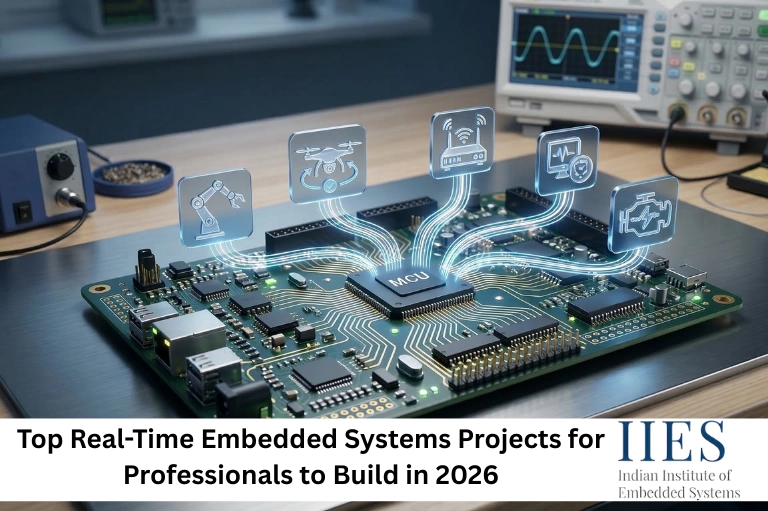
What Are Real-Time Embedded Systems?
A real time embedded system is a computing system designed to perform a specific function within a defined time limit. If the system fails to complete the task within the required time, it may cause system malfunction or failure.
These systems are widely used in automotive control systems, industrial automation, robotics, aerospace technology, medical devices, and IoT systems.
Real-Time Embedded Systems Definition
A real-time embedded system is a dedicated computing system that processes inputs and generates outputs within strict time constraints to ensure reliable and predictable system behavior.

Examples of Real-Time Embedded Systems
Application | Real-Time Function |
Automotive Airbag System | Deploys airbag within milliseconds |
Industrial Motor Controller | Maintains real-time speed and torque control |
Medical Heart Monitor | Continuously monitors patient vital signs |
Robotics Systems | Controls sensors and actuators instantly |
Aircraft Flight Control | Maintains real-time flight stability |
These examples clearly show how real time embedded systems applications are used in safety-critical environments.
Why Real-Time Embedded Systems Are Important in Industrial Applications
Modern industries rely heavily on embedded automation and intelligent control systems. Real-time computing ensures machines respond instantly and predictably, which is essential for industrial operations.
Key Benefits
- Precise timing control
- High system reliability
- Deterministic task execution
- Efficient hardware utilization
- Real-time monitoring and automation
Industries such as automotive manufacturing, healthcare technology, and industrial robotics depend on these systems to ensure safe and efficient operations.
Basic vs Advanced Embedded Projects
Many beginners start with small microcontroller experiments, but professional engineers work on complex systems involving RTOS, communication protocols, debugging tools, and industrial interfaces.
Beginner Projects | Professional Projects |
LED blinking system | RTOS based multitasking system |
Temperature monitoring | Industrial motor control system |
LCD display project | Automotive ECU simulation |
UART communication | Embedded Linux device development |
Basic sensor project | Real-time industrial monitoring system |
This transition from beginner experiments to advanced embedded systems projects is essential for engineers who want to work on real-world systems.
Best Real Time Embedded Systems Projects for Professionals
1. RTOS Based Industrial Motor Control System
Objective
To design a real-time motor control system that monitors motor speed and controls operation using an RTOS-based scheduling mechanism.
Components Required
- STM32 or ARM Cortex microcontroller
- Motor driver module
- DC motor or BLDC motor
- Speed sensor or encoder
- Power supply unit
Working Principle
The microcontroller reads motor speed from sensors and processes the data using an RTOS scheduler. Based on the required speed, the system adjusts PWM signals to control the motor driver. Real-time task scheduling ensures accurate and stable motor operation.
Skills Learned
- RTOS task scheduling
- PWM motor control
- Embedded C programming
- Industrial automation concepts
2. Automotive ECU Monitoring System
Objective
To develop a real-time automotive monitoring system that reads vehicle sensor data and performs fault diagnostics.
Components Required
- Automotive microcontroller
- CAN bus module
- Vehicle sensors (temperature, speed, pressure)
- LCD or display module
- Embedded firmware
Working Principle
Sensors continuously send data to the ECU through the CAN bus. The microcontroller processes the sensor data in real time and identifies abnormal conditions. The system displays vehicle parameters and logs faults for diagnostics.
Skills Learned
- Automotive communication protocols (CAN)
- Real-time data processing
- Embedded system diagnostics
- Automotive embedded systems development
3. Real-Time Patient Monitoring System
Objective
To create a medical monitoring system that continuously tracks patient health parameters in real time.
Components Required
- Microcontroller board
- Pulse sensor
- Oxygen saturation sensor (SpO2)
- Display module
- Communication interface
Working Principle
Sensors measure vital signs such as heart rate and oxygen levels. The embedded system processes this data in real time and displays the information. If abnormal values are detected, an alert notification is triggered.
Skills Learned
- Medical sensor interfacing
- Real-time signal processing
- Embedded system design
- Healthcare device development
4.Smart Traffic Control System Using RTOS
Objective
To design an intelligent traffic management system that adjusts signal timing based on real-time traffic conditions.
Components Required
- Microcontroller with RTOS
- Traffic sensors or IR sensors
- Traffic signal LEDs
- Communication module
Working Principle
Traffic sensors detect vehicle density at intersections. The RTOS schedules tasks to analyze traffic conditions and dynamically adjust signal timings. Emergency vehicles can also receive priority signals.
Skills Learned
- RTOS multitasking
- Smart city system development
- Sensor integration
- Traffic automation algorithms
5. Embedded Linux Smart Surveillance System
Objective
To develop a real-time surveillance system capable of monitoring video feeds and detecting motion.
Components Required
- Embedded Linux board (Raspberry Pi)
- Camera module
- Network interface
- Storage system
Working Principle
The embedded Linux device captures video from the camera and processes it using motion detection algorithms. When motion is detected, the system records the footage and sends alerts to the monitoring system.
Skills Learned
- Embedded Linux development
- Video processing
- Network communication
- Security system design
6. Real-Time Industrial Data Logger System
Objective
To design a system that continuously records industrial machine data for monitoring and analysis.
Components Required
Working Principle
Sensors collect machine parameters and send them to the microcontroller. The system processes the data in real time and stores it in a storage device for further analysis.
Skills Learned
- Data acquisition systems
- Embedded memory management
- Industrial monitoring techniques
7. IoT-Based Real-Time Environmental Monitoring System
Objective
To monitor environmental conditions and transmit real-time data to cloud platforms.
Components Required
- ESP32 microcontroller
- Temperature and humidity sensors
- Wi-Fi communication module
- Cloud dashboard platform
Working Principle
Sensors collect environmental data which is processed by the microcontroller. The system sends this information to a cloud server where users can monitor conditions remotely.
Skills Learned
- IoT embedded systems development
- Wireless communication protocols
- Cloud data integration
8. Autonomous Robot Navigation System
Objective
To build a robot that navigates automatically by detecting obstacles and adjusting its movement.
Components Required
- Microcontroller board
- Ultrasonic sensors
- Motor driver module
- DC motors
Working Principle
Sensors detect obstacles in the robot’s path. The embedded controller processes sensor data in real time and adjusts motor movement to avoid collisions and navigate safely.
Skills Learned
- Robotics control systems
- Sensor fusion techniques
- Real-time decision algorithms
9. Drone Flight Stabilization System
Objective
To develop a control system that stabilizes a drone using real-time sensor data.
Components Required
- Flight controller microcontroller
- IMU sensor (gyroscope and accelerometer)
- Brushless motors
- Electronic speed controllers (ESC)
Working Principle
IMU sensors detect orientation and motion of the drone. The controller processes this data and adjusts motor speeds using control algorithms to maintain stable flight.
Skills Learned
- Real-time control algorithms
- Sensor data processing
- Drone embedded systems
10. Smart Home Automation System Using RTOS
Objective
To create a smart home system capable of controlling multiple devices simultaneously.
Components Required
Working Principle
The system monitors sensor inputs and controls household devices such as lights and appliances. RTOS manages multiple tasks including device control, sensor monitoring, and network communication.
Skills Learned
- IoT system development
- RTOS multitasking
- Smart automation systems

Architecture of Real-Time Embedded Systems
The architecture of real time embedded systems defines how hardware and software components interact to perform tasks within strict timing constraints. Unlike general-purpose computing systems, real-time embedded systems process inputs and generate outputs within a predictable and deterministic time frame.
A typical real-time embedded system processes data from sensors, executes control algorithms using embedded firmware, and generates output actions through actuators or communication interfaces.
These systems are widely used in automotive control units, industrial automation, robotics, and medical devices, where accurate and timely responses are essential.
Core Components of Real-Time Embedded Systems
Component | Function |
Sensors | Capture real-world physical data such as temperature, pressure, motion, or speed |
Microcontroller / Processor | Executes the embedded program and controls system operations |
Real-Time Operating System (RTOS) | Manages task scheduling and ensures tasks meet timing deadlines |
Memory (RAM / Flash) | Stores firmware, application code, and runtime data |
Communication Interfaces | Enable data exchange using protocols like UART, SPI, I2C, CAN |
Actuators | Convert system decisions into physical actions such as motor movement |
Basic Working Architecture
A simplified workflow of a real time embedded system typically follows these steps:
- Sensors collect environmental or system data.
- The microcontroller processes the data using embedded software.
- An RTOS scheduler prioritizes tasks based on timing requirements.
- The system makes decisions using control algorithms.
- Actuators perform the required action.
Example Workflow
Stage | Example in Industrial System |
Input | Temperature sensor detects machine heat |
Processing | Embedded controller analyzes the data |
Decision | RTOS schedules cooling control task |
Output | Cooling fan speed is increased |
This architecture ensures critical tasks execute without delay in industrial motor control systems, medical monitoring devices, and automotive safety systems.
Real Industry Use Case: Automotive Airbag System
One of the most critical real time embedded systems applications used in the automotive industry is the airbag deployment system, designed to respond instantly during a vehicle collision.
Modern vehicles use impact sensors and accelerometers to continuously monitor sudden changes in speed. When a crash occurs, the sensors immediately send signals to the embedded control unit (ECU).
The controller processes this information and decides whether to deploy the airbags. This entire process happens within 20–30 milliseconds.
Because missing this deadline could risk passenger safety, this system is classified as a hard real-time embedded system.
How the System Works
Step | Process |
1 | Crash sensors detect sudden deceleration |
2 | Sensor data is sent to the embedded control unit |
3 | Controller processes data using real-time algorithms |
4 | Deployment signal is triggered |
5 | Airbags inflate instantly |
Technologies Used
- Crash sensors
- Automotive microcontrollers
- Embedded C firmware
- Safety-certified RTOS
- CAN bus communication
Real-time processing ensures immediate crash detection, fast decision making, and reliable airbag activation.
Common Mistakes to Avoid in Real-Time Embedded Systems Projects
Developing real time embedded systems projects for professionals requires careful planning, efficient coding practices, and reliable hardware design.
Avoiding the following mistakes improves system reliability and performance.
1. Ignoring Real-Time Constraints
Real-time systems must respond within strict deadlines. Missing these deadlines may cause system failure in applications like industrial motor control systems or automotive safety systems.
Tip: Analyze task execution time, interrupt latency, and scheduling delays.
2. Poor Task Scheduling in RTOS
In rtos based embedded projects, incorrect task priorities may cause high-priority tasks to be blocked.
Tip: Use proper priority-based scheduling and task management.
3. Lack of Proper Debugging Strategy
Without effective embedded systems debugging techniques, identifying system faults becomes difficult.
Common debugging tools include:
- JTAG debuggers
- Logic analyzers
- Serial debugging logs
- Oscilloscopes
4. Not Testing Under Real-Time Conditions
Testing only in simulations may hide real-world issues.
Embedded systems must be tested under conditions like:
- High processing load
- Sensor noise
- Communication delays
This is why embedded systems testing and validation are essential.
5. Inefficient Memory Management
Embedded devices have limited memory.
Common issues include:
- Memory leaks
- Stack overflow
- Excessive dynamic memory allocation
Efficient Embedded C memory optimization improves system stability.
Important Things to Consider When Creating Embedded Systems Projects
When designing advanced embedded systems projects, engineers must evaluate several technical factors.
1. Hardware Selection
Selecting the right hardware is critical.
Key considerations:
- Processing power
- Memory capacity
- Peripheral interfaces
- Power consumption
Popular platforms include:
- STM32 microcontrollers
- Raspberry Pi
- ESP32
- ARM Cortex processors
2. Real-Time Operating System Selection
A real time operating system (RTOS) helps manage multiple tasks efficiently.
Common RTOS platforms include:
- FreeRTOS
- VxWorks
- Zephyr RTOS
- RTLinux
These systems support task scheduling, synchronization, and interrupt handling.
3. Reliable Communication Protocols
Embedded devices often communicate using specialized protocols.
Protocol | Application |
UART | Serial communication |
SPI | High-speed device communication |
I2C | Sensor interfacing |
CAN | Automotive communication |
Ethernet | Industrial networking |
Selecting the right protocol ensures reliable data transfer.
4. Power Management
Power efficiency is important for portable and IoT devices.
Engineers should consider:
- Low-power microcontrollers
- Sleep modes
- Efficient power regulators
- Battery management systems
5. System Scalability
Professional embedded systems major projects should support future upgrades.
Examples include:
- Adding new sensors
- Upgrading communication modules
- Integrating AI-based processing
Scalable designs simplify system maintenance and expansion.

Conclusion
Real-time embedded systems are essential for modern technology. Industries such as automotive, healthcare, robotics, and industrial automation rely heavily on systems that operate within strict timing constraints.
Working on real time embedded systems projects for professionals helps engineers gain expertise in:
By building advanced embedded systems projects, engineers can develop practical skills needed for real-world embedded system development and high-demand technology careers.