What is a Development Board?
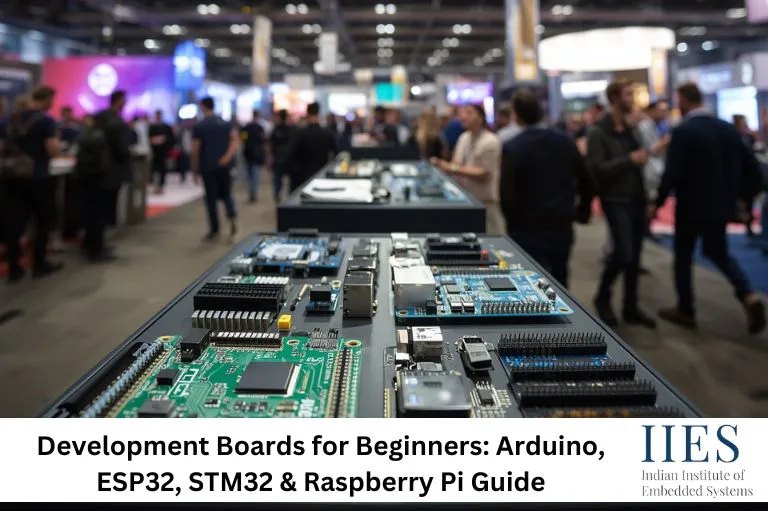
A development board is a ready-made electronic platform designed to help engineers, students, and hobbyists develop and test embedded applications quickly.
A typical development board includes:
- Microcontroller or microprocessor
- USB programming interface
- GPIO pins
- Power supply circuit
- Clock circuitry
- LEDs and buttons
- Communication interfaces
Instead of designing hardware from scratch, beginners can directly write code, upload programs, and test projects.
Development boards are widely used in:

Why Development Boards are Important for Beginners
Learning embedded systems only through theory is difficult. Practical implementation helps students understand:
- GPIO control
- Timers
- Interrupts
- ADC and DAC
- Communication protocols
- Real-time systems
- Sensor interfacing
Development boards simplify learning because they eliminate complex hardware setup in the early stages.
Benefits of using development boards for beginners:
- Faster learning
- Easy debugging
- Lower cost
- Large community support
- Ready-made libraries
- Simple programming environments
Best Development Boards for Beginners
Arduino Uno
Best for:
- Absolute beginners
- School and college students
- Basic electronics projects
- Robotics beginners
Arduino Uno is one of the most popular microcontroller boards for beginners. It is simple, affordable, and supported by a huge global community.
Main Features
| Feature | Details |
|---|
| Microcontroller | ATmega328P |
| Programming Language | C/C++ |
| IDE | Arduino IDE |
| Operating Voltage | 5V |
| Connectivity | USB |
| Difficulty Level | Easy |
Why Arduino Uno is Beginner Friendly
Arduino focuses on simplicity. Even students with no programming experience can blink LEDs and interface sensors within minutes.
Advantages:
- Very easy setup
- Huge online tutorials
- Massive library ecosystem
- Beginner-friendly syntax
- Low-cost hardware
Typical Arduino Projects
- LED blinking
- Temperature monitoring
- Obstacle avoidance robot
- Line follower robot
- Home automation basics
Limitations
- Limited processing power
- Not ideal for advanced IoT
- Limited memory
Arduino is perfect for building confidence during the early stages of embedded systems learning.

ESP32 Development Board
Best for:
- IoT projects
- Wireless communication
- Smart home systems
- Cloud-connected devices
ESP32 is currently one of the best IoT development boards available for beginners and professionals.
Main Features
| Feature | Details |
|---|
| Wi-Fi | Built-in |
| Bluetooth | Built-in |
| Dual Core Processor | Yes |
| Programming | Arduino IDE / ESP-IDF |
| Cost | Very low |
| Difficulty | Medium |
Why ESP32 is Popular
ESP32 combines:
- High performance
- Low price
- Wireless connectivity
- Large community support
This makes it ideal for modern embedded applications.
Popular ESP32 Projects
- Smart home automation
- IoT weather station
- Wireless sensor network
- Mobile app control
- Cloud monitoring systems
Advantages
- Built-in Wi-Fi and Bluetooth
- Excellent performance
- Supports IoT applications
- Low power modes
- Affordable pricing
Limitations
- Slightly more complex than Arduino
- Wireless debugging can confuse beginners
If your goal is modern IoT development, ESP32 is one of the best boards to start with.
Raspberry Pi
Best for:
- Linux learning
- Python programming
- Networking
- AI and computer vision projects
Unlike Arduino and ESP32, Raspberry Pi is not just a microcontroller board. It is a complete single-board computer.
Main Features
| Feature | Details |
|---|
| Operating System | Linux |
| Programming | Python, C, Java |
| HDMI Support | Yes |
| USB Ports | Yes |
| Networking | Wi-Fi/Ethernet |
| Difficulty | Medium |
Why Raspberry Pi is Different
Raspberry Pi can:
- Run Linux
- Connect monitors
- Run desktop applications
- Host web servers
- Process images and videos
Popular Raspberry Pi Projects
- Home media server
- AI face recognition
- IoT dashboard
- Smart surveillance
- Web hosting
Advantages
- Full Linux environment
- Excellent for software-hardware integration
- Strong Python support
- Supports AI frameworks
Limitations
- Higher cost
- Not real-time like microcontrollers
- Higher power consumption
Raspberry Pi is excellent for students interested in both software and electronics.
STM32 Nucleo Boards
Best for:
- Industry-level embedded systems
- RTOS learning
- Advanced driver development
- Professional embedded engineering
STM32 boards are widely used in real commercial products.
Main Features
| Feature | Details |
|---|
| Processor | ARM Cortex-M |
| IDE | STM32CubeIDE |
| Language | Embedded C |
| Performance | High |
| Peripherals | Rich |
| Difficulty | Advanced |
Why STM32 is Important
STM32 teaches concepts used in professional embedded systems development:
- Register-level programming
- RTOS
- DMA
- Advanced timers
- Power optimization
Common STM32 Projects
- Industrial automation
- Motor control
- Medical devices
- Automotive systems
- Real-time applications
Advantages
- Industry relevance
- High processing power
- Professional ecosystem
- Rich peripheral support
Limitations
- Steeper learning curve
- Documentation can overwhelm beginners
STM32 is ideal for students planning careers in embedded systems companies.
NXP LPC1768 Development Board
Best for:
- Communication protocols
- Automotive basics
- Embedded C programming
- RTOS fundamentals
The LPC1768 is another strong ARM Cortex-M based development board used in embedded systems education.
Important Features
| Feature | Details |
|---|
| CAN Support | Yes |
| UART | Multiple |
| ADC | Yes |
| Timers | Advanced |
| IDE Support | Keil, MCUXpresso |
| Difficulty | Medium to Advanced |
Why LPC1768 is Valuable
This board is excellent for learning:
- CAN communication
- UART
- SPI
- I2C
- Embedded C fundamentals
Common LPC1768 Projects
- CAN communication systems
- Sensor interfacing
- Industrial control systems
- RTOS projects
Advantages
- Rich communication peripherals
- Strong industrial relevance
- Excellent for protocol learning
Limitations
- Smaller community than Arduino
- Requires deeper embedded knowledge
Arduino vs ESP32 vs STM32 vs Raspberry Pi
| Feature | Arduino Uno | ESP32 | STM32 | Raspberry Pi |
|---|
| Difficulty | Easy | Medium | Advanced | Medium |
| Wi-Fi | No | Yes | Some Models | Yes |
| Bluetooth | No | Yes | Some Models | Yes |
| Processing Power | Low | Medium | High | Very High |
| Real-Time Capability | Yes | Yes | Yes | Limited |
| Linux Support | No | No | No | Yes |
| Best For | Beginners | IoT | Professional Embedded | Software + Hardware |
| Cost | Low | Very Low | Medium | Higher |
Key Factors to Consider Before Choosing a Development Board
Your Learning Goal
Different boards serve different purposes.
Choose Arduino if:
- You are completely new
- You want simple projects
- You want quick results
Choose ESP32 if:
- You want IoT skills
- You need Wi-Fi projects
- You want wireless communication
Choose STM32 or LPC1768 if:
- You want embedded systems career preparation
- You want RTOS learning
- You want advanced embedded programming
Choose Raspberry Pi if:
- You want Linux experience
- You enjoy Python programming
- You want AI and networking projects
Programming Difficulty Comparison
| Board | Difficulty Level |
|---|
| Arduino Uno | Easy |
| Raspberry Pi | Easy to Medium |
| ESP32 | Medium |
| LPC1768 | Medium to Advanced |
| STM32 | Advanced |
Community and Learning Resources
One major factor beginners ignore is community support.
Boards with large communities provide:
- Tutorials
- Forums
- Example projects
- GitHub libraries
- Faster troubleshooting
Strongest Communities
More Professional Ecosystems
Development Tools and IDEs
Arduino IDE
Best for beginners because of:
- Simple interface
- Easy code upload
- Ready-made libraries
STM32CubeIDE
Used for professional STM32 development:
- Advanced debugging
- Peripheral configuration
- RTOS integration
Keil IDE
Common in embedded systems training and ARM development.
Linux Environment
Raspberry Pi introduces:
- Terminal commands
- Linux file systems
- Networking concepts
Beginner Embedded Systems Learning Roadmap
Path 1: Beginner Friendly Route
- Arduino Uno
- Sensors and actuators
- Basic robotics
- Communication protocols
Path 2: IoT Engineer Route
- ESP32 basics
- Wi-Fi projects
- MQTT and cloud integration
- Mobile app communication
Path 3: Professional Embedded Engineer Route
- Arduino fundamentals
- STM32 or LPC1768
- RTOS
- Driver development
- Embedded Linux basics
Common Mistakes Beginners Make
Buying Advanced Boards Too Early
Many beginners buy powerful boards without understanding fundamentals.
Start simple first.
Ignoring Datasheets
Datasheets explain:
- Pin configuration
- Electrical characteristics
- Communication details
Learning to read documentation is a critical embedded systems skill.
Skipping Basic Concepts
Before learning RTOS or advanced protocols, understand:
- GPIO
- Timers
- Interrupts
- UART
- ADC
Strong fundamentals make advanced topics easier.
Copy-Pasting Code Without Understanding
Beginners often use libraries without understanding how hardware works.
Try to:
- Read code carefully
- Modify examples
- Debug manually
This builds real engineering skills.
Which Development Board Should You Buy First?
Best Overall for Absolute Beginners
Arduino Uno
Best Value IoT Development Board
ESP32
Best for Industry-Level Embedded Systems
STM32 Nucleo
Best for Linux and AI Projects
Raspberry Pi
Best for Communication Protocol Learning
LPC1768
Future Scope of Embedded Systems and IoT
Embedded systems continue to grow rapidly in:
- Automotive electronics
- Electric vehicles
- Smart homes
- Industrial automation
- Robotics
- Healthcare devices
- Consumer electronics
- Aerospace systems
Learning development boards today can open opportunities in:
- Embedded software engineering
- IoT development
- Firmware engineering
- Hardware testing
- Robotics engineering
Final Recommendation
If you are completely new to embedded systems, begin with Arduino to build confidence quickly.
After understanding basics:
- Move to ESP32 for IoT projects
- Move to STM32 or LPC1768 for professional embedded development
Do not rush into advanced topics immediately. Focus on understanding how hardware and software interact.
Consistent hands-on practice is the fastest way to become skilled in embedded systems.
Conclusion
Choosing the best development board for beginners depends entirely on your learning objectives. Arduino Uno provides the easiest entry point, ESP32 offers modern wireless capabilities, Raspberry Pi combines software and hardware learning, while STM32 and LPC1768 prepare students for professional embedded systems careers.
The best approach is to start with simple projects, strengthen your programming and electronics fundamentals, and gradually move toward more advanced platforms.
Embedded systems is a practical field. The more projects you build, the stronger your understanding becomes.