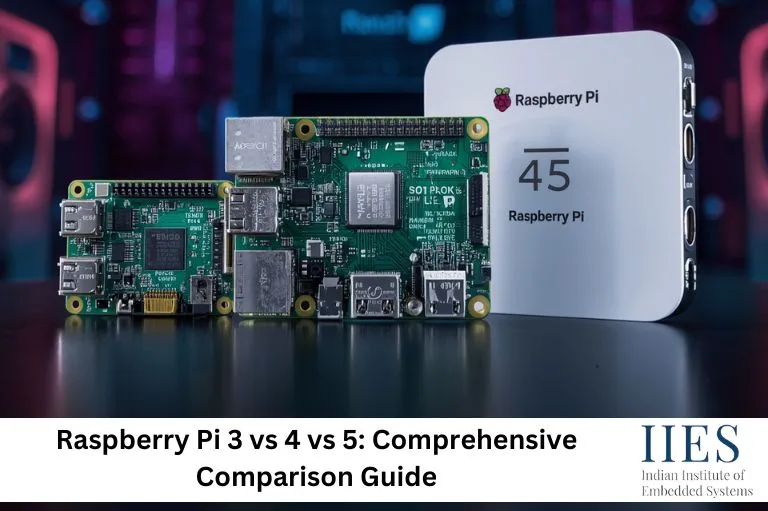
What is Raspberry Pi?
Raspberry Pi is a compact single-board computer developed to promote computer science education and practical electronics learning. Despite its small size, it can perform tasks typically associated with desktop computers, including:
- Programming
- Web browsing
- IoT development
- Home automation
- Robotics
- Artificial Intelligence
- Machine Learning
- Media streaming
- Industrial automation
Its affordability and flexibility have made it one of the most popular development platforms worldwide.

Raspberry Pi 3 Overview
Released in 2016, Raspberry Pi 3 was a significant upgrade over previous generations. It introduced built-in Wi-Fi and Bluetooth, making wireless connectivity easier for IoT applications.
Key Features
- Quad-core ARM Cortex-A53 processor
- 1GB LPDDR2 RAM
- Built-in Wi-Fi and Bluetooth
- HDMI output
- 40 GPIO pins
- MicroSD card storage
Best For
- Basic IoT projects
- Home automation
- Learning Linux
- Programming practice
- Educational projects
Although still capable of handling many tasks, Raspberry Pi 3 struggles with resource-intensive applications and modern AI workloads.
Raspberry Pi 4 Overview
The Raspberry Pi 4 marked one of the biggest performance jumps in the Raspberry Pi lineup. It introduced faster processing, more RAM options, USB 3.0 support, and dual 4K display capability.
Key Features
- Quad-core ARM Cortex-A72 processor
- Up to 8GB RAM
- USB 3.0 ports
- Gigabit Ethernet
- Dual-band Wi-Fi
- Dual 4K display support
Best For
- Advanced IoT applications
- Edge computing
- Robotics
- Smart home systems
- Lightweight server applications
Raspberry Pi 4 remains one of the most widely used boards due to its excellent balance between performance and affordability.
Raspberry Pi 5 Overview
Raspberry Pi 5 represents the most powerful Raspberry Pi ever released. It delivers desktop-class performance and introduces significant improvements in CPU speed, graphics processing, storage access, and peripheral support.
Key Features
- Quad-core ARM Cortex-A76 processor
- Up to 8GB RAM
- PCIe support
- Faster GPU
- Improved camera interfaces
- Significantly enhanced I/O performance
Best For
- AI and machine learning projects
- Computer vision
- Industrial automation
- Edge AI computing
- High-performance robotics
For developers working on modern embedded systems and AI-powered applications, Raspberry Pi 5 provides a substantial performance advantage.
Raspberry Pi 3 vs 4 vs 5 Specifications Comparison
| Feature | Raspberry Pi 3 | Raspberry Pi 4 | Raspberry Pi 5 |
|---|
| CPU | Cortex-A53 Quad-Core | Cortex-A72 Quad-Core | Cortex-A76 Quad-Core |
| Clock Speed | 1.2 GHz | 1.5 GHz | 2.4 GHz |
| RAM | 1GB | Up to 8GB | Up to 8GB |
| USB Ports | USB 2.0 | USB 3.0 + USB 2.0 | USB 3.0 + USB 2.0 |
| Ethernet | Fast Ethernet | Gigabit Ethernet | Gigabit Ethernet |
| Wi-Fi | 802.11n | Dual-band | Dual-band |
| Bluetooth | 4.1 | 5.0 | 5.0 |
| PCIe Support | No | No | Yes |
| AI Capability | Limited | Moderate | Excellent |
| Graphics | Basic | Improved | Advanced |
CPU Performance Comparison
One of the biggest differences between Raspberry Pi 3, 4, and 5 is processing power.
Raspberry Pi 3
The Cortex-A53 processor is suitable for simple projects and educational purposes. It performs well for coding, web servers, and sensor-based IoT applications.
Raspberry Pi 4
The Cortex-A72 processor delivers a major improvement in processing speed. Applications launch faster, multitasking becomes smoother, and system responsiveness improves significantly.
Raspberry Pi 5
The Cortex-A76 processor provides desktop-level performance. Tasks such as image processing, machine learning inference, and video analysis run considerably faster.
Winner
Raspberry Pi 5

RAM and Multitasking Comparison
RAM plays a critical role when running multiple applications simultaneously.
Raspberry Pi 3
With only 1GB RAM, users may experience slowdowns when multitasking.
Raspberry Pi 4
Available in multiple memory configurations up to 8GB, making it suitable for demanding workloads.
Raspberry Pi 5
Enhanced memory architecture and improved bandwidth provide smoother multitasking and faster application performance.
Winner
Raspberry Pi 5
Graphics Performance Comparison
Graphics capabilities are important for multimedia, gaming, and AI-based visual processing.
Raspberry Pi 3
Basic graphics suitable for educational use and lightweight applications.
Raspberry Pi 4
Supports dual 4K displays and improved video playback.
Raspberry Pi 5
Offers significant graphics improvements with smoother rendering and better support for modern workloads.
Winner
Raspberry Pi 5
Raspberry Pi for IoT Projects
IoT developers often prioritize connectivity, power efficiency, and reliability.
Raspberry Pi 3 for IoT
Ideal for:
- Smart sensors
- Home automation
- Environmental monitoring
- Remote control systems
Raspberry Pi 4 for IoT
Ideal for:
- IoT gateways
- Industrial monitoring
- Smart city projects
- Cloud-connected devices
Raspberry Pi 5 for IoT
Ideal for:
- Edge AI
- Real-time analytics
- Computer vision systems
- Predictive maintenance
Best Choice for IoT
For basic IoT projects, Raspberry Pi 3 remains sufficient. For professional and industrial IoT deployments, Raspberry Pi 5 offers the best performance.
Raspberry Pi for Embedded Systems
Embedded systems increasingly require more processing power and intelligent decision-making capabilities.
Raspberry Pi 3
- Suitable for:
- Educational embedded systems
- Basic control applications
- Sensor interfacing
Raspberry Pi 4
- Suitable for:
- Industrial control systems
- Advanced automation
- Robotics platforms
Raspberry Pi 5
- Suitable for:
- AI-enabled embedded systems
- Machine vision
- Autonomous robots
- Edge computing
Best Choice for Embedded Systems
Raspberry Pi 5
AI and Machine Learning Capabilities
Artificial Intelligence is becoming a key component of modern embedded systems.
Raspberry Pi 3
Limited AI capability due to lower processing power and memory.
Raspberry Pi 4
Can run TensorFlow Lite and lightweight machine learning models.
Raspberry Pi 5
Optimized for AI workloads with significantly faster inference performance and support for advanced edge AI applications.
Best Choice for AI
Raspberry Pi 5
Power Consumption Comparison
Energy efficiency matters for battery-powered and always-on devices.
Raspberry Pi 3
Lowest power consumption among the three models.
Raspberry Pi 4
Moderate power consumption.
Raspberry Pi 5
Higher performance requires more power and improved cooling.
Best Choice for Low-Power Applications
Raspberry Pi 3
Which Raspberry Pi Should You Choose?
Choose Raspberry Pi 3 If
- You are a beginner.
- You need a low-cost platform.
- You are learning programming.
- Your projects are lightweight.
Choose Raspberry Pi 4 If
- You need balanced performance.
- You work on robotics or IoT.
- You need more RAM.
- You want good value for money.
Choose Raspberry Pi 5 If
- You need maximum performance.
- You work with AI and computer vision.
- You develop industrial applications.
- You require future-proof hardware.
Final Verdict: Raspberry Pi 3 vs 4 vs 5
The right Raspberry Pi depends on your goals and project requirements.
Raspberry Pi 3 remains a good entry-level platform for learning and simple IoT applications.
Raspberry Pi 4 offers an excellent balance between cost and performance.
Raspberry Pi 5 is the best option for AI, robotics, industrial automation, and advanced embedded systems.
For students and beginners, Raspberry Pi 4 is often the sweet spot. For professionals building next-generation intelligent systems, Raspberry Pi 5 is the clear winner.
Conclusion
When comparing Raspberry Pi 3 vs 4 vs 5, each model serves a different audience. Raspberry Pi 3 is ideal for beginners, Raspberry Pi 4 is the best all-rounder, and Raspberry Pi 5 is designed for advanced applications involving AI, robotics, computer vision, and industrial automation. Understanding your project requirements will help you select the most suitable Raspberry Pi and maximize your development experience.