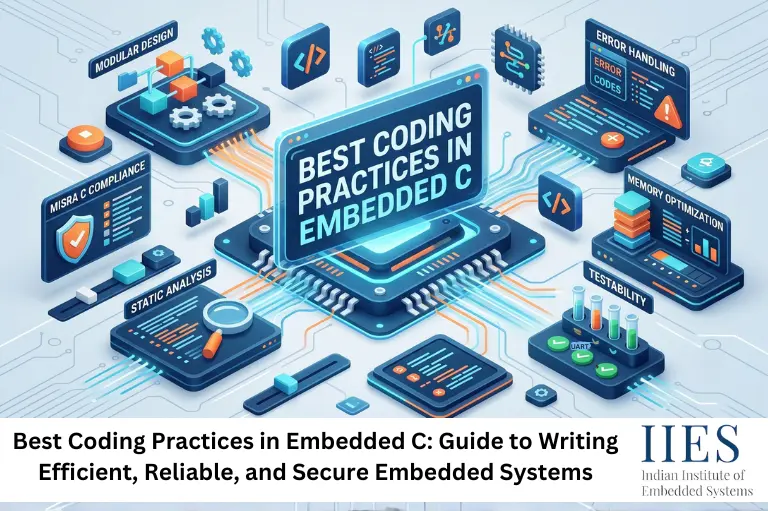
Why Best Coding Practices Matter in Embedded C Programming
Unlike desktop applications, embedded software often controls critical hardware functions. A small coding mistake can result in:
- System crashes
- Hardware failures
- Security vulnerabilities
- Excessive power consumption
- Unexpected device behavior
- Costly maintenance and debugging efforts
Following embedded c best practices helps developers:
- Improve software reliability
- Enhance code maintainability
- Reduce debugging time
- Optimize memory usage
- Improve performance
- Increase product lifespan
- Meet safety and compliance requirements
For industries such as automotive, aerospace, healthcare, and industrial automation, coding standards are not optional, they are essential.

Understanding Embedded C Programming
Embedded C is an extension of the standard C language tailored for microcontrollers and embedded processors.
Unlike general-purpose software development, embedded c programming focuses on:
- Direct hardware interaction
- Real-time execution
- Interrupt handling
- Device driver development
- Memory-efficient programming
- Power-aware system design
Common devices developed using Embedded C include:
- Washing machines
- Smart refrigerators
- Security systems
- Medical monitoring devices
- Automotive ECUs
- Industrial controllers
- IoT sensors
- Smart wearables
Best Coding Practices in Embedded C
1. Design Before Writing Code
One of the most overlooked embedded programming techniques is spending sufficient time on design.
Before implementation:
- Define system requirements
- Create software architecture diagrams
- Identify hardware interfaces
- Plan memory allocation
- Analyze timing constraints
A well-designed system significantly reduces future debugging and maintenance efforts.
Recommended Workflow
Requirements → Architecture → Module Design → Coding → Testing → Deployment
2. Use Version Control from Day One
Modern embedded development should always use version control systems such as Git.
Benefits include:
- Change tracking
- Team collaboration
- Rollback capabilities
- Branch management
- Better release control
Frequent commits make troubleshooting easier and reduce development risks.
3. Follow Consistent Coding Standards
Consistent coding style improves readability and maintainability.
Recommended Coding Conventions
Element | Recommendation |
Variable Names | lowercase_with_underscores |
Constants | UPPERCASE |
Functions | descriptive_function_names() |
Indentation | 4 spaces |
Maximum Line Length | 80-100 characters |
Comments | Explain why, not what |
Braces | Consistent formatting |
Example:
#define MAX_SPEED 100

void initialize_sensor(void)

{

    sensor_status = SENSOR_READY;

}
These conventions are among the most widely accepted embedded c coding practices used in professional development environments.
Writing Clean and Readable Embedded C Code
Code readability directly impacts project scalability.
Use Descriptive Naming
Avoid:

int x;

Prefer:

int motor_speed;
Clear names reduce confusion and improve long-term maintainability.
Keep Functions Small
Large functions become difficult to test and debug.
Good practice:
- Single responsibility per function
- Maximum 30–50 lines when possible
- Limit parameters
Instead of:
process_everything();

Use:

read_sensor();

calculate_temperature();

update_display();
Comments should explain intent.
Avoid:

i++;
Good:
// Increment packet counter after successful transmission
i++;
Efficient Memory Management Techniques in Embedded C Programming
Memory is often the most limited resource in embedded systems.
Proper memory utilization directly affects reliability and performance.
1. Segmentation
Segmentation divides memory into logical sections.
Benefits:
- Better organization
- Easier memory protection
- Improved modularity
2. Paging
Paging organizes memory into fixed-size blocks.
Advantages:
- Efficient allocation
- Reduced fragmentation
- Better memory utilization
3. Swapping
Swapping temporarily moves inactive data between memory areas.
Benefits:
- Increased memory efficiency
- Better multitasking support
- Reduced memory pressure
Additional Memory Optimization Tips
- Minimize global variables
- Reuse buffers
- Avoid unnecessary dynamic memory allocation
- Use static allocation when possible
- Reduce stack consumption
- Monitor memory leaks
These techniques are considered core embedded programming techniques for resource-constrained devices.
Debugging and Error Handling Strategies
Debugging is one of the most critical phases of embedded software development.
Effective Debugging Methods
Brute Force Debugging
Adding logs and monitoring outputs.
Backtracking
Tracing the error from failure point to source.
Deduction Technique
Using systematic elimination to identify root causes.
Testing-Based Debugging
Creating targeted test cases to isolate faults.
Error Handling Best Practices
Program Carefully
Defensive coding reduces unexpected failures.
Add Runtime Checks
Validate:
- Inputs
- Sensor data
- Communication packets
- Memory boundaries
Use Assertions
Example:
assert(sensor_value < MAX_SENSOR_LIMIT);
Implement Graceful Recovery
Instead of crashing:
- Retry operations
- Enter safe mode
- Notify users

Effective Testing and Verification Practices for Embedded C Programs
Testing ensures both software and hardware operate as intended.
Why Embedded Testing Matters
Testing helps:
- Identify software defects
- Improve product quality
- Reduce maintenance costs
- Enhance reliability
- Minimize deployment risks
Types of Embedded Testing
Unit Testing
Tests individual functions.
Integration Testing
Validates communication between modules.
Hardware-in-the-Loop Testing
Tests software using real hardware components.
System Testing
Evaluates complete product functionality.
Regression Testing
Ensures updates do not introduce new defects.
Safety and Security Considerations in Embedded C Programming
As connected devices continue to grow, cybersecurity is becoming a major requirement.
Secure Communication Protocols
Use:
Data Encryption
Protect sensitive information during storage and transmission.
Authentication Mechanisms
Verify device and user identities before granting access.
Firewall Protection
Prevent unauthorized network access.
Hardware-Based Security
Modern microcontrollers increasingly support:
- Secure boot
- Trusted execution environments
- Hardware encryption engines
These practices are especially important for IoT and industrial embedded systems.
Techniques for Power Optimization in Embedded C Programming
Power efficiency is essential for battery-operated devices.
Minimize Local Variables
Reduces stack memory usage.
Reduce Function Parameters
Improves execution efficiency.
Use Inline Functions
For small functions:
inline int add(int a, int b)
{

    return a + b;

}
Prefer Pre-Increment
Use:
++i;
Instead of:
i++;
when appropriate.
Avoid Cascaded Function Calls
Deep call chains increase execution overhead.
Leverage Hardware Accelerators
Use:
- DMA controllers
- DSP modules
- SIMD processors
for computationally intensive operations.
Profile-Guided Optimization
Measure before optimizing.
Many embedded projects waste power because developers optimize based on assumptions rather than actual profiling data.
Practical Embedded C Programming Examples
Example 1: LED Blinking Application
Skills Learned:
- GPIO configuration
- Timing control
- Microcontroller basics
Example 2: Temperature Monitoring System
Skills Learned:
- ADC interfacing
- Sensor reading
- Data processing
Example 3: Smart Home Automation Node
Skills Learned:
- Wireless communication
- Power management
- IoT integration
These projects are excellent embedded c practice problems for beginners and intermediate learners.
Common Mistakes to Avoid in Embedded C Programming
Even experienced developers occasionally make these mistakes:
Mistake | Impact |
Ignoring code reviews | Hidden bugs |
Excessive global variables | Maintenance challenges |
Poor naming conventions | Reduced readability |
Inadequate testing | Reliability issues |
Dynamic memory misuse | Memory fragmentation |
Missing security controls | Vulnerabilities |
Lack of documentation | Knowledge loss |
Avoiding these mistakes significantly improves software quality.
Future Trends in Embedded C Programming for 2026 and Beyond
The embedded industry is evolving rapidly.
Key trends include:
AI at the Edge
Microcontrollers increasingly run machine learning models locally.
Secure-by-Design Development
Security is becoming a mandatory requirement rather than an afterthought.
Real-Time IoT Applications
Growing demand for low-latency intelligent devices.
Automotive Software Expansion
Electric and autonomous vehicles continue driving embedded innovation.
Energy-Aware Computing
Power optimization will remain a critical design objective.
Developers who master modern embedded c topics will be well-positioned for future opportunities.
Benefits of Embedded C Programming
Embedded C remains one of the most widely used programming languages because it offers:
- Fast execution speed
- Hardware-level control
- High portability
- Efficient memory usage
- Lower development costs
- Strong ecosystem support
- Excellent real-time performance
Its flexibility makes it suitable for applications ranging from consumer electronics to mission-critical industrial systems.
Learning Embedded C Programming and Certification Opportunities
Professionals seeking structured learning can benefit from an embedded c programming course that combines theory with practical projects.
A quality training program should cover:
- Microcontrollers
- Embedded C fundamentals
- Device drivers
- RTOS concepts
- Communication protocols
- Debugging techniques
- Embedded testing methodologies
The Indian Institute of Embedded Systems (IIES) offers training programs designed to help students and professionals build practical embedded development skills through instructor-led learning, hands-on projects, and online classes. Learners pursuing an embedded c certification can strengthen their industry readiness and improve career opportunities in automotive, IoT, robotics, consumer electronics, and industrial automation sectors.

Conclusion
Mastering the best coding practices in embedded C goes far beyond writing functional code. Modern embedded systems demand reliability, security, efficiency, maintainability, and scalability. By following proven embedded c best practices, implementing effective testing strategies, optimizing memory and power consumption, and staying current with emerging technologies, developers can build robust systems capable of meeting real-world challenges.
Whether you are starting with an embedded c tutorial, solving embedded c practice problems, pursuing an embedded c certification, or enrolling in an embedded c programming course, developing strong coding habits today will help you build more efficient and future-ready embedded systems tomorrow.