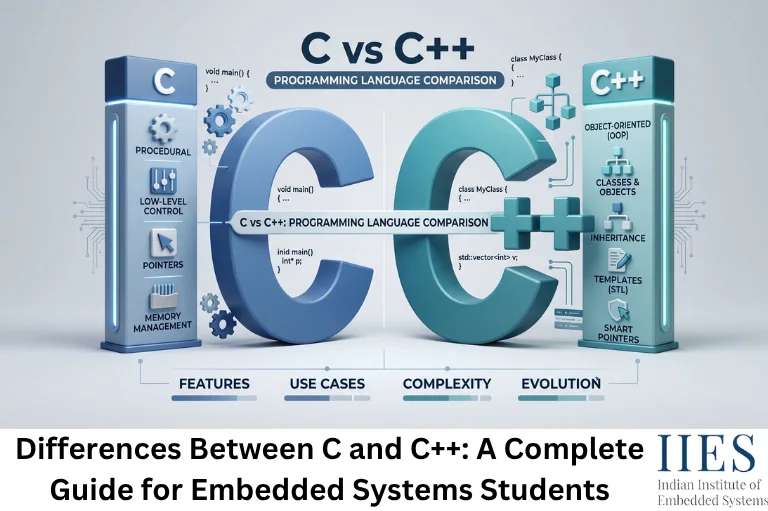
Understanding the Relationship Between C and C++
Before comparing their features, students should understand one important point:
C and C++ are separate programming languages.
They share a historical relationship and a significant amount of similar syntax, but modern C++ should not be treated as simply “C with extra features.”
For example, both languages use familiar programming concepts such as:
- Variables
- Functions
- Loops
- Conditional statements
- Arrays
- Structures
- Pointers
However, the way experienced programmers design software in C can be very different from the way they design software in C++.
A programmer can write something that looks similar in both languages while following completely different design principles.
C vs C++ Comparison Table
| Feature | C | C++ |
|---|
| Programming style | Primarily procedural | Multi-paradigm |
| Main program organization | Functions | Functions, classes, objects and templates |
| Object-oriented programming | Not built into the language | Supported |
| Classes | No | Yes |
| Inheritance | No | Yes |
| Polymorphism | Implemented manually when needed | Direct language support |
| Function overloading | No | Yes |
| Templates | No | Yes |
| Constructors and destructors | No | Yes |
| Memory allocation | malloc() and free() | new and delete, plus modern resource-management techniques |
| Standard library style | Smaller and more procedural | Larger and more feature-rich |
| Abstraction level | Usually lower | Can range from low to high |
| Typical embedded use | Firmware, drivers and low-level code | Complex embedded software and larger systems |
This table gives the basic picture, but the most important differences become clearer when we examine how programmers think in each language.
Can You Mix C and C++ in the Same Project?
Yes, and it’s extremely common — especially in embedded and systems work, where a C++ application often links against C libraries (hardware abstraction layers, vendor SDKs, or older codebases nobody wants to rewrite). The bridge is something you’ll run into constantly once you start mixing the two: extern "C". It tells the C++ compiler not to apply C++’s naming rules to a given function, so the linker can match it up the way a C compiler would.
Outside of that kind of deliberate interop, though, C and C++ programs aren’t interchangeable. They’re compiled differently, they link differently, and beyond a shared subset of basic syntax, code written idiomatically in one won’t run in the other.
Programming Approach: Procedural C vs Multi-Paradigm C++
The most common difference taught to beginners is that C is procedural while C++ supports object-oriented programming.
That is true, but it is not the complete story.
C Programming Approach
In C, programs are commonly organized around:
- Functions
- Data structures
- Explicit operations on data
For example, consider a simple LED device. In C, we might define the data separately and create functions that operate on that data.
c
typedef struct {
    int pin;
    int state;
} LED;

void led_on(LED *led)
{
    led->state = 1;
}

void led_off(LED *led)
{
    led->state = 0;
}
The data and functions are separate. The programmer explicitly passes the structure to functions. This style is straightforward and gives the programmer a clear view of what is happening.
C++ Programming Approach
In C++, we can combine data and related operations inside a class.
cpp
class LED {
private:
    int pin;
    bool state;

public:
    LED(int p) {
        pin = p;
        state = false;
    }

    void on() {
        state = true;
    }

    void off() {
        state = false;
    }
};
Here, the LED is represented as an object. The class groups together:
- Data
- Operations
- Initialization logic
This can make large software projects easier to organize. However, in embedded systems, the choice is not simply about which approach is more modern. The correct choice depends on the system requirements.
C++ Provides More Abstraction
One of the biggest differences between C and C++ is the level of abstraction available to the programmer.
C usually requires programmers to express more details explicitly. C++ provides language features that can hide or automate certain implementation details.
For example, C++ supports:
- Classes
- Encapsulation
- Constructors
- Destructors
- Templates
- Operator overloading
- Function overloading
- Standard containers
These features can help programmers manage complexity. Consider a large embedded product such as:
- Automotive control systems
- Robotics platforms
- Industrial automation equipment
- Medical devices
- Communication systems
As the number of software modules increases, organizing everything through independent structures and functions can become difficult. C++ provides additional tools to create reusable software components.
However, abstraction must be used carefully. In embedded development, a programmer should understand what the abstraction costs in terms of:
- Flash memory
- RAM
- CPU execution time
- Stack usage
- Predictability
A good embedded engineer should never use a feature simply because it is available.
Memory Management in C and C++
Memory management is another major difference.
Memory Management in C
C commonly uses functions such as:
malloc()calloc()realloc()free()
For example:
c
int *data = malloc(10 * sizeof(int));

free(data);
The programmer is responsible for allocating and releasing memory correctly. This gives direct control, but it also creates risks such as:
- Memory leaks
- Dangling pointers
- Double-free errors
- Invalid memory access
Memory Management in C++
C++ introduced new and delete. For example:
cpp
int *data = new int[10];

delete[] data;
However, modern C++ programming often focuses on resource management techniques that reduce the need for manually calling new and delete.
The important lesson for embedded systems students is this: neither C nor C++ automatically makes memory management safe. The programmer must understand memory ownership, lifetime, and system constraints.
In many small embedded systems, dynamic memory allocation may be avoided or tightly controlled because predictable memory behavior is important.
Classes and Objects
Classes are one of the most visible differences between C and C++.
C does not have built-in classes. C++ allows programmers to define classes that combine:
- Data members
- Member functions
- Access control
- Constructors
- Destructors
For example:
cpp
class Motor {
private:
    int speed;

public:
    void setSpeed(int value) {
        speed = value;
    }
};
C can achieve similar software organization using structures and functions. For example:
c
typedef struct {
    int speed;
} Motor;

void Motor_SetSpeed(Motor *motor, int value)
{
    motor->speed = value;
}
This leads to an important embedded systems lesson: C cannot directly use object-oriented syntax, but programmers can still design modular and structured systems in C.
Many successful embedded software systems use C structures and function interfaces to create clean hardware abstraction layers and device drivers.
Constructors and Destructors in C++
C++ provides constructors and destructors. A constructor can initialize an object automatically when it is created. A destructor can perform cleanup when an object’s lifetime ends.
For example:
cpp
class Sensor {
public:
    Sensor() {
        // Initialize sensor
    }

    ~Sensor() {
        // Cleanup resources
    }
};
C does not provide constructors and destructors as language features. The programmer usually creates explicit initialization functions.
c
void Sensor_Init(Sensor *sensor)
{
    // Initialize sensor
}
Both approaches can work effectively. In embedded programming, explicit initialization is sometimes preferred because engineers want initialization order and hardware operations to be completely visible.
Function Overloading
C++ supports function overloading. This means multiple functions can have the same name if their parameter lists are different.
cpp
int add(int a, int b);

float add(float a, float b);
The compiler determines which function to call based on the arguments.
C does not support function overloading. In C, programmers usually use different function names.
c
int add_int(int a, int b);

float add_float(float a, float b);
Function overloading can improve readability in some situations, but explicit naming can also make an embedded codebase easier to inspect.
Templates in C++
Templates are another major feature of C++. Templates allow programmers to write generic code.
For example:
cpp
template
T maximum(T a, T b)
{
    return (a > b) ? a : b;
}
The same template can work with multiple data types.
C does not have built-in templates. Similar behavior in C may require:
- Macros
- Void pointers
- Separate functions for different data types
Templates can provide powerful abstraction, but they can also increase code complexity. For embedded developers, templates should be used with an understanding of generated code and memory requirements.
Standard Libraries and Available Features
The C standard library is relatively small and focused. It provides functionality for:
- Input and output
- String handling
- Memory allocation
- Mathematical operations
- File operations
C++ provides a broader standard library. It includes features such as:
- Containers
- Algorithms
- Strings
- Smart pointers
- Templates
- Utility classes
For example, C++ provides containers such as std::vector, std::array, std::map, and std::queue. These can simplify application development.
However, embedded engineers must consider whether a particular library feature is appropriate for the target device. A feature that works perfectly on a desktop computer may not be suitable for a microcontroller with limited RAM, Flash, or CPU performance.
Error Handling
C commonly handles errors using:
- Return values
- Error codes
- Status variables
For example:
c
if (Sensor_Init() != 0)
{
    // Handle error
}
C++ supports additional mechanisms such as exceptions. However, exceptions may not be enabled or preferred in all embedded environments because they can affect code size and execution behavior.
For this reason, many embedded C++ projects follow restricted coding guidelines based on system requirements. The language feature itself is not automatically good or bad. The important question is: is the feature suitable for the hardware and reliability requirements of the product?
C Gives More Explicit Control
A major philosophical difference between C and C++ is how much the programmer sees directly.
C programmers frequently work explicitly with:
- Memory
- Pointers
- Data structures
- Function calls
- Bit operations
- Hardware registers
For example, embedded C code may directly manipulate a register:
This explicit style is one reason C remains highly important in embedded programming. The programmer can clearly see the operations being performed.
C++ can also perform low-level operations, but it additionally provides mechanisms for building higher-level abstractions around hardware. For example, a C++ class can represent a GPIO peripheral while internally performing register-level operations. This can create cleaner interfaces in larger projects.
Are C and C++ Programs Compatible?
This is where many beginners become confused.
C and C++ have similar syntax, but they are separate languages with different standards and rules. Therefore, you should not assume that every C program is valid C++. You should also not assume that every C++ program can be compiled as C.
C++ programs using features such as classes, templates, references, function overloading, namespaces, and inheritance cannot be directly compiled by a C compiler.
Some C code can be compiled by a C++ compiler, especially when it stays within a compatible subset. However, there are important differences in language rules, types, declarations, keywords, and other behavior.
Therefore, professional projects should clearly identify whether a source file is intended to be compiled as C or C++. Do not simply rename a .c file to .cpp and assume the program will behave correctly.
Can C and C++ Be Used Together?
Yes. C and C++ can be used together in the same larger software project. This is common when:
- A C library already exists
- Low-level drivers are written in C
- Higher-level application software is written in C++
- Legacy C code must be reused
However, interoperability must be handled correctly. One important concept used when C++ code communicates with C interfaces is extern "C". For example:
cpp
extern "C" {
    #include "driver.h"
}
This helps manage differences in how C++ and C compilers handle external function names.
When combining C and C++ in embedded projects, engineers must also carefully consider:
- Compiler compatibility
- Linkage
- Header files
- Data structures
- Build systems
Is C Better Than C++ for Embedded Systems?
There is no universal answer.
C is often an excellent choice when working with:
- Microcontroller firmware
- Device drivers
- Hardware registers
- Bootloaders
- Resource-constrained systems
- Legacy embedded platforms
C++ can be an excellent choice for:
- Large embedded software projects
- Robotics
- Automotive software
- Complex control systems
- Embedded Linux applications
- Systems requiring strong software abstraction
The correct question is not “which language is better?” A better question is: “which language and programming approach are appropriate for this hardware and software requirement?”
A small 8-bit microcontroller and a modern embedded Linux system have completely different requirements. The language choice should reflect those requirements.
C vs C++ in Embedded Systems: Practical Considerations
Let us look at this from a practical embedded engineering perspective.
When C Is Often Preferred
C is commonly preferred when:
- Memory is extremely limited.
- The system requires simple and predictable code.
- Hardware registers must be accessed directly.
- The project uses an existing C ecosystem.
- The microcontroller has limited resources.
- The software architecture is relatively small.
When C++ Can Be Useful
C++ can be useful when:
- The embedded project is large.
- Software components require reusable interfaces.
- Hardware abstraction is important.
- The system has sufficient resources.
- Multiple developers work on complex software.
- Object-oriented or generic programming improves maintainability.
Modern embedded development is not simply divided into “C for hardware and C++ for applications.” Both languages can be used close to hardware. The real difference is how the software is designed and which language features are appropriate for the target system.
If You Learn C++, Do You Automatically Know C?
No.
Learning C++ gives you knowledge that transfers to C, including:
- Variables
- Conditions
- Loops
- Functions
- Arrays
- Basic pointers
- Fundamental programming logic
However, writing good C requires learning C-specific programming practices. Similarly, a C programmer does not automatically become an effective C++ programmer simply because they understand C syntax.
For example, an experienced C programmer moving to C++ must learn concepts such as:
- RAII
- Constructors and destructors
- Templates
- Standard containers
- Object lifetime
- Modern C++ resource management
A C++ programmer moving to C must become comfortable with more explicit control over memory, resource cleanup, data organization, interfaces, and error handling.
The syntax transfers, but the programming mindset must also change.
Should Embedded Systems Students Learn C or C++ First?
For students specifically interested in microcontrollers and embedded firmware, learning C first is often a strong foundation.
C teaches important concepts such as memory layout, pointers, arrays, structures, bitwise operations, functions, and register manipulation. These concepts are extremely valuable when debugging embedded systems.
After building a strong C foundation, learning C++ becomes easier. However, students targeting modern software-heavy embedded domains should also learn modern C++ because many advanced embedded projects use it.
A practical learning path is:
Step 1: Build Strong C Fundamentals
Focus on:
- Variables and data types
- Operators
- Conditions
- Loops
- Functions
- Arrays
- Pointers
- Structures
- Dynamic memory
- Bitwise operations
Step 2: Apply C to Embedded Programming
Practice:
- GPIO programming
- Timers
- UART
- SPI
- I2C
- Interrupts
- Memory-mapped registers
Step 3: Move to C++
Then learn:
- Classes
- Objects
- Constructors
- Destructors
- References
- Templates
- Standard containers
- Resource management
Step 4: Apply C++ Carefully to Embedded Systems
Understand how language features affect:
- Memory
- Performance
- Binary size
- Deterministic behavior
This progression helps students understand both hardware-level programming and modern software design.
C vs C++: A Simple Embedded Systems Example
Imagine that you are designing firmware for a temperature sensor.
In C, you may create:
c
typedef struct {
    int temperature;
} TemperatureSensor;

void Sensor_Init(TemperatureSensor *sensor);

int Sensor_Read(TemperatureSensor *sensor);
The data and functions are separate.
In C++, you could represent the sensor as:
cpp
class TemperatureSensor {
public:
    TemperatureSensor();

    int read();
};
Neither approach is automatically superior. For a small sensor module, the C approach may be simple and direct. For a large system with multiple types of sensors, interfaces, and hardware implementations, C++ abstraction may help organize the code.
An embedded engineer must understand both the software design and the underlying hardware.
Key Differences Between C and C++
The most important differences can be summarized as follows:
- Primarily procedural.
- Smaller language feature set.
- Explicit programming style.
- Direct control over memory and hardware.
- Common in firmware and low-level embedded software.
- Uses structures and functions for program organization.
- Multi-paradigm language.
- Supports object-oriented and generic programming.
- Provides classes and objects.
- Supports templates and function overloading.
- Provides more abstraction tools.
- Can be used for both low-level and complex software systems.
Final Thoughts
The differences between C and C++ go far beyond the addition of classes.
Although the two languages share a historical relationship and some syntax, modern C and modern C++ are best understood as separate languages with different programming styles.
C encourages programmers to work explicitly with the fundamental building blocks of software. This makes it particularly valuable for understanding memory, hardware, and embedded systems.
C++ provides additional mechanisms for abstraction, code reuse, and managing large software systems. When used carefully, these features can also be extremely valuable in embedded development.