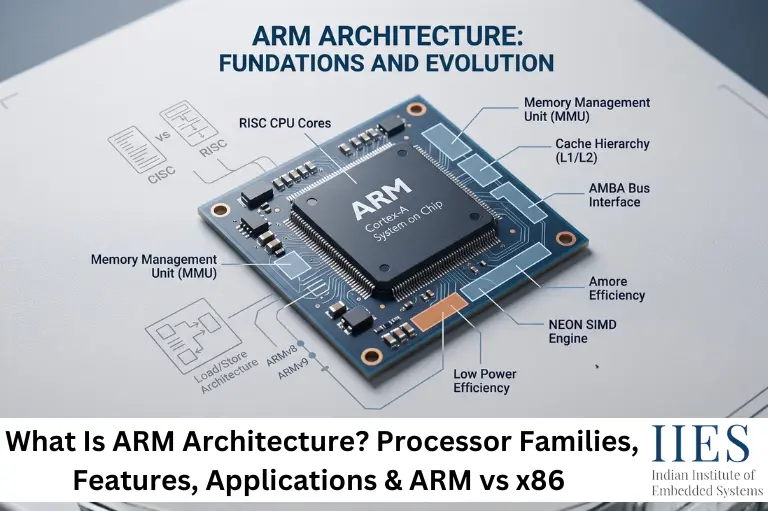
What is ARM Architecture?
ARM architecture is the design blueprint that defines how an ARM processor executes instructions, manages memory, communicates with peripherals, and performs computations.
Unlike processors designed for general-purpose desktop computing, ARM processors are optimized to deliver high performance while consuming minimal power. This makes them ideal for battery-powered and real-time embedded applications.
Today, ARM-based processors are found in:
- Smartphones
- Embedded systems
- IoT devices
- Automotive ECUs
- Medical equipment
- Consumer electronics
- Industrial controllers
- Smart home devices
- Wearables
- Networking equipment
Instead of manufacturing processors, Arm Ltd. designs processor architectures and licenses them to semiconductor companies such as STMicroelectronics, NXP, Texas Instruments, Microchip, Renesas, Nordic Semiconductor, Qualcomm, Broadcom, and many others, who build their own ARM-based chips.
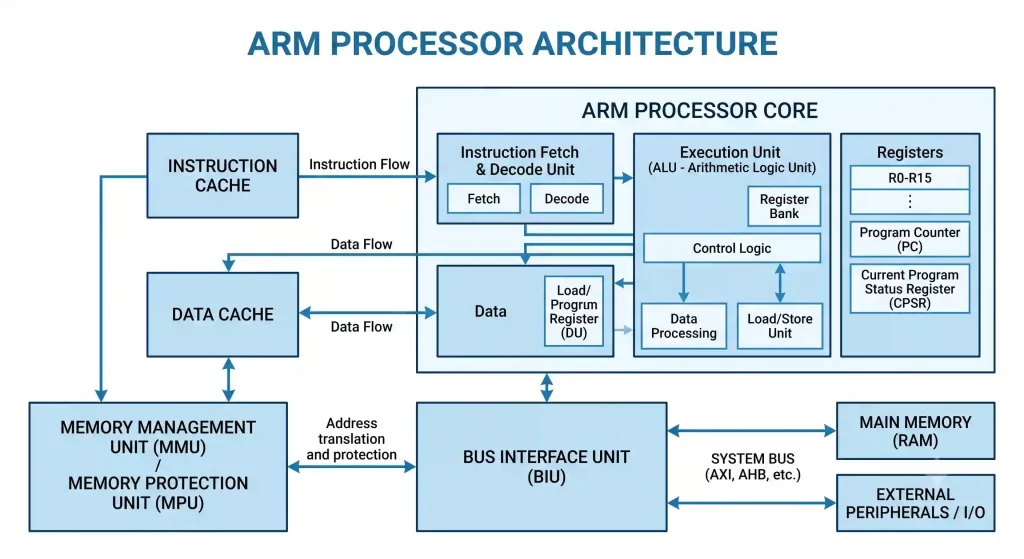
ARM Processor Architecture
ARM Processor Features
Modern ARM processors include features that improve both performance and energy efficiency.
Key Features
- 32-bit and 64-bit architectures
- Low power consumption
- High processing efficiency
- Pipelined instruction execution
- Hardware interrupt support
- Memory protection
- Multiple operating modes
- DSP extensions (selected models)
- Floating Point Unit (FPU)
- TrustZone security (supported processors)
- SIMD/NEON acceleration (Cortex-A)
- CMSIS software support
- Excellent RTOS compatibility
- Wide IDE and toolchain support

ARM Architecture Basics
Before exploring advanced ARM processors, it’s important to understand the basic concepts behind the architecture.
ARM processors are designed around a simple philosophy:
- Execute instructions quickly
- Reduce unnecessary hardware complexity
- Consume less power
- Improve code efficiency
- Deliver predictable performance
- Support real-time applications
Most modern ARM-based microcontrollers also include:
- CPU Core
- Flash Memory
- SRAM
- Interrupt Controller
- Timers
- GPIO
- UART
- SPI
- I²C
- ADC
- DMA Controller
- Clock Management Unit
These peripherals make ARM microcontrollers capable of controlling complete embedded systems without requiring additional processors.
What Does RISC Mean in ARM Architecture?
One of the defining characteristics of ARM architecture is its RISC (Reduced Instruction Set Computing) design philosophy.
Instead of using hundreds of complex instructions, RISC processors rely on a smaller set of simple instructions that can usually be executed in fewer clock cycles.
Characteristics of RISC
- Simple instruction set
- Fixed instruction formats
- Faster instruction execution
- Easier pipelining
- Lower hardware complexity
- Better power efficiency
- Improved compiler optimization
This design allows ARM processors to achieve high performance while keeping power consumption low, which is essential for embedded and battery-powered devices.
ARM Processor Architecture Explained
An ARM processor consists of several hardware components that work together to execute programs efficiently.
Component | Purpose |
CPU Core | Executes program instructions |
Registers | Store temporary data for fast access |
ALU | Performs arithmetic and logical operations |
Control Unit | Manages instruction execution |
Cache Memory | Reduces memory access time |
Bus Interface | Transfers data between components |
Interrupt Controller | Handles external and internal interrupts |
Memory System | Stores program code and runtime data |
Together, these components enable ARM processors to deliver reliable performance across a wide range of embedded applications.
ARM Processor Families
ARM offers several processor families, each designed for different performance and application requirements.
ARM Family | Best For |
Cortex-M | Microcontrollers and Embedded Systems |
Cortex-R | Real-Time Systems |
Cortex-A | Application Processors |
Neoverse | Servers and Cloud Computing |
Cortex-M Series
- Low power
- Cost-effective
- Real-time applications
- STM32, LPC, SAM, Nordic, GD32
Cortex-R Series
- Safety-critical systems
- Fast interrupt response
- Industrial automation
- Automotive controllers
- Storage devices
Cortex-A Series
- Linux-based embedded systems
- Smartphones
- Tablets
- Multimedia devices
- Single-board computers
Neoverse
- Cloud infrastructure
- Data centers
- Networking
- High-performance computing
Which ARM Architecture Is Suitable for Different Types of Embedded Systems?
There isn’t a single ARM processor that’s ideal for every application. ARM offers multiple processor families, each optimized for different performance, power, memory, and real-time requirements.
Choosing the right architecture depends on factors such as processing speed, power consumption, operating system support, peripheral requirements, and application complexity.
Recommended ARM Architecture by Application
Application | Recommended ARM Architecture | Why It’s Suitable |
Learning Embedded Systems | Cortex-M0 / M0+ | Simple, affordable, and beginner-friendly |
Consumer Electronics | Cortex-M3 / M4 | Good performance with low power consumption |
IoT Devices | Cortex-M4 / M33 | Efficient processing, low power, strong security |
Industrial Automation | Cortex-M7 / Cortex-R | High reliability and fast real-time response |
Automotive ECUs | Cortex-R | Functional safety and deterministic performance |
Medical Devices | Cortex-M33 / Cortex-R | Secure and reliable operation |
Robotics | Cortex-M7 | High-speed control and real-time processing |
Smart Home Devices | Cortex-M4 | Balanced performance and energy efficiency |
Wearable Devices | Cortex-M0+ / M23 | Ultra-low power consumption |
Linux Embedded Systems | Cortex-A5 / A7 / A53 / A55 | Supports Linux and multimedia applications |
Smartphones | Cortex-A Series | High-performance application processing |
Edge Devices | Cortex-A + AI Accelerator | Handles machine learning workloads efficiently |
Practical Tip: If you’re starting with embedded systems, a Cortex-M4-based STM32 development board offers an excellent balance of performance, learning resources, and industry relevance.
ARM Architecture in Embedded Systems
ARM processors have become the preferred choice for embedded systems because they combine high performance with excellent power efficiency. Their scalable architecture allows manufacturers to use ARM cores in everything from small battery-powered sensors to complex industrial controllers.
Today, ARM-based microcontrollers are widely used in:
- Industrial automation
- Automotive electronics
- Consumer products
- Medical equipment
- Smart appliances
- Drones
- Robotics
- Security systems
- Communication devices
- Smart energy meters
Many popular microcontroller families are built on ARM Cortex-M cores, including STM32, NXP LPC, SAM, TM4C, and Nordic nRF series.
ARM Architecture in IoT
IoT devices often operate on batteries and remain active for months or even years. ARM architecture is well suited for these applications because it delivers efficient processing while minimizing power consumption.
Why ARM is Ideal for IoT
- Low energy consumption
- Fast wake-up from sleep modes
- Integrated security features
- Efficient sensor data processing
- Reliable wireless communication support
- Real-time control capabilities
- Long battery life
Common IoT Applications
- Smart home devices
- Smart lighting
- Fitness trackers
- Environmental monitoring
- Smart agriculture
- Asset tracking
- Industrial IoT sensors
- Healthcare monitoring systems
Why ARM Matters in Industrial Computing
Industrial systems demand processors that can operate reliably for long periods while responding quickly to real-time events. ARM processors meet these requirements through efficient processing, predictable performance, and support for real-time operating systems.
Key Benefits in Industrial Applications
- Reliable real-time performance
- Low heat generation
- High energy efficiency
- Long-term hardware availability
- Wide industrial software support
- Compatibility with FreeRTOS and Embedded Linux
- Easy integration with industrial communication protocols
Industrial Applications
- PLCs
- CNC machines
- Factory automation
- Motor control
- Industrial gateways
- Human Machine Interfaces (HMIs)
- Predictive maintenance systems
How Snapdragon Works with ARM Architecture
Many people assume Snapdragon is an ARM processor, but they are not the same.
ARM develops and licenses the processor architecture, while Qualcomm designs Snapdragon system-on-chips (SoCs) using ARM-compatible CPU cores along with additional hardware such as GPUs, AI engines, modems, image processors, and security modules.
A Snapdragon chip typically includes:
- ARM-based CPU cores
- Graphics Processing Unit (GPU)
- AI Engine (NPU)
- Image Signal Processor (ISP)
- 5G Modem
- Memory Controller
- Security Processor
- Multimedia Engine
This integration allows Snapdragon processors to power smartphones, tablets, automotive infotainment systems, and edge AI devices with high performance and efficient power usage.

ARM vs x86: What’s the Difference?
Both ARM and x86 are widely used processor architectures, but they are designed with different goals in mind.
Feature | ARM | x86 |
Instruction Set | RISC | CISC |
Power Consumption | Very Low | Higher |
Heat Generation | Low | Higher |
Battery Efficiency | Excellent | Moderate |
Performance per Watt | Excellent | Good |
Embedded Systems | Excellent | Limited |
Smartphones | Dominant | Rare |
Desktop Computers | Growing | Dominant |
Servers | Increasing Adoption | Widely Used |
Real-Time Applications | Excellent | Depends on Platform |
Choose ARM When
- Building embedded systems
- Designing battery-powered products
- Developing IoT devices
- Creating wearable electronics
- Working with microcontrollers
- Optimizing for energy efficiency
Choose x86 When
- Running desktop software
- High-end gaming
- Workstations
- Legacy enterprise applications
- Software requiring x86 compatibility
What Makes ARM Architecture Different from x86?
Although both execute software instructions, their design philosophies are different.
ARM Focuses On
- Energy efficiency
- Simpler instruction set
- High performance per watt
- Compact embedded devices
- Mobile computing
- Real-time processing
x86 Focuses On
- Maximum raw performance
- Complex instruction execution
- Broad desktop software compatibility
- High-end computing workloads
As ARM processors continue to improve, they are expanding beyond embedded systems into laptops, servers, and AI-enabled computing platforms, making them increasingly competitive with traditional x86 processors.
Pros and Cons of ARM Processors
Choosing the right processor architecture involves understanding both its strengths and limitations. ARM processors excel in embedded and low-power applications, but they may not always be the best choice for every workload.
Pros | Cons |
Low power consumption | Some desktop software is optimized for x86 |
High performance per watt | Learning curve for beginners |
Excellent real-time performance | Advanced Cortex-A development is more complex |
Wide ecosystem and vendor support | Feature set varies between ARM cores |
Scalable from simple MCUs to powerful processors | High-performance ARM processors can be expensive |
Strong security features | Vendor-specific SDKs may differ |
Large developer community | Architecture versions require careful selection |
Real-World Applications of ARM Architecture
ARM processors are used in a wide range of industries because they combine efficiency, reliability, and scalability.
Consumer Electronics
- Smartphones
- Smart TVs
- Smart speakers
- Digital cameras
- Gaming handhelds
Automotive
- Engine Control Units (ECUs)
- Advanced Driver Assistance Systems (ADAS)
- Infotainment systems
- Digital instrument clusters
- Battery Management Systems (BMS)
Industrial Automation
- Programmable Logic Controllers (PLCs)
- Human Machine Interfaces (HMIs)
- Industrial gateways
- Robotic controllers
- Machine monitoring systems
Medical Devices
- Patient monitoring systems
- Portable diagnostic equipment
- Infusion pumps
- Wearable health devices
- Imaging equipment
IoT and Smart Home
- Smart locks
- Smart thermostats
- Security cameras
- Smart lighting
- Environmental sensors
Robotics
- Autonomous robots
- Drone flight controllers
- Industrial robotic arms
- Mobile robots
- Vision-based robotic systems
How to Learn ARM Architecture
Learning ARM architecture becomes much easier when you combine theory with practical development.
Step 1: Learn C Programming
Understand:
- Variables
- Functions
- Pointers
- Structures
- Bitwise operations
- Memory management
Step 2: Understand Embedded Systems Basics
Focus on:
- Microcontrollers
- GPIO
- Timers
- Interrupts
- UART
- SPI
- I²C
- ADC
- PWM
Step 3: Learn ARM Cortex-M Architecture
Study topics such as:
- Registers
- Memory map
- Exception model
- NVIC
- Stack
- Startup code
- Boot process
Step 4: Start with an ARM Development Board
Popular beginner-friendly boards include:
- STM32 Nucleo
- STM32 Discovery
- NXP FRDM Boards
- TI LaunchPad
- Raspberry Pi Pico (RP2040)
Step 5: Learn Embedded Development Tools
Common tools include:
- STM32CubeIDE
- Keil MDK
- IAR Embedded Workbench
- VS Code
- SEGGER J-Link
- OpenOCD
- GDB Debugger
Step 6: Build Real Projects
Practice by developing:
- LED blinking
- UART communication
- Sensor interfacing
- LCD display
- Motor control
- FreeRTOS tasks
- IoT applications
- Data logging systems
Building projects helps reinforce concepts and prepares you for real-world embedded development.
Where to Learn ARM Architecture in Bangalore
If you’re looking to learn ARM architecture through practical, hands-on training, the Indian Institute of Embedded Systems (IIES), Bangalore offers industry-focused courses covering ARM Cortex processors, Embedded C, STM32, RTOS, and embedded systems development. The training emphasizes real-world projects, hardware interfacing, and firmware development, making it suitable for students, fresh graduates, and working professionals aiming for careers in embedded systems.
Best Practices When Working with ARM Processors
- Read the processor reference manual before coding.
- Understand the memory map of the microcontroller.
- Use CMSIS libraries for portability.
- Keep interrupt service routines (ISRs) short.
- Use hardware timers instead of software delays where possible.
- Enable compiler warnings during development.
- Organize code into reusable modules.
- Test on actual hardware, not just in simulation.
- Follow coding standards such as MISRA C for safety-critical projects.

Conclusion
ARM architecture has become the foundation of modern embedded systems because it combines high performance, low power consumption, and excellent scalability. From simple microcontrollers used in smart sensors to powerful processors running Linux and Android, ARM continues to power billions of devices across industries.
For beginners, understanding what is ARM architecture provides a solid foundation for learning embedded systems, microcontrollers, RTOS, and firmware development. As you gain experience, exploring ARM Cortex-M, Cortex-R, and Cortex-A processors will help you build more advanced embedded applications.
Whether your goal is to design IoT devices, develop automotive software, build industrial automation systems, or prepare for embedded systems interviews, learning ARM architecture is a valuable step toward a successful career.