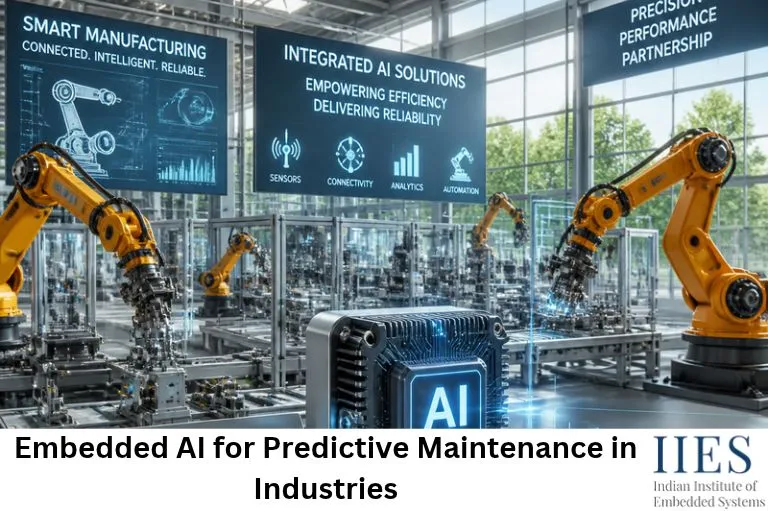
What Is Embedded AI in Industrial Automation?
Embedded AI refers to the integration of artificial intelligence and machine learning algorithms into embedded hardware devices. These devices collect information from their surroundings, process the data and make decisions without requiring continuous communication with an external computer or cloud server.
In industrial automation, embedded AI helps machines understand their operating conditions by analysing information collected through different sensors.
For example, consider an industrial electric motor operating continuously in a manufacturing plant. A vibration sensor can measure the motor’s vibration levels, while a temperature sensor monitors its operating temperature.
An embedded AI system processes this information and learns the normal operating behaviour of the motor. When unusual vibration patterns or abnormal temperature changes occur, the system can identify a possible fault and generate an alert.
Embedded AI in industrial automation can support:
- Real-time machine condition monitoring.
- Automatic detection of abnormal operating conditions.
- Motor and bearing fault diagnosis.
- Temperature and vibration analysis.
- Predictive maintenance using AI.
- Intelligent industrial equipment monitoring.
The major advantage is that intelligence is available directly at the device level, allowing faster responses without depending entirely on cloud infrastructure.
Why Do Industrial Machines Need Predictive Maintenance?
Industrial equipment experiences continuous mechanical and electrical stress. Over time, components may wear out, become misaligned or operate outside their recommended limits.
Some common industrial machine problems include:
- Bearing wear and mechanical damage.
- Excessive motor vibration.
- Electrical overload.
- Motor winding overheating.
- Shaft misalignment.
- Lubrication problems.
- Abnormal pressure and temperature changes.
Traditional preventive maintenance follows fixed schedules. For example, a factory may inspect its motors every three months, regardless of their actual condition.
However, a machine may develop a fault before the next scheduled inspection. Similarly, replacing components that are still functioning properly can increase maintenance expenses.
Predictive maintenance using AI addresses these limitations by monitoring actual equipment conditions rather than depending only on fixed maintenance intervals.
An AI-based system analyses sensor readings over time and identifies patterns that may indicate developing equipment problems.
For example:
| Machine Condition | Possible Indication |
| Increasing vibration | Bearing damage or misalignment |
| Abnormal temperature rise | Overheating or excessive load |
| Unusual motor current | Electrical or mechanical fault |
| Irregular operating frequency | Changes in machine performance |
| Increasing acoustic noise | Mechanical wear or loose components |
By identifying these changes early, maintenance teams can investigate equipment before a complete breakdown occurs.
How Embedded AI Detects Industrial Machine Failures
An embedded AI-based equipment failure detection system generally follows a sequence of data collection, processing, analysis and decision-making.
Collecting Data Using Sensors
Sensors are the foundation of machine condition monitoring. They continuously collect information about the physical and electrical behaviour of industrial equipment.
Commonly used sensors include:
- Vibration Sensors: Accelerometers measure vibration levels in rotating machinery. They help identify bearing defects, shaft misalignment, imbalance and mechanical looseness.
- Temperature Sensors: Temperature sensors monitor the heat generated by motors, bearings and other machine components. Unusual temperature increases may indicate friction, overload or cooling problems.
- Current Sensors: These sensors measure the electrical current consumed by motors. Changes in current patterns can help identify overload conditions, winding problems and mechanical stress.
- Pressure Sensors: Used in pumps, compressors and hydraulic systems to identify abnormal pressure variations.
- Acoustic Sensors: Microphones and acoustic sensors capture machine sounds that can help identify unusual operating conditions.
Combining multiple sensor inputs improves the ability of an industrial monitoring system to identify different types of faults.
Processing Sensor Data Through an Embedded System
Once sensor readings are collected, they are transferred to an embedded controller for processing.
Microcontrollers such as ESP32 and STM32 are commonly used in embedded monitoring projects because they support sensor interfacing, data acquisition and real-time processing.
The controller performs operations such as:
- Reading analogue and digital sensor values.
- Filtering unwanted noise.
- Converting raw sensor signals into meaningful measurements.
- Calculating important features.
- Preparing sensor data for machine learning models.
For example, an accelerometer connected to an STM32 microcontroller may continuously collect vibration samples from an industrial motor.
Instead of sending every raw measurement to a cloud server, the embedded system can process the collected data locally.
Analysing Data Using Machine Learning
This is where embedded AI becomes important.
A machine learning model analyses sensor data and identifies patterns associated with normal and abnormal equipment behaviour.
Depending on the application, different machine learning techniques can be used:
- Anomaly Detection: Identifies unusual behaviour that differs from the normal operating pattern of a machine.
- Classification Models: Categorise equipment conditions into predefined classes such as normal operation, bearing fault, overheating or excessive vibration.
- Regression Models: Estimate continuous values such as temperature trends or remaining useful life when sufficient training data is available.
- Time-Series Analysis: Examines changes in sensor measurements over time to identify developing faults.
For example, an AI-based vibration analysis model can examine vibration measurements from a motor and identify patterns that may indicate bearing damage.
The model does not simply compare one sensor reading against a fixed threshold. It can learn more complex relationships between sensor measurements and operating conditions.
Detecting Abnormal Machine Behaviour
After analysing the sensor readings, the embedded AI model generates an output representing the machine’s condition.
A simple system may classify machine conditions as:
| AI Model Output | Machine Condition | Action |
| Normal | Healthy operating condition | Continue monitoring |
| Warning | Unusual vibration detected | Schedule inspection |
| Abnormal | Possible bearing fault | Notify maintenance team |
| Critical | Severe operating abnormality | Trigger safety response |
The actual response depends on the machine, model accuracy and industrial safety requirements.
This process enables real-time fault detection using Edge AI, allowing the system to identify potential equipment problems close to where the data is generated.
Generating Alerts and Maintenance Notifications
When the system detects an abnormal condition, it can communicate the result through different interfaces.
Possible notification methods include:
- LED indicators and buzzer alarms.
- LCD or OLED display messages.
- Industrial control system integration.
- Wi-Fi or Ethernet communication.
- MQTT-based IoT dashboards.
- Cloud-based maintenance platforms.
For example, an ESP32-based monitoring device can send a fault notification to an industrial dashboard when abnormal vibration patterns are detected.
The maintenance team can then inspect the machine and take appropriate action.

Real-World Applications of AI-Based Equipment Failure Detection
Embedded AI can be applied to different industrial machines and equipment.
Electric Motor Failure Detection
Electric motors are widely used in manufacturing plants, conveyor systems, pumps and industrial machinery.
Common motor problems include excessive vibration, overheating, electrical imbalance and bearing damage.
An embedded AI system can collect motor vibration, temperature and current readings to identify unusual operating patterns.
By analysing these sensor inputs, the system can detect possible motor faults and notify maintenance personnel.
Bearing Failure Detection
Bearings support rotating shafts and reduce friction between moving components. Bearing damage can affect machine performance and eventually cause equipment breakdown.
Vibration sensors are particularly useful for identifying bearing-related problems.
An AI-based vibration analysis model can examine frequency patterns and detect abnormal signals associated with bearing wear or defects.
This makes bearing failure detection an important application of embedded AI in industrial maintenance.
Industrial Pump Monitoring
Industrial pumps are used in water treatment plants, chemical processing facilities, oil and gas industries and manufacturing units.
Pump failures may occur because of cavitation, overheating, abnormal pressure, leakage or mechanical wear.
Embedded AI systems can monitor pressure, temperature, vibration and motor current to identify unusual operating conditions.
The collected information helps maintenance teams investigate problems before they significantly affect pump performance.
Conveyor System Monitoring
Conveyor belts are essential in automotive manufacturing, packaging industries and material-handling facilities.
Common problems include motor overload, belt misalignment, roller damage and abnormal vibration.
By combining proximity, vibration and current sensors with embedded AI, conveyor monitoring systems can identify abnormal behaviour and support timely maintenance.
Industrial Compressor Monitoring
Air compressors operate in manufacturing plants, automotive workshops and industrial production environments.
Changes in pressure, temperature, vibration and current consumption may indicate mechanical or operational problems.
AI-powered machine monitoring can analyse these measurements and identify unusual compressor behaviour.
Technologies Used in Embedded AI for Predictive Maintenance
Developing an intelligent industrial monitoring system requires a combination of hardware, software, sensors and machine learning technologies.
| Technology | Role in Predictive Maintenance |
| ESP32 | Sensor interfacing, data collection and edge processing |
| STM32 | Real-time embedded processing and control |
| Accelerometer | Vibration measurement |
| Temperature Sensor | Monitoring equipment temperature |
| Current Sensor | Measuring electrical current |
| TinyML | Running lightweight ML models on embedded devices |
| TensorFlow Lite for Microcontrollers | Deploying machine learning models on microcontrollers |
| Python | Sensor data analysis and model development |
| MQTT | Transmitting monitoring information |
| Industrial IoT | Connecting machines and monitoring platforms |
Role of ESP32 in Industrial Monitoring
ESP32 is a popular microcontroller platform for IoT and embedded monitoring projects.
It provides processing capabilities, GPIO interfaces and built-in wireless connectivity in many variants.
An ESP32-based condition monitoring project can collect sensor readings, process data and communicate equipment status through Wi-Fi.
For example, an ESP32 can interface with an accelerometer and temperature sensor to monitor an electric motor.
When combined with a lightweight machine learning model, it can identify selected abnormal operating patterns locally.
Role of STM32 in Industrial Applications
STM32 microcontrollers are based on ARM Cortex-M processor architectures and are widely used in embedded control and real-time applications.
Their processing capabilities and peripheral interfaces make them suitable for sensor acquisition, signal processing and embedded machine learning.
An STM32-based system can collect vibration signals, perform signal-processing operations and execute a trained machine learning model to classify equipment conditions.
Role of TinyML in Predictive Maintenance
TinyML refers to deploying machine learning models on resource-constrained embedded devices.
Traditional machine learning applications may require powerful computers or cloud infrastructure. However, TinyML makes it possible to execute selected lightweight models directly on microcontrollers.
In predictive maintenance, TinyML can help identify abnormal vibration patterns, classify machine operating conditions and detect unusual sensor behaviour.
This reduces dependence on continuous cloud communication and supports faster local decision-making.

How an Embedded AI Predictive Maintenance Project Works
Consider a practical project: AI-Based Industrial Motor Fault Detection Using ESP32 and Vibration Sensors.
The objective is to monitor an electric motor and identify abnormal vibration patterns using an embedded machine learning model.
Hardware Components
- ESP32 development board.
- MPU6050 or another suitable accelerometer.
- Temperature sensor.
- Electric motor.
- OLED display.
- Buzzer or LED indicator.
- Power supply.
Software and Development Tools
- Embedded C or C++.
- Arduino IDE or ESP-IDF.
- Python for dataset preparation.
- TensorFlow or another suitable machine learning framework.
- TensorFlow Lite for Microcontrollers, where supported.
Project Development Process
- Sensor Integration: Connect the vibration sensor to the ESP32 and configure the required communication interface.
- Data Collection: Collect vibration measurements from the motor under different operating conditions.
- Dataset Preparation: Record and label samples representing normal and selected abnormal conditions.
- Model Training: Use Python and machine learning libraries to train a classification or anomaly detection model.
- Model Conversion: Convert and optimise the trained model for the target microcontroller.
- Embedded Deployment: Integrate the model into the ESP32 firmware.
- Real-Time Prediction: Collect new sensor readings and pass the processed data to the deployed model.
- Fault Notification: Display the predicted machine condition and activate an alert when an abnormal condition is identified.
Expected Project Output
| Operating Condition | System Response |
| Normal motor operation | Healthy status |
| Increased vibration | Warning notification |
| Abnormal vibration pattern | Possible fault detected |
| High temperature | Temperature alert |
This project demonstrates how embedded systems, sensor interfacing, Embedded C programming and machine learning can work together to solve an industrial problem.
It also provides practical experience in hardware integration, data processing and AI model deployment.
Embedded AI vs Traditional Predictive Maintenance
Both approaches aim to reduce unexpected equipment failures, but their working methods can differ.
| Parameter | Traditional Monitoring | Embedded AI Monitoring |
| Data analysis | Manual inspection or fixed thresholds | Machine learning-based analysis |
| Fault identification | Depends on predefined conditions and inspection | Learns patterns from sensor data |
| Processing | External monitoring equipment or manual analysis | Can run directly on embedded hardware |
| Response | May involve delayed inspection | Supports real-time alerts |
| Adaptability | Limited by configured rules | Can support updated trained models |
| Cloud dependency | Depends on implementation | Local inference can operate without continuous cloud access |
Embedded AI does not completely replace traditional industrial monitoring. Instead, it adds intelligent data analysis capabilities that can improve equipment condition monitoring.
Benefits of Embedded AI in Industrial Equipment Monitoring
Early Fault Detection
Embedded AI can identify unusual operating patterns before they develop into serious equipment problems.
Reduced Downtime
Early identification of potential failures allows maintenance teams to plan inspections and repairs more effectively.
Real-Time Processing
Edge AI enables sensor data to be analysed locally, reducing the need to send every measurement to a remote server.
Improved Maintenance Planning
Predictive maintenance helps organisations prioritise equipment inspections based on actual operating conditions.
Reduced Communication Requirements
Local processing can reduce the amount of raw sensor data transmitted to cloud platforms.
Better Equipment Visibility
Continuous monitoring provides useful information about the operating condition of industrial machines.
Challenges in Implementing Embedded AI for Predictive Maintenance
Despite its benefits, deploying embedded AI in industrial environments involves several technical challenges.
- Limited Hardware Resources: Microcontrollers have limited memory, processing capacity and storage. Machine learning models must be optimised to operate within these constraints.
- Sensor Noise: Industrial environments often contain electrical interference, mechanical noise and fluctuating operating conditions. Proper filtering and signal processing are essential.
- Quality of Training Data: AI models require representative datasets covering normal and faulty operating conditions. Insufficient or incorrectly labelled data can reduce prediction accuracy.
- Changing Operating Conditions: Machine behaviour may vary depending on load, speed, temperature and environmental conditions. Models must account for these variations.
- Model Deployment: Converting and deploying trained models on microcontrollers requires knowledge of model optimisation, memory management and embedded software development.
- Industrial Safety: AI predictions should not replace safety-rated protection systems. Critical machine shutdown functions must follow appropriate industrial safety requirements.
Understanding these challenges is important when developing reliable embedded AI applications for real-world industrial environments.
Future of Embedded AI in Smart Manufacturing
The combination of embedded AI, Industrial IoT and edge computing is creating new possibilities for smart manufacturing.
Industrial machines are increasingly equipped with sensors and connected monitoring systems that provide continuous information about their operating conditions.
Some important developments include:
- TinyML-Based Monitoring: Lightweight machine learning models will enable more intelligent processing directly on low-power embedded devices.
- Advanced Fault Diagnosis: AI systems will increasingly analyse multiple sensor inputs to identify different equipment faults.
- Digital Twins: Real-time machine data can support digital representations of industrial equipment for performance analysis and simulation.
- Connected Industrial Systems: Edge devices can communicate with industrial IoT platforms to provide centralised equipment monitoring.
- Energy-Efficient AI: Optimised machine learning models can support intelligent monitoring with lower processing and power requirements.
As these technologies develop, embedded AI will become an important part of intelligent industrial automation and predictive maintenance.
Conclusion
Embedded AI is changing how industries monitor and maintain their equipment. By combining sensors, embedded controllers and machine learning algorithms, industrial systems can identify abnormal machine behaviour and support early fault detection.
From motor and bearing monitoring to pump and compressor fault diagnosis, Embedded AI for Predictive Maintenance offers practical solutions for improving equipment reliability and reducing unexpected downtime.
For engineering students and aspiring embedded developers, this technology also provides an excellent opportunity to work on practical projects involving Embedded C, ESP32, STM32, sensor interfacing, signal processing and TinyML.
Learning how to integrate hardware and intelligent algorithms is an important step towards developing real-world solutions for the growing industrial automation sector.
C and C++ are commonly used for embedded firmware development, while Python is widely used for dataset preparation, machine learning model training and testing.