What Are Embedded Systems?
An embedded system is a dedicated computing system integrated into a larger device to perform a specific task. Unlike general-purpose computers, which can run multiple applications, embedded systems are designed around a defined set of functions.
These systems typically combine hardware and software to receive input, process information, and produce an output.
For example, an automatic washing machine uses an embedded system to control water levels, motor speed, washing time, and temperature. A microcontroller receives information from sensors and executes programmed instructions to manage the washing process.
How Do Embedded Systems Work?
An embedded system generally follows a simple input-processing-output cycle:
- Input: Sensors, switches, or user interfaces provide information to the system.
- Processing: A microcontroller or microprocessor processes the input according to the programmed logic.
- Output: The system controls motors, displays, relays, actuators, or other electronic components.
- Feedback: Some embedded systems continuously monitor sensor information and adjust their outputs.
For example, in an automatic temperature control system, a temperature sensor measures the surrounding temperature. The microcontroller compares the measured value with the programmed setting and switches a fan or heating element accordingly.
Main Components of Embedded Systems
| Component | Function |
| Microcontroller or Microprocessor | Executes instructions and controls system operations; common examples include 8051, AVR, PIC, ARM Cortex-M, and STM32 |
| Sensors | Collect information from the physical environment, such as temperature, pressure, ultrasonic, accelerometer, and proximity sensors |
| Actuators | Convert electrical control signals into physical actions using motors, solenoids, relays, and valves |
| Memory | Stores program instructions, temporary data, and configurations using Flash, SRAM, and EEPROM |
| Embedded Software | Controls the hardware and defines how the system responds to inputs; commonly developed in Embedded C, C++, and assembly |
| Communication Interfaces | Let devices exchange information using UART, SPI, I2C, CAN, and Ethernet |
Applications of Embedded Systems
Embedded systems are used across several industries:
- Automotive electronics: Engine control units, airbag controllers, electronic power steering, and ABS.
- Consumer electronics: Washing machines, microwave ovens, smart televisions, and digital cameras.
- Healthcare: Patient monitoring equipment, digital thermometers, and portable diagnostic devices.
- Industrial automation: Motor controllers, programmable control equipment, and monitoring devices.
- Robotics: Motor control, sensor integration, and robotic movement control.
What Are Cyber-Physical Systems?
Cyber-Physical Systems (CPS) are integrated systems that connect physical processes with computational and communication technologies.
They use sensors to collect information from the physical environment, computing systems to analyse that information, communication networks to exchange data, and actuators to influence physical processes. Unlike a standalone embedded system, a Cyber-Physical System can involve multiple connected devices working together to monitor and control a larger environment.
For example, consider a smart manufacturing facility. Machines collect operational data through sensors, embedded controllers process equipment information, and networked systems exchange data with a central monitoring platform. The system can identify abnormal operating conditions and initiate appropriate control actions.
This integration allows industries to improve productivity, equipment monitoring, operational efficiency, and predictive maintenance.
How Do Cyber-Physical Systems Work?
A Cyber-Physical System connects the physical and digital environments through continuous data exchange.
Its working process generally involves the following stages:
Physical Data Collection
Sensors collect information such as temperature, vibration, pressure, speed, and position.
Data Processing
Embedded controllers and computing platforms process the collected information.
Communication
Network technologies transfer information between devices, controllers, and monitoring platforms.
Decision-Making
Software analyses the information and determines the appropriate response.
Physical Control
Actuators execute commands to change or regulate the physical process.
Continuous Feedback
Sensors measure the updated physical conditions and provide feedback for further control.
For example, in an industrial temperature monitoring system, sensors measure the temperature of machines. The controller processes the readings and communicates them to a monitoring platform. If the temperature exceeds a defined limit, the system can activate a cooling mechanism or generate an alert.

Main Components of Cyber-Physical Systems
| Component | Function |
| Physical Components | Machines, motors, vehicles, and industrial equipment being monitored or controlled |
| Embedded Computing Systems | Microcontrollers and embedded controllers process sensor information and execute control instructions |
| Sensors and Actuators | Sensors collect physical information; actuators perform actions based on control commands |
| Communication Networks | Connect devices and computing platforms using Ethernet, Wi-Fi, CAN, and industrial protocols |
| Software and Control Algorithms | Analyse incoming information, coordinate operations, and manage control decisions |
| Monitoring and Data Platforms | Show system performance, equipment status, and operating conditions; may support analytics and predictive maintenance |
Embedded Systems vs Cyber-Physical Systems: Key Differences
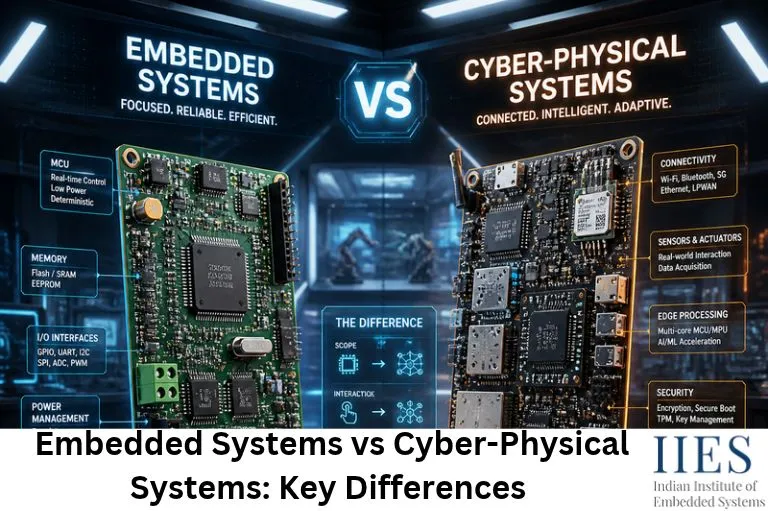
Although embedded systems and Cyber-Physical Systems share several technologies, their objectives and system-level capabilities are different. An embedded system generally focuses on performing a specific function within a device. A Cyber-Physical System integrates computing, communication, and physical processes to manage a broader operation.
| Comparison Factor | Embedded Systems | Cyber-Physical Systems |
| Definition | Dedicated computing systems designed for specific tasks | Integrated systems connecting computation, communication, and physical processes |
| Main Purpose | Perform predefined functions | Monitor and control interconnected physical processes |
| Architecture | Hardware and embedded software | Physical components, computing, communication, and control |
| Connectivity | May operate independently or communicate with other devices | Communication and coordination are central to the system |
| Processing | Usually processes information locally | Can combine local and distributed processing |
| Control | Controls specific hardware or device functions | Coordinates physical processes across connected components |
| Communication | Uses interfaces such as UART, SPI, I2C, and CAN | Uses networking and communication technologies to connect multiple components |
| Complexity | Generally limited to a specific device or function | Often involves multiple interconnected subsystems |
| Real-Time Requirements | Common in time-sensitive applications | Important for coordinating physical processes and system responses |
| Security | Focuses on protecting device firmware, hardware, and data | Must also consider network communication and interconnected components |
| Examples | Washing machine controller, digital thermometer, motor controller | Smart grid, autonomous vehicle systems, smart manufacturing |
Difference in System Architecture
Embedded systems generally use a microcontroller or microprocessor to execute a specific application. Their architecture includes processing units, memory, input/output interfaces, sensors, and actuators. Cyber-Physical Systems use a broader architecture that combines embedded computing, physical equipment, communication networks, and control software.
For example, a motor controller can operate as an embedded system by receiving speed commands and controlling motor rotation. However, when multiple motor controllers, sensors, industrial machines, and monitoring platforms communicate to coordinate an entire manufacturing process, they can become part of a Cyber-Physical System.
Difference in Communication and Connectivity
An embedded system can operate without an external network. For example, a basic electronic temperature controller can measure temperature and switch a fan without connecting to the internet.
Cyber-Physical Systems generally depend on communication between different components. Devices exchange information to coordinate operations, monitor physical processes, and support system-level decisions, using technologies such as Ethernet, Wi-Fi, CAN, and industrial networks.
Difference in Processing and Decision-Making
Traditional embedded systems typically execute predefined instructions based on sensor inputs and programmed conditions. For example, a basic motor controller can increase or decrease motor speed according to a predefined input.
Cyber-Physical Systems can combine information from multiple devices and use more advanced control algorithms to manage complex physical operations. For example, a smart manufacturing system can analyse machine vibration, temperature, production speed, and equipment status to identify abnormal operating conditions.
Difference in Applications
Embedded systems are commonly found inside individual products and electronic devices, while Cyber-Physical Systems are used in larger interconnected environments. An embedded controller may manage a single vehicle function, such as braking or engine control. A Cyber-Physical System may coordinate multiple vehicle subsystems, sensors, communication interfaces, and control mechanisms to support advanced vehicle functions.

Real-World Examples of Embedded Systems and Cyber-Physical Systems
Understanding practical examples makes the differences easier to understand.
Automotive Embedded Systems
Modern vehicles contain multiple automotive embedded systems that perform dedicated functions:
- Engine Control Unit (ECU)
- Anti-lock Braking System (ABS)
- Electronic Power Steering (EPS)
- Airbag Control Module
- Battery Management System (BMS)
Each controller receives information from sensors and executes programmed instructions to manage a particular vehicle function. When these controllers interact with vehicle networks, sensors, and coordinated control systems to manage broader vehicle operations, they can form part of a Cyber-Physical System.
Smart Manufacturing Systems
Industrial machines use sensors to measure temperature, vibration, pressure, and operating speed. Embedded controllers process the collected information and communicate it to other industrial systems. The information can be analysed to identify equipment abnormalities, improve production efficiency, and support predictive maintenance.
For example, if vibration measurements indicate unusual machine behaviour, the monitoring system can generate an alert so maintenance teams can inspect the equipment before a major failure occurs.
Healthcare Monitoring Devices
A digital blood pressure monitor is an example of an embedded system. It uses sensors and electronic components to measure blood pressure and display the results. A connected healthcare monitoring environment can go further by integrating multiple monitoring devices, communication networks, data processing platforms, and clinical monitoring systems. Such an interconnected setup can be designed as a Cyber-Physical System.
Robotics and Automation
Robots use embedded controllers to process sensor information and control motors, joints, and movement. In an industrial robotic environment, multiple robots, sensors, conveyor systems, and central controllers may communicate to coordinate production activities, showing how embedded systems contribute to larger Cyber-Physical Systems.
Relationship Between Embedded Systems, IoT, and Cyber-Physical Systems
Embedded Systems, the Internet of Things (IoT), and Cyber-Physical Systems are closely related technologies, but they serve different purposes.
- Embedded systems provide the computing and control capabilities required to operate electronic devices.
- IoT connects physical devices to communication networks so they can collect and exchange information.
- Cyber-Physical Systems integrate computing, communication, and physical processes to monitor and control real-world operations.
Consider an industrial temperature monitoring application:
| Technology | Role in the Application |
| Embedded System | A microcontroller reads temperature sensor data |
| IoT | The device sends temperature readings to a remote monitoring platform |
| Cyber-Physical System | Connected sensors, controllers, machines, and software coordinate monitoring and control of the physical industrial process |
Not every embedded system is an IoT device, and not every IoT application is a complete Cyber-Physical System. Understanding these differences helps students see how different technologies work together in modern engineering applications.
Role of Embedded Systems in Cyber-Physical Systems
Embedded systems play a foundational role in Cyber-Physical Systems because they provide the local computing and hardware control required to interact with physical processes.
Sensor Data Acquisition
Embedded controllers collect information from physical sensors such as temperature, pressure, vibration, and position sensors.
Real-Time Data Processing
Controllers process sensor inputs and execute control algorithms within defined timing requirements.
Hardware Control
Embedded systems operate actuators, motors, valves, and other physical components.
Communication
Embedded devices exchange information with other controllers and computing platforms through suitable communication protocols.
System Monitoring
Embedded controllers monitor equipment status and detect abnormal operating conditions.
For example, in an autonomous vehicle, embedded systems process information from cameras, radar, LiDAR, and other sensors. They support different vehicle control functions, while the larger interconnected architecture coordinates perception, decision-making, and vehicle operation.
Technologies Used in Embedded Systems and Cyber-Physical Systems
Students interested in these technologies should understand the hardware, software, communication, and control concepts used in both areas.
| Technology | Application |
| Embedded C | Programming microcontrollers and embedded devices |
| C++ | Developing embedded applications and system software |
| ARM Cortex-M | Microcontroller-based embedded applications |
| STM32 | Developing sensor-based and real-time embedded systems |
| RTOS | Managing multiple tasks and time-sensitive operations |
| UART | Serial communication between electronic devices |
| SPI | High-speed communication with peripheral devices |
| I2C | Connecting sensors and peripheral components |
| CAN Protocol | Communication in automotive and industrial systems |
| Ethernet | Network communication between system components |
| IoT | Connecting devices for data exchange and remote monitoring |
| Control Systems | Managing and regulating physical processes |
Importance of Real-Time Embedded Systems
Real-time embedded systems are particularly important in applications where processing and response time affect system performance and safety. For example, an automotive braking controller must process relevant sensor information and respond within strict timing requirements. Similarly, industrial automation systems require predictable control responses to coordinate machines and equipment.
Cyber-Physical Systems also rely on real-time computing because delays in sensing, communication, processing, or actuation can affect the behaviour of physical processes. Students should therefore understand real-time operating systems, interrupt handling, task scheduling, communication protocols, and hardware interfacing.
Challenges in Designing Cyber-Physical Systems
Developing Cyber-Physical Systems requires knowledge of multiple engineering disciplines. Unlike a standalone embedded device, these systems must coordinate physical components, software, communication networks, and control mechanisms.
| Challenge | Description |
| System Complexity | Integrating several controllers, sensors, networks, and physical devices increases complexity; all components must work together correctly |
| Communication Delays | Network delays can affect the timing of control operations, so systems must handle latency and data transmission issues |
| Cybersecurity | Connected systems may face unauthorized access, data manipulation, and communication attacks; security is needed at device, network, and application levels |
| Reliability and Safety | Failures in automotive, healthcare, and industrial applications can have serious consequences, so testing, validation, and fault handling are essential |
| Real-Time Performance | Systems must respond within the required time limits, particularly when controlling physical equipment |
Career Opportunities in Embedded Systems and Cyber-Physical Systems
Both fields offer opportunities for students and engineering graduates interested in electronics, programming, automation, and hardware-software integration. Students from ECE, EEE, E&I, and related engineering backgrounds can develop the technical knowledge required for these career paths.
Some relevant job roles include:
| Job Role | Focus Area |
| Embedded Software Engineer | Develops embedded software for controllers and devices |
| Embedded Firmware Engineer / Firmware Developer | Develops low-level microcontroller firmware |
| Automotive Embedded Engineer | Works on vehicle electronic systems |
| RTOS Developer | Builds time-sensitive multitasking applications |
| IoT Developer | Connects devices for data exchange and remote monitoring |
| Robotics Engineer | Works on robot control and sensor integration |
| Industrial Automation Engineer | Works on automated industrial processes and equipment |
| Control Systems Engineer | Develops control algorithms for physical processes |
| Systems Integration Engineer | Integrates hardware, software, and networks into complete systems |
Skills Students Should Learn
To build a career in embedded systems and Cyber-Physical Systems, students should develop knowledge in the following areas:
- C Programming and Embedded C
- Microcontrollers and Microprocessors
- ARM Cortex-M Architecture
- STM32 Microcontroller Programming
- Sensors and Actuators
- UART, SPI, I2C, and CAN Protocols
- Real-Time Operating Systems
- Embedded Linux Fundamentals
- IoT Communication and Networking
- Hardware Debugging and Testing
Practical experience is particularly important. Students should work with development boards, interface sensors, write firmware, debug hardware connections, and develop complete applications.
Conclusion
Embedded Systems and Cyber-Physical Systems are closely connected technologies that play an important role in modern engineering and industrial development.
Embedded systems provide dedicated computing and hardware control, while Cyber-Physical Systems combine embedded computing, communication networks, and physical processes to support coordinated and intelligent operations.
From automotive electronics and robotics to healthcare and smart manufacturing, both technologies are contributing to the development of connected and automated systems. For engineering students, building strong fundamentals in Embedded C, microcontrollers, ARM architecture, STM32, communication protocols, and real-time operating systems provides a valuable foundation.
At the Indian Institute of Embedded Systems (IIES), students can develop practical embedded systems knowledge through technical training and hands-on project work, helping them strengthen the skills required for embedded software, firmware, automotive electronics, and IoT-related career opportunities.
Explore the Embedded Systems Course with Placement Assistance at IIES to learn more about practical training opportunities, or start with practical projects and hands-on training.