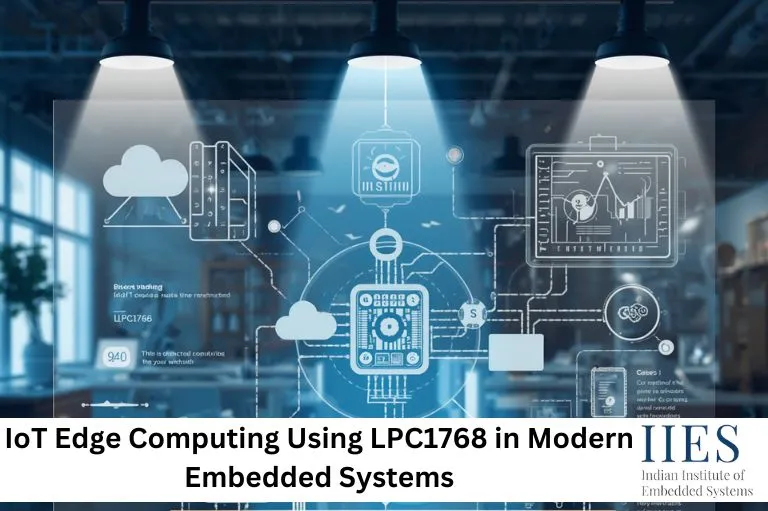
What is IoT Edge Computing?
IoT edge computing is a distributed computing approach where data processing occurs closer to IoT devices and sensors rather than relying entirely on centralized cloud servers.
In traditional cloud-based IoT systems, the architecture typically works as follows:
Sensor → Microcontroller → Internet → Cloud Server → Data Processing → Response
This approach creates delays because sensor data must travel to remote servers before decisions are made.
In edge computing architecture, the workflow becomes:
Sensor → Edge Device → Local Processing → Immediate Action → Cloud Storage
Here, the embedded device itself performs local analysis and decision-making. Only essential or summarized data is transmitted to the cloud.
This architecture improves:
- Response speed
- Network efficiency
- System reliability
- Data privacy
- Real-time control performance

Why Edge Computing is Important in Modern IoT Systems
As billions of IoT edge devices become connected worldwide, transmitting all sensor data continuously to cloud servers becomes inefficient.
Problems with Traditional Cloud-Centric IoT
High Latency
Cloud communication introduces delays that may not be acceptable in industrial or safety-critical applications.
Increased Bandwidth Usage
Continuous data transmission consumes significant network bandwidth.
Internet Dependency
Systems may stop functioning correctly if internet connectivity is interrupted.
Higher Operational Costs
Cloud storage and network infrastructure costs increase with growing device deployments.
Security and Privacy Risks
Sending raw sensor data to external servers may expose sensitive information.
Advantages of IoT Edge Computing
Faster Real-Time Decision Making
Edge devices can immediately respond to changing conditions without waiting for cloud instructions.
Examples include:
- Activating cooling systems when temperature exceeds limits
- Triggering alarms during gas leakage detection
- Automatically controlling irrigation systems
- Monitoring industrial machine faults
Reduced Network Traffic
Local filtering ensures only important information is transmitted to the cloud.
This significantly reduces:
- Data transmission load
- Network congestion
- Cloud storage requirements
Improved Reliability
Even if internet connectivity fails, the edge system can continue operating independently.
Better Scalability
Edge-enabled embedded systems distribute computational tasks across multiple devices, improving overall scalability.

LPC1768 for IoT Edge Computing
The NXP LPC1768 microcontroller is widely used in embedded and IoT applications because of its powerful processing capability and communication support.
It is based on the ARM Cortex-M3 processor and provides several features required for embedded edge computing applications.
ARM Cortex-M3 Processing Capability
The LPC1768 uses the ARM Cortex-M3 core operating at speeds up to 100 MHz.
This processing capability allows the controller to:
- Analyze sensor data locally
- Execute filtering algorithms
- Handle multitasking operations
- Perform real-time control
- Support industrial IoT edge computing applications
The ARM Cortex-M3 architecture is optimized for low-power and high-performance embedded systems.
Communication Interfaces in LPC1768
Modern IoT systems require reliable communication between sensors, wireless modules, and cloud gateways.
The LPC1768 supports multiple communication interfaces including:
These interfaces allow integration with:
- Temperature sensors
- Air quality sensors
- Wireless communication modules
- Industrial controllers
- Smart monitoring devices
This flexibility makes LPC1768 suitable for cloud and edge computing environments.
Built-In ADC for Sensor Integration
Many environmental and industrial sensors generate analog signals.
The LPC1768 includes:
This enables precise measurement of:
- Temperature
- Humidity
- Gas concentration
- Voltage levels
- Light intensity
The ADC plays an important role in smart environmental monitoring systems.
Real-Time IoT Processing Using LPC1768
One of the biggest advantages of embedded edge computing is real-time response capability.
The LPC1768 supports:
- Interrupt-based programming
- Fast context switching
- Real-time event handling
- Deterministic control operations
These features are essential for:
- Industrial automation
- Safety systems
- Smart healthcare devices
- Intelligent transportation systems
Local Data Processing in IoT
IoT sensors generate massive amounts of data continuously. However, not every sensor reading is important.
Local data processing in IoT allows the LPC1768 to:
- Filter duplicate values
- Remove unnecessary readings
- Detect abnormal conditions
- Compress data before transmission
For example:
A temperature monitoring system may read values every second. If the temperature remains stable, transmitting identical values repeatedly wastes bandwidth.
Instead, the LPC1768 can:
- Compare current and previous readings
- Send updates only when thresholds change
- Trigger alerts locally during emergencies
This is one of the core advantages of IoT data filtering techniques.
MQTT in IoT Systems
MQTT (Message Queuing Telemetry Transport) is one of the most commonly used communication protocols in IoT edge computing.
MQTT is designed for:
- Low-bandwidth communication
- Lightweight embedded devices
- Reliable message delivery
- Efficient network usage
The protocol follows a publish-subscribe model:
- Devices publish sensor data
- Brokers manage communication
- Applications subscribe to required topics
Benefits of MQTT include:
- Reduced communication overhead
- Efficient operation for embedded devices
- Scalable IoT architecture
- Reliable cloud integration
MQTT is commonly used with LPC1768-based edge systems.
Example: Smart Environmental Monitoring System
A practical example of IoT edge computing is a smart environmental monitoring system using LPC1768.
System Components
- Temperature sensor
- Humidity sensor
- Gas sensor
- LPC1768 microcontroller
- Wi-Fi or Ethernet module
- Cloud dashboard
Working Principle
Data Collection
Sensors continuously collect environmental data.
Local Analysis
The LPC1768 processes sensor readings locally.
Immediate Decision Making
If dangerous gas levels are detected:
- Alarm is activated
- Warning LED turns ON
- Emergency notification is generated
Cloud Communication
Only important or summarized data is sent to the cloud using MQTT.
This combination of local intelligence and cloud connectivity creates an efficient smart environmental monitoring system.
Applications of LPC1768-Based Edge Systems
Industrial IoT Edge Computing
- Machine condition monitoring
- Predictive maintenance
- Fault detection systems
Smart Agriculture
- Automated irrigation control
- Soil moisture monitoring
- Climate analysis systems
Smart Cities
- Air pollution monitoring
- Intelligent traffic systems
- Smart street lighting
Healthcare Monitoring
- Patient health tracking
- Real-time physiological analysis
- Emergency alert systems
Home Automation
- Smart energy management
- Security systems
- Intelligent lighting control
Security Benefits of Edge Computing
Edge computing also improves IoT security.
Instead of sending raw sensor data continuously:
- Sensitive information can be processed locally
- Data exposure is minimized
- Unauthorized cloud access risks are reduced
Local processing also helps organizations comply with privacy regulations.
Future of IoT Edge Computing
The future of IoT edge computing is closely connected with:
Future embedded controllers will increasingly combine:
- Local intelligence
- Real-time analytics
- Cloud synchronization
- AI-driven decision making
Microcontrollers like LPC1768 provide a strong foundation for learning modern embedded edge computing concepts.
Conclusion
IoT edge computing is transforming modern embedded systems by enabling faster, smarter, and more reliable data processing near the source of data generation. Instead of relying entirely on cloud infrastructure, edge-enabled embedded systems perform local analysis and real-time decision-making directly within the device.
The LPC1768 microcontroller, with its ARM Cortex-M3 processing core, communication interfaces, ADC support, and real-time capability, is highly suitable for developing efficient edge computing applications.
From industrial automation and smart agriculture to healthcare and environmental monitoring, LPC1768-based systems demonstrate how embedded controllers can combine local intelligence with cloud connectivity to create scalable and efficient IoT solutions.
As IoT networks continue to expand, edge computing will become one of the most important technologies for building high-performance, low-latency, and intelligent embedded systems.