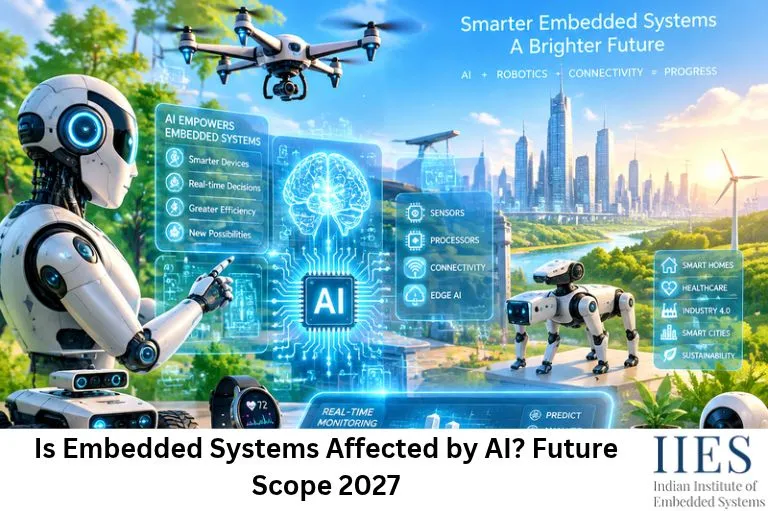
What Is the Impact of AI on Embedded Systems?
Embedded systems are specialised computing systems designed to perform specific functions within electronic devices. They generally consist of a microcontroller or processor, memory, sensors, communication interfaces and embedded software.
For example, a washing machine uses an embedded controller to manage water levels, motor speed, washing cycles and temperature. Similarly, an automotive Electronic Control Unit (ECU) processes sensor information to control different vehicle functions.
Traditionally, embedded systems followed predefined programming instructions. When a sensor detected a particular condition, the microcontroller executed the corresponding instructions.
Artificial Intelligence introduces another capability: analysing data, identifying patterns and making predictions based on trained models.
The impact of AI on embedded systems can be understood through three important developments:
- Intelligent decision-making: AI models can analyse information collected from sensors and identify patterns that traditional rule-based programming may not easily recognise.
- Local data processing: Edge AI allows certain AI operations to run directly on embedded hardware instead of sending every data request to a remote cloud server.
- Automation and prediction: AI-powered embedded devices can identify unusual operating conditions, predict possible failures and adjust their behaviour based on available data.
For example, consider an industrial motor connected to temperature and vibration sensors. A traditional embedded system can monitor sensor readings and activate an alarm when the temperature crosses a predefined limit. An AI-powered system can analyse vibration and temperature patterns to identify unusual behaviour and help predict potential equipment problems.
This combination of embedded programming, electronics, sensors and AI is creating new applications across multiple industries.
How Is AI Changing Embedded Systems Engineering?
AI is influencing embedded engineering at different stages, from software development to product testing and real-time device operation.
However, it is important to understand that AI does not eliminate the need for embedded hardware and software knowledge.
Here are some important areas where artificial intelligence is changing embedded systems engineering.
AI-Based Embedded Software Development
AI-powered coding assistants can help developers generate code examples, explain programming errors, suggest improvements and assist with debugging.
For example, an embedded developer working with STM32 microcontrollers can use AI tools to understand peripheral configuration, generate sample C code or troubleshoot compilation errors.
However, AI-generated code must be reviewed and tested before being used in an actual embedded application. Developers still need to understand memory limitations, hardware registers, interrupt handling, timing requirements and processor architecture.
Intelligent Sensor Data Processing
Embedded devices frequently collect information through sensors such as temperature sensors, accelerometers, pressure sensors, cameras and vibration sensors.
AI models can analyse this information to identify patterns and detect unusual conditions.
For example, an industrial monitoring device can use vibration sensor data to identify possible abnormalities in rotating machinery.
Edge AI Applications
Edge AI enables artificial intelligence models to operate closer to where data is generated.
Instead of sending every sensor reading to a cloud server, an embedded device can process relevant information locally.
This approach can reduce communication delays, lower network usage and improve privacy in applications where local processing is suitable.
Automated Testing and Debugging
AI-based development tools can assist engineers with code analysis, test-case generation, documentation and identifying potential programming errors.
Nevertheless, embedded systems require hardware-level validation, real-time testing and verification under actual operating conditions.
Engineers must ensure that the software behaves correctly when connected to physical components and electronic circuits.
What Are Edge AI and TinyML in Embedded Systems?
Edge AI and TinyML are two important technologies connecting artificial intelligence with embedded devices. Engineering students interested in combining AI with embedded development should understand their differences.
What Is Edge AI?
Edge AI refers to running artificial intelligence models on devices located near the source of data rather than depending entirely on remote cloud computing.
For example, an intelligent security camera can analyse video locally and identify a person or detect unusual activity without continuously uploading all video data to a cloud server.
Edge AI is useful in applications where response time, network connectivity, bandwidth and data privacy are important considerations.
Common Edge AI applications include:
- Smart surveillance systems
- Industrial equipment monitoring
- Automotive driver assistance
- Smart home devices
- Medical monitoring equipment
- Robotics and automation
What Is TinyML?
TinyML refers to running machine learning models on small, resource-constrained devices such as microcontrollers.
Unlike powerful computers, microcontrollers generally have limited processing power, memory and energy availability. Therefore, machine learning models must be optimised to operate within these restrictions.
For example, a low-power sensor device can use a small machine learning model to recognise certain sound patterns or detect abnormal vibration.
Technologies such as TensorFlow Lite for Microcontrollers and other embedded machine learning frameworks help developers deploy suitable models on supported hardware.
Edge AI vs TinyML: What Is the Difference?
| Comparison | Edge AI | TinyML |
| Meaning | AI processing near the data source | Machine learning on highly resource-constrained devices |
| Hardware | Edge computers, processors and capable embedded platforms | Microcontrollers and low-power devices |
| Processing capacity | Can support relatively larger models depending on hardware | Designed for smaller, optimised models |
| Applications | Smart cameras, industrial systems and robotics | Sensor classification, sound recognition and predictive monitoring |
| Main focus | Local AI processing | Efficient machine learning on small devices |
Both technologies demonstrate how embedded engineering is expanding beyond traditional microcontroller programming.
Real-World Applications of AI in Embedded Systems
AI-powered embedded systems are already relevant across several industries. Understanding these applications can help engineering students identify which technical areas they may want to explore.
Automotive Industry
Modern vehicles contain multiple embedded controllers responsible for engine management, braking, vehicle stability, infotainment and other functions.
AI can support advanced automotive applications such as driver monitoring, object recognition, road-scene analysis and predictive vehicle maintenance.
For example, an advanced driver assistance system can use camera and sensor information to identify nearby vehicles, pedestrians and road conditions.
Students interested in automotive embedded systems should understand microcontrollers, CAN communication, real-time programming, sensor interfaces and automotive software fundamentals.
Industrial Automation
Manufacturing industries use embedded controllers, sensors and industrial communication systems to monitor and control machinery.
AI-based predictive maintenance systems can analyse vibration, temperature and operational data to identify patterns associated with equipment deterioration.
This can help maintenance teams investigate potential problems before unexpected equipment failures occur.
Internet of Things (IoT)
IoT devices collect and exchange information through connected sensors and electronic systems.
Combining AI with IoT allows devices to perform intelligent data analysis and automate certain operations.
Examples include smart energy monitoring, intelligent home automation, environmental monitoring and connected industrial equipment.
Healthcare and Medical Devices
Embedded technology is used in medical monitoring equipment, diagnostic devices and portable healthcare systems.
AI can support applications such as medical image analysis, wearable sensor-data processing and intelligent monitoring.
However, medical applications require careful validation, reliability and compliance with applicable safety and regulatory requirements.
Robotics
Robots use embedded controllers, sensors, motors and communication interfaces to perform physical operations.
AI can help robotic systems recognise objects, interpret sensor information, navigate environments and adapt their actions.
This creates opportunities for engineers who understand embedded programming, electronics, control systems and intelligent software.
Will AI Replace Embedded Systems Engineers?
This is one of the biggest questions among engineering students entering the technology industry.
The short answer is that AI can automate certain engineering tasks, but embedded systems engineering involves much more than writing programming code.
An embedded engineer must understand how software interacts with physical hardware and operates under real-world constraints.
Consider developing a smart temperature monitoring device. The engineer needs to select suitable components, connect sensors, configure the microcontroller, write embedded software, test communication interfaces and verify that the complete system operates correctly.
An AI tool may assist with generating code or explaining errors, but it cannot remove the need for engineers to understand the actual hardware, validate the system and take responsibility for its behaviour.
There are also several engineering challenges that require technical judgement:
- Limited memory and processing resources
- Power consumption and battery optimisation
- Real-time processing requirements
- Hardware and software integration
- Interrupt handling and peripheral configuration
- Communication failures and debugging
- System reliability and security
AI may change how engineers perform their work, but the ability to understand, develop, test and maintain embedded products remains important.
For freshers, the better approach is not to avoid embedded systems because of AI. Instead, they should learn the fundamentals and gradually understand how AI can be integrated into embedded applications.
What Skills Should Embedded Engineers Learn in 2027?
As embedded systems and artificial intelligence become more closely connected, students should develop a strong foundation in traditional embedded engineering before moving towards advanced technologies.
Here are the important skills to focus on.
C Programming and Embedded C
C programming is one of the fundamental skills for embedded software development.
Students should understand:
- Variables, arrays and pointers
- Structures and unions
- Functions and memory management
- Bitwise operators
- Data structures
- Register-level programming
- Embedded C programming techniques
These concepts help developers write efficient software for microcontrollers and resource-constrained devices.
Microcontroller Programming
Students should learn how microcontrollers interact with electronic components and external devices.
Practical experience with platforms such as 8051 and STM32 helps them understand GPIO, timers, interrupts, ADC, PWM and peripheral configuration.
ARM Cortex-M Architecture
ARM Cortex-M processors are widely used in microcontroller-based embedded applications.
Students should understand processor architecture, registers, memory organisation, interrupts and peripheral interfaces.
Communication Protocols
Embedded devices communicate with sensors, controllers and other electronic components through different communication interfaces.
Important protocols include:
Understanding these protocols is useful for developing connected embedded applications, automotive electronics and IoT devices.
RTOS Fundamentals
Real-Time Operating Systems help embedded applications manage multiple tasks and meet timing requirements.
Students should understand task scheduling, semaphores, queues, task synchronisation and multitasking.
Embedded Linux
Embedded Linux is used in several advanced devices, including industrial gateways, networking equipment and intelligent electronic products.
Knowledge of Linux commands, shell scripting, device drivers and system fundamentals can help students explore advanced embedded software roles.
Python and Machine Learning Fundamentals
Students interested in Edge AI and TinyML can gradually learn Python, basic mathematics, machine learning concepts, model training and model optimisation.
They should also understand how trained models can be converted and deployed on supported embedded hardware.
The important point is to avoid jumping directly into AI frameworks without first understanding programming, electronics and embedded development.
What Are the Career Opportunities in Embedded Systems with AI?
The combination of embedded systems and AI is creating opportunities in different engineering domains.
However, students should understand that some roles require additional specialisation, experience or advanced knowledge beyond a basic embedded systems course.
Some career paths include:
| Job Role | Important Skills |
| Embedded Software Engineer | C, Embedded C, microcontrollers and debugging |
| Firmware Engineer | C programming, hardware interfaces and firmware development |
| Automotive Embedded Engineer | C, CAN, microcontrollers and automotive fundamentals |
| IoT Developer | Embedded C, sensors, communication and IoT platforms |
| Embedded Linux Developer | Linux, C, shell scripting and device drivers |
| Edge AI Engineer | Embedded programming, machine learning and model deployment |
| TinyML Developer | C/C++, machine learning and microcontroller optimisation |
| Robotics Engineer | Embedded systems, sensors, control systems and robotics software |
Freshers generally begin with foundational embedded software, firmware, testing or junior engineering roles. More specialised AI-related roles may require additional knowledge of machine learning, mathematics, model optimisation and deployment.
Students should also remember that job titles and requirements vary between companies. Building practical projects and understanding the complete development process can help demonstrate technical ability during interviews.
How Can Engineering Students Prepare for Embedded Systems Careers in the AI Era?
For ECE, EEE, E&I and other engineering graduates, preparing for an embedded engineering career requires a structured learning approach.
Instead of trying to learn every new technology simultaneously, students should follow a step-by-step process.
Step 1: Build Programming Fundamentals
Start with C programming, pointers, arrays, structures, data structures and problem-solving exercises.
Step 2: Understand Electronics and Microcontrollers
Learn basic electronics, microcontroller architecture, GPIO, timers, interrupts and hardware interfacing.
Step 3: Practise Embedded C
Write programs that interact with actual microcontroller peripherals. Understand how software controls physical hardware.
Step 4: Learn Communication Protocols
Implement UART, SPI and I2C communication and explore CAN fundamentals for automotive applications.
Step 5: Work on Practical Projects
Build applications such as sensor monitoring systems, temperature controllers, smart home devices and motor control systems.
Step 6: Explore RTOS and Embedded Linux
After understanding the fundamentals, progress towards task scheduling, multitasking and embedded operating system concepts.
Step 7: Explore AI Integration
Learn basic machine learning and investigate how small models can be deployed on supported microcontrollers or edge devices.
For example, students can build a sensor-based anomaly detection project that collects vibration data and uses a suitable machine learning model to identify unusual patterns.
This learning path helps students develop a combination of programming, electronics, hardware integration and emerging technology skills.
Why Choose Indian Institute of Embedded Systems (IIES) to Build Your Embedded Engineering Foundation?
For students planning to enter embedded engineering, selecting a practical training programme is an important step.
The Indian Institute of Embedded Systems (IIES) provides technical training for engineering graduates who want to develop skills in embedded software, microcontroller programming, electronics and related technologies.
The Embedded Systems Course with Placement at IIES focuses on building technical fundamentals and practical implementation skills.
Students learn important topics such as:
The training approach includes practical assignments and project development to help students understand how embedded systems work beyond theoretical concepts.
Students can also explore the PG Diploma in Embedded Systems with Artificial Intelligence, which introduces additional learning areas related to AI-enabled embedded applications, Edge AI and TinyML.
IIES offers online and offline training options for eligible engineering graduates and provides placement assistance, technical interview preparation and career guidance.
Students searching for the best embedded system training institute in Bangalore with placement can explore the course curriculum and available training options before making an enrolment decision.
Explore the courses:
Conclusion: Does Embedded Systems Have a Future in the AI Era?
Artificial intelligence is changing the embedded engineering landscape, but it is also expanding the possibilities of what embedded devices can achieve.
From automotive electronics and industrial automation to IoT, robotics and intelligent healthcare devices, the combination of embedded systems and AI is opening new areas of engineering development.
For freshers, the most important decision is to build a strong technical foundation rather than focus only on learning popular AI tools.
C programming, Embedded C, microcontrollers, ARM architecture, communication protocols, RTOS, debugging and practical project development remain valuable learning areas. Students can then expand their knowledge into Edge AI, TinyML and machine learning deployment.
The future of embedded engineering will involve professionals who understand both the physical hardware and the intelligence running on it.
If you are an engineering graduate planning to enter the technology industry in 2027, embedded systems can be a career path worth exploring, particularly if you enjoy programming, electronics and solving real-world engineering problems.