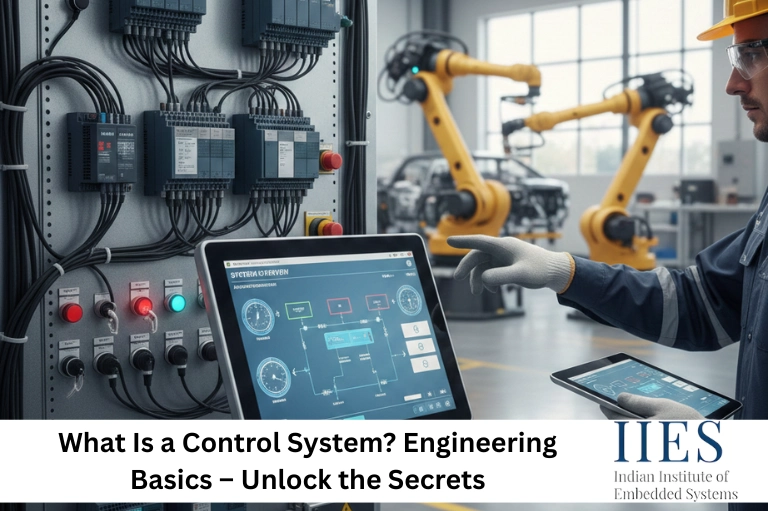
What Is a Control System?
A control system is a mechanism that manages, directs, or regulates the behavior of another system to achieve a desired output.
In simple words:
A control system ensures that a machine automatically produces the expected result by reducing the difference between desired output and actual output.
This difference is called error, and minimizing error is the core objective of every feedback control system.
Control systems are fundamental to automation and control engineering, enabling machines to operate with accuracy, safety, and stability.

Basics of Control Systems
To understand control systems in engineering, you must first understand their building blocks.
Core Components of a Control System
Component | Function | Example |
Input | Desired value (setpoint) | 25°C room temperature |
Controller | Processes error and decides action | Thermostat logic |
Actuator | Converts signal into action | Heater motor |
Plant/System | Process being controlled | Room |
Sensor | Measures actual output | Temperature sensor |
Feedback | Sends measured value back | Sensor signal |
All components must function together. In industrial control systems, reliability is improved using redundancy, calibration methods, and safety mechanisms.
Types of Control Systems
Understanding the types of control systems helps engineers design efficient automation solutions.
1. Open Loop Control System
An open loop control system does not use feedback.
- No automatic error correction
- Simple design
- Lower cost
- Suitable for predictable environments
Example:
A microwave operates for a fixed time regardless of food temperature.
Open loop systems are efficient but cannot compensate for disturbances like load variations or environmental changes.
2. Closed Loop Control System (Feedback Control System)
A closed loop control system uses feedback to compare actual output with desired output and correct errors automatically.
Example:
A thermostat adjusts heating based on real-time room temperature.
Closed loop systems improve:
- Accuracy
- Stability
- Disturbance rejection
- System reliability
This is why most industrial control systems and robotic systems rely on feedback control systems.
Open Loop vs Closed Loop Control System
Parameter | Open Loop System | Closed Loop System |
Feedback | Not used | Used |
Error Correction | Manual | Automatic |
Accuracy | Moderate | High |
Stability | Lower | Higher |
Complexity | Simple | Advanced |
Application | Basic appliances | Robotics & industrial automation |
Closed loop systems dominate modern control systems applications due to their precision and adaptability.

Control System Examples in Real Life
Control systems applications are present in nearly every industry.
Industry | Application |
Automotive | Cruise control, ABS |
Aerospace | Autopilot systems |
Robotics | Self-balancing robots |
Manufacturing | Conveyor belt automation |
Healthcare | Infusion pumps |
Smart Homes | HVAC temperature control |
These control system examples highlight the importance of automation in engineering.
Real-World Case Example: Cruise Control
Let’s examine how a closed loop control system works in a car.
Scenario:
Driver sets speed to 60 km/h.
Workflow:
- Driver sets desired speed (Input).
- Speed sensor measures actual speed.
- Controller compares actual speed with setpoint.
- If speed decreases (uphill), throttle increases.
- If speed increases (downhill), throttle reduces.
This continuous correction maintains stable vehicle speed despite external disturbances — a practical feedback control system in action.
Mini Practical Workflow: Designing a Temperature Control System
Here’s a simplified engineering workflow used in automation and control engineering.
Step 1: Define Objective
Maintain temperature at 25°C.
Step 2: Select Hardware
Step 3: Implement Control Logic
Apply a PID control algorithm to reduce temperature error.
Step 4: Tune Controller
Adjust proportional, integral, and derivative gains.
Step 5: Test Stability
Measure overshoot, settling time, and steady-state error.
This workflow reflects how industrial control systems are developed and tested.
Key Concepts in Control Systems
Feedback
Feedback allows systems to automatically detect and correct errors.
Stability
A stable system returns to equilibrium after a disturbance.
Response Time
Indicates how quickly output reaches desired value.
Transfer Function
A mathematical representation of system behavior:
G(s)=Output(s)Input(s)G(s) = \frac{Output(s)}{Input(s)}G(s)=Input(s)Output(s)Transfer functions help engineers analyze stability and performance in control systems in engineering.
PID Control in Industrial Control Systems
PID control (Proportional–Integral–Derivative) is widely used in automation.
Term | Purpose |
Proportional | Responds to current error |
Integral | Eliminates accumulated error |
Derivative | Predicts future error trend |
Applications include:
- Robotics motion systems
- HVAC systems
- Motor speed control
- Manufacturing automation
- Drone stabilization
Proper tuning ensures minimal overshoot and fast response.
Control Systems in Robotics
Control systems in robotics enable:
- Balance control
- Path tracking
- Motion precision
- Obstacle avoidance
Robots combine sensors such as gyroscopes, accelerometers, and cameras with feedback controllers to perform accurate movements.
Modern robotic systems increasingly integrate adaptive algorithms and data-driven optimization techniques to enhance performance in dynamic environments.
Industrial Control Systems and Smart Automation
Industrial control systems manage large-scale operations such as:
- Power plants
- Oil refineries
- Smart factories
- Manufacturing lines
With Industry 4.0, automation systems now incorporate:
- IoT-based monitoring
- Predictive maintenance
- Cloud connectivity
- Real-time diagnostics
This integration increases efficiency, reduces downtime, and enhances operational safety.
Intelligent Automation and the Future of Control Systems
Traditional control systems rely on mathematical models and feedback loops. However, modern automation increasingly integrates advanced computational intelligence.
Technologies such as neural networks, adaptive algorithms, AI-driven optimization models, contextual decision systems, and intelligent data processing are being combined with classical control theory to improve system performance.
For example:
- Neural network controllers can adjust parameters dynamically.
- Predictive models help detect anomalies before failure.
- Intelligent optimization improves energy efficiency in industrial control systems.
This convergence of classical control systems and intelligent automation is shaping the next generation of engineering solutions.
Conclusion
Understanding what is a control system is essential for mastering automation and control engineering. From basics of control systems to advanced industrial control systems, these principles power robotics, aerospace, automotive systems, and smart infrastructure.
Whether comparing open loop vs closed loop control systems or implementing a feedback control system using PID algorithms, control systems applications remain central to modern engineering.
For students and professionals looking to build practical expertise, specialized embedded courses at IIES Bangalore provide hands-on training in control systems, industrial automation, and real-time embedded applications. These industry-oriented programs focus on practical implementation, live projects, and placement-focused skill development.
As industries move toward intelligent automation and adaptive technologies, control systems will continue to be the backbone of precision, stability, and innovation.