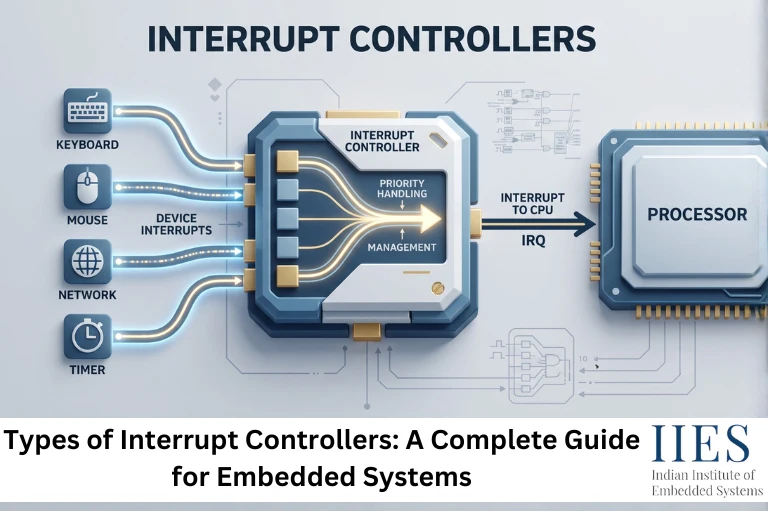
What Is an Interrupt Controller?
An interrupt controller is a hardware component that manages interrupt requests generated by peripherals such as timers, UARTs, GPIOs, ADCs, communication interfaces, and external devices.
Its primary responsibility is to determine:
- Which interrupt should be serviced first
- Which interrupts are enabled or disabled
- Which interrupt has the highest priority
- Whether multiple interrupts can occur simultaneously
- When an interrupt should be forwarded to the CPU
Instead of connecting every peripheral directly to the processor, the interrupt controller acts as an intelligent intermediary that organizes and prioritizes interrupt requests for efficient processing.
How an Interrupt Controller Works
The interrupt handling process typically follows these steps:
- A peripheral generates an interrupt request.
- The interrupt controller receives the request.
- It checks whether the interrupt is enabled.
- The priority level is evaluated.
- The highest-priority pending interrupt is selected.
- The interrupt is forwarded to the processor.
- The CPU saves its current execution context.
- The processor jumps to the corresponding ISR.
- The ISR completes its task and clears the interrupt.
- The CPU restores the previous context and resumes normal execution.
This workflow ensures that important events are handled promptly without continuously polling hardware devices.

Interrupt Controller Architecture
A typical interrupt controller consists of several functional blocks.
    Peripheral 1

           │

      Peripheral 2

           │

      Peripheral 3

           │

      Peripheral N

           │

  -------------------------

  | Interrupt Controller |

  -------------------------

    │    │      │

Priority  Mask  Pending Logic

    │

Vector Selection

    │

    CPU

    │

Interrupt Service Routine
Key Components
Interrupt Inputs
Receive interrupt requests from peripherals.
Priority Logic
Determines which interrupt should be serviced first.
Mask Register
Enables or disables individual interrupt sources.
Pending Register
Stores interrupt requests waiting for service.
Vector Logic
Selects the correct ISR address from the interrupt vector table.
CPU Interface
Transfers interrupt information to the processor.
Key Features of Interrupt Controllers
Different interrupt controllers offer different capabilities, but most include the following features:
- Multiple interrupt channels
- Configurable interrupt priorities
- Interrupt masking and enabling
- Pending interrupt detection
- Interrupt nesting support
- Fast interrupt response
- Vector-based interrupt handling
- Software-generated interrupts (supported in advanced controllers)
- Low interrupt latency
- Support for external and internal interrupt sources
Types of Interrupt Controllers
Different processors and embedded systems use different interrupt controller architectures based on complexity, performance, and application requirements.
- Generic Interrupt Controller (GIC)
- Nested Vector Interrupt Controller (NVIC)
- Programmable Interrupt Controller (PIC)
- Advanced Programmable Interrupt Controller (APIC)
- External Interrupt Controller (EIC)
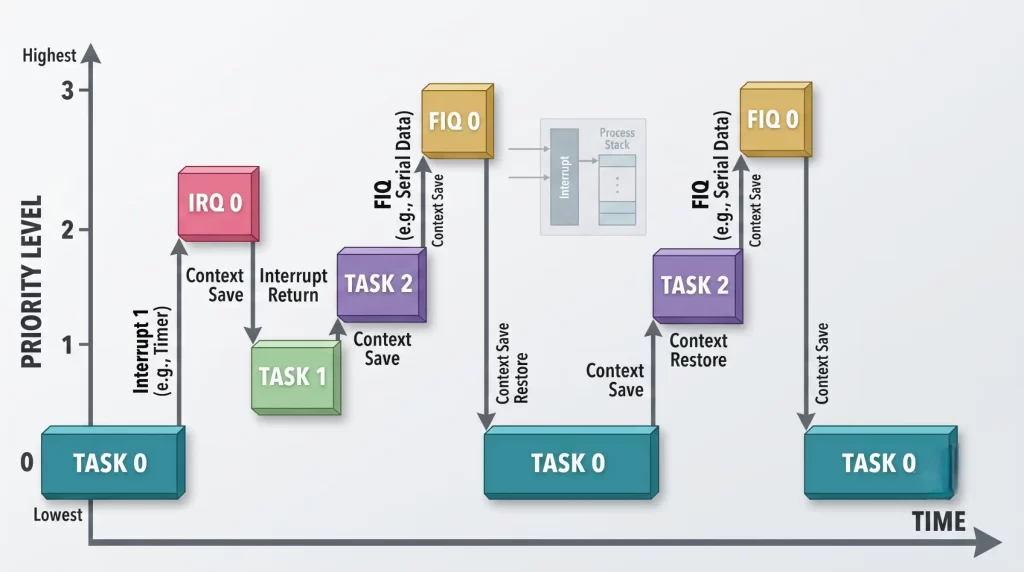
1. Generic Interrupt Controller (GIC)
The Generic Interrupt Controller (GIC) is developed by ARM for Cortex-A multicore processors.
Commonly Used In
Features
- Supports multicore processors
- Interrupt routing to specific CPU cores
- Software Generated Interrupts (SGIs)
- Private Peripheral Interrupts (PPIs)
- Shared Peripheral Interrupts (SPIs)
- Configurable priorities
- Interrupt grouping for secure and non-secure worlds
Advantages
- Excellent scalability
- Low interrupt latency
- Supports virtualization
- Efficient multicore interrupt distribution
Typical Applications
- Smartphones
- Automotive ECUs
- Networking equipment
- Industrial automation
- AI edge devices
2. Nested Vectored Interrupt Controller (NVIC)
The Nested Vectored Interrupt Controller (NVIC) is integrated into ARM Cortex-M microcontrollers.
Commonly Used In
- STM32
- NXP LPC
- Nordic nRF
- TI Tiva
- Microchip SAM
- GD32
Features
- Integrated into Cortex-M core
- Hardware interrupt nesting
- Vector-based interrupt handling
- Programmable priorities
- Fast interrupt entry and exit
- Low interrupt latency
Advantages
- Minimal software overhead
- Efficient real-time performance
- Easy interrupt management
- Ideal for embedded firmware
Typical Applications
- IoT devices
- Consumer electronics
- Robotics
- Medical devices
- Wearables
- Industrial control
3. Programmable Interrupt Controller (PIC)
The Programmable Interrupt Controller (PIC) manages interrupt requests in many legacy computer systems and older embedded platforms.
Commonly Used In
- Intel x86 legacy systems
- Older industrial computers
- Educational hardware platforms
Features
- Interrupt prioritization
- Interrupt masking
- Cascaded interrupt support
- Configurable interrupt vectors
Advantages
- Simple architecture
- Reliable operation
- Easy implementation
Limitations
- Limited scalability
- Higher latency compared to modern controllers
- Less suitable for multicore systems
4. Advanced Programmable Interrupt Controller (APIC)
The Advanced Programmable Interrupt Controller (APIC) is designed for modern multicore x86 processors.
Commonly Used In
- Intel processors
- AMD processors
- Desktop computers
- Servers
- High-performance workstations
Features
- Local APIC for each processor core
- I/O APIC for external interrupts
- Inter-processor interrupts (IPIs)
- High interrupt scalability
Advantages
- Efficient multicore interrupt handling
- Supports symmetric multiprocessing (SMP)
- Better performance than traditional PIC
5. External Interrupt Controller (EIC)
An External Interrupt Controller (EIC) handles interrupt signals originating outside the processor.
Common Sources
- Push buttons
- Sensors
- Rotary encoders
- Touch panels
- External communication modules
Features
- Edge-triggered interrupts
- Level-triggered interrupts
- Configurable triggering modes
- Noise filtering (available on some MCUs)
Applications
- Home automation
- Robotics
- Industrial sensors
- Smart appliances
- Battery-powered embedded systems

Comparison of Different Types of Interrupt Controllers
Interrupt Controller | Common Processor | Multicore Support | Interrupt Nesting | Typical Applications |
Generic Interrupt Controller (GIC) | ARM Cortex-A | Yes | Yes | Linux, Automotive, High-performance Embedded Systems |
Nested Vectored Interrupt Controller (NVIC) | ARM Cortex-M | No (single-core Cortex-M) | Yes | STM32, IoT, Consumer Electronics |
Programmable Interrupt Controller (PIC) | Legacy x86 | Limited | Limited | Older PCs, Industrial Systems |
Advanced Programmable Interrupt Controller (APIC) | Modern x86 | Yes | Yes | Servers, Workstations, Desktop PCs |
External Interrupt Controller (EIC) | Various MCUs | Depends on MCU | Depends on MCU | Sensors, GPIO, Robotics, Embedded Devices |
Advantages of Interrupt Controllers
Interrupt controllers improve the efficiency and responsiveness of embedded systems by managing multiple interrupt sources intelligently.
1. Faster Event Handling
- Responds immediately to hardware events
- Reduces response time compared to polling
- Improves real-time system performance
2. Efficient CPU Utilization
Instead of continuously checking peripherals, the CPU executes the main application until an interrupt occurs.
Benefits:
- Lower processor workload
- Reduced unnecessary instructions
- Improved overall efficiency
3. Interrupt Prioritization
Multiple interrupt requests may occur at the same time. An interrupt controller:
- Assigns priorities
- Services critical interrupts first
- Delays less important interrupts until later
Example:
- Emergency shutdown → Highest priority
- UART communication → Medium priority
- Button press → Lower priority
4. Supports Interrupt Nesting
Higher-priority interrupts can interrupt lower-priority ISRs.
Benefits:
- Faster response to critical events
- Better real-time performance
- Improved system reliability
5. Simplifies Firmware Development
Developers can focus on writing individual ISRs instead of manually checking every peripheral. This results in:
- Cleaner code
- Better modularity
- Easier maintenance
6. Scales to Multiple Peripherals
Modern MCUs may include dozens or even hundreds of interrupt sources, including UART, SPI, I2C, CAN, USB, Ethernet, Timers, DMA, GPIO, and ADC. The interrupt controller manages all of them efficiently.
7. Improves Power Efficiency
The processor can remain in sleep mode until an interrupt occurs.
Common use cases:
- Battery-powered IoT devices
- Wearables
- Portable medical equipment
- Wireless sensor nodes
Limitations of Interrupt Controllers
Although interrupt controllers improve system performance, they also introduce certain design challenges.
1. Interrupt Overhead
Each interrupt requires:
- Saving CPU context
- Executing the ISR
- Restoring the previous context
Frequent interrupts can reduce application performance.
2. Interrupt Latency
Latency is the delay between an interrupt request and ISR execution. Latency may increase due to:
- Higher-priority interrupts
- Long-running ISRs
- Interrupt masking
- Operating system scheduling
3. Priority Inversion
Improper priority assignment can delay critical interrupts. For example:
- A low-priority ISR occupies the CPU.
- A medium-priority interrupt keeps executing.
- A high-priority task waits longer than expected.
Proper interrupt priority planning helps avoid this issue.
4. Complex Debugging
Interrupt-related bugs are often difficult to reproduce because they depend on timing. Common issues include:
- Missed interrupts
- Race conditions
- Nested interrupt conflicts
- Incorrect interrupt clearing
5. Shared Resources
Multiple ISRs may access the same variables or hardware resources. Without proper synchronization, this can lead to:
- Data corruption
- Unexpected behavior
- System instability

Conclusion
Understanding the types of interrupt controllers is essential for designing efficient and reliable embedded systems. Whether you are working with a simple ARM Cortex-M microcontroller or a multicore Cortex-A processor, the interrupt controller ensures that hardware events are handled quickly and in the correct order.
Different interrupt controllers are designed for different applications. For example, the NVIC is optimized for low-latency interrupt handling in microcontrollers, while the GIC provides advanced interrupt routing and prioritization for multicore processors running operating systems such as Embedded Linux.
As embedded systems continue to integrate more peripherals and support increasingly complex applications, selecting the appropriate interrupt controller and configuring it correctly becomes a key part of firmware development. A solid understanding of interrupt priorities, latency, masking, and nesting helps developers build responsive, stable, and real-time embedded applications.