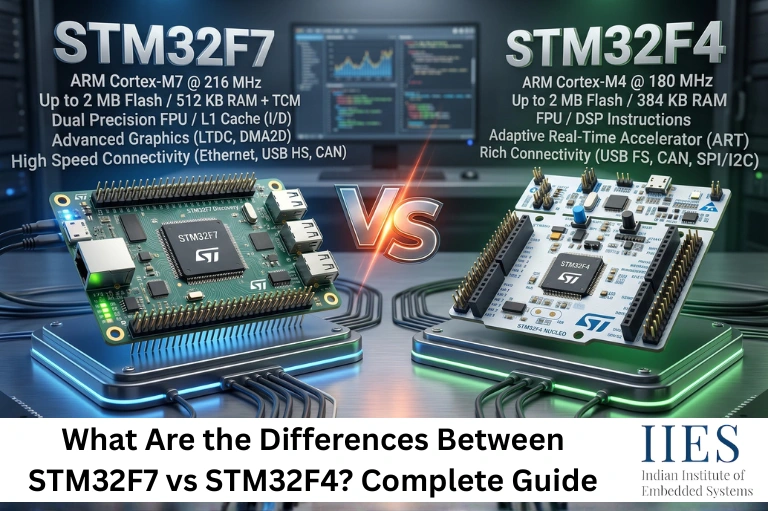
Why This Comparison Matters
Selecting between stm32f4 vs stm32f7 is not just about clock speed. It affects:
- System performance and responsiveness
- Power consumption
- Cost of development and hardware
- Scalability for future upgrades
- Compatibility with advanced features like graphics, AI, and connectivity
If you’re building anything from IoT devices to high-end embedded systems, this decision is critical.

STM32F7 vs STM32F4 Comparison Table
Feature | STM32F4 Series | STM32F7 Series |
Core Architecture | ARM Cortex-M4 | ARM Cortex-M7 |
Max Clock Speed | Up to 180 MHz | Up to 216 MHz |
Performance (DMIPS) | ~225 DMIPS | ~462 DMIPS |
Floating Point Unit | Single-precision FPU | Double-precision FPU |
Cache Memory | No cache | L1 Instruction & Data Cache |
Flash Memory | 512 KB – 2 MB | Up to 2 MB |
SRAM | Up to 256 KB | Up to 512 KB |
External Memory Support | Limited (FSMC) | Advanced (SDRAM, Quad-SPI) |
Graphics Support | Basic | Advanced (LCD-TFT controller) |
Communication Interfaces | UART, SPI, I2C, CAN, USB | All F4 + Ethernet, more CAN |
Analog Features | Standard ADC/DAC | Higher precision, more channels |
Power Efficiency | Good | Optimized but higher under load |
Development Ecosystem | Mature, widely used | Growing, advanced tools |
Cost | Lower | Higher |
Best For | General embedded systems, IoT | High-performance, GUI, AI, DSP |
Core Architecture: STM32F4 vs STM32F7
STM32F4 Architecture
The stm32f4 architecture is based on the ARM Cortex-M4 core, which is optimized for:
- Digital signal processing (DSP)
- Real-time control systems
- Moderate computational workloads
Key highlights:
- Clock speed up to 180 MHz
- Single-precision Floating Point Unit (FPU)
- Efficient for control systems and embedded logic
This makes the stm32f4 microcontroller a reliable and widely adopted choice for mid-range applications.
STM32F7 Architecture
The stm32f7 architecture uses the more advanced ARM Cortex-M7 core, designed for high-performance embedded systems.
Key improvements:
- Clock speed up to 216 MHz
- Double-precision FPU
- Superscalar pipeline and cache (L1 cache)
- Higher instruction throughput
Compared to STM32F4, the stm32f7 microcontroller can execute more instructions per cycle, making it significantly faster in real-world applications, not just on paper.
Performance Comparison
Feature | STM32F4 Series | STM32F7 Series |
Core | Cortex-M4 | Cortex-M7 |
Max Clock Speed | ~180 MHz | ~216 MHz |
Performance | Moderate | High |
FPU | Single precision | Double precision |
Cache | No | Yes (Instruction + Data cache) |
Practical Insight
In real projects:
- STM32F4 works well for motor control, sensors, and embedded logic
- STM32F7 is better for graphics, audio processing, and AI edge tasks
Memory and Storage Capabilities
STM32F4 Memory
- Flash: 512 KB to 2 MB
- SRAM: Up to 256 KB
- Limited external memory support
STM32F7 Memory
- Flash: Up to 2 MB
- SRAM: Up to 512 KB
- Advanced external memory support:
Why This Matters
If your application involves:
- GUI (Touchscreens)
- Large datasets
- Firmware updates
Then the stm32f7 series provides a clear advantage.
Peripheral and Connectivity Features
STM32F4 Peripherals
The stm32f4 series offers:
- UART, SPI, I2C, CAN
- USB OTG
- ADC and DAC
- Standard timers
STM32F7 Peripherals
The stm32f7 series expands significantly:
- Ethernet support
- Advanced timers
- More ADC/DAC channels
- Hardware cryptography support (in some models)
- LCD-TFT controller for display applications
Real-World Example
If you’re building:
- A smart home controller → STM32F4 is enough
- A touchscreen-based industrial UI → STM32F7 is better

Power Efficiency and Optimization
Both families include:
- Sleep mode
- Stop mode
- Standby mode
However:
- STM32F4 is efficient for simpler systems
- STM32F7 includes improved power management despite higher performance
Important Note
Higher performance usually increases power consumption. While STM32F7 is optimized, it may still consume more power under heavy workloads.
Development Ecosystem and Tooling
STM32F4 Development
- Mature ecosystem
- Extensive documentation
- Large community support
- Popular tools: STM32CubeF4
Common choice for beginners and production systems.
STM32F7 Development
- Supported by STM32CubeF7
- More advanced debugging and optimization tools
- Increasing community adoption
Development Boards
Popular options include:
- STM32F4 development board (e.g., Nucleo, Discovery)
- STM32F7 development board with display support
Choosing the right stm32f7 development board is crucial if your project involves graphics or high-speed processing.
Cost Comparison: STM32F7 vs STM32F4
When comparing stm32f7 vs stm32f4, cost is an important factor in choosing the right microcontroller.
- STM32F4 series: More affordable and widely used in cost-sensitive projects, making it ideal for IoT devices and general embedded systems.
- STM32F7 series: Higher cost due to advanced performance, larger memory support, and additional features like graphics and Ethernet.
In practical terms, STM32F4 offers better value for simple applications, while STM32F7 justifies its cost in high-performance and GUI-based systems.
Real-World Use Cases
STM32F4 Use Cases
Best suited for:
- Motor control systems
- Industrial automation
- Audio applications
- IoT devices
- Embedded controllers
STM32F7 Use Cases
Designed for:
- Advanced human-machine interfaces (HMI)
- High-end audio processing
- Edge AI applications
- Image and signal processing
- Industrial control systems with visualization
Mini Case Study
Scenario: Smart Industrial Controller
Using STM32F4:
- Handles sensors and actuators efficiently
- Lower cost
- Limited UI capability
Using STM32F7:
- Supports touchscreen dashboard
- Real-time analytics
- Higher memory for logging and processing
Conclusion: If UI + processing is needed → STM32F7 wins.
Future Trends (2026 and Beyond)
The embedded industry is evolving rapidly. Here’s how stm32f4 vs stm32f7 fits into future trends:
1. Edge AI Integration
STM32F7 is better suited due to higher processing capability.
2. Graphical Interfaces
Demand for display-based systems is rising → favors STM32F7.
3. IoT Expansion
STM32F4 remains relevant for low-cost, scalable IoT deployments.
4. Real-Time Data Processing
STM32F7 enables faster analytics at the edge.
Best Practices for Choosing Between STM32F4 and STM32F7
Choose STM32F4 if:
- You need cost-effective solutions
- Your application is control-focused
- Power consumption must be minimal
- You want faster development with proven libraries
Choose STM32F7 if:
- You need high performance
- Your system uses GUI or display
- You require large memory
- You plan for future scalability
Common Mistakes to Avoid
- Choosing STM32F7 without needing its performance (increases cost)
- Underestimating memory requirements in STM32F4 projects
- Ignoring power constraints in high-performance applications
- Not considering long-term scalability

Conclusion
The comparison of stm32f7 vs stm32f4 ultimately comes down to your project requirements.
- STM32F4 remains a powerful, efficient, and cost-effective choice for most embedded applications.
- STM32F7 delivers superior performance, advanced features, and scalability for next-generation systems.
If you’re building a system that demands speed, memory, and advanced interfaces, STM32F7 is the future-ready option. For stable, efficient, and budget-friendly designs, STM32F4 continues to be a solid foundation.
Carefully evaluate your application needs, scalability plans, and budget before making a decision.