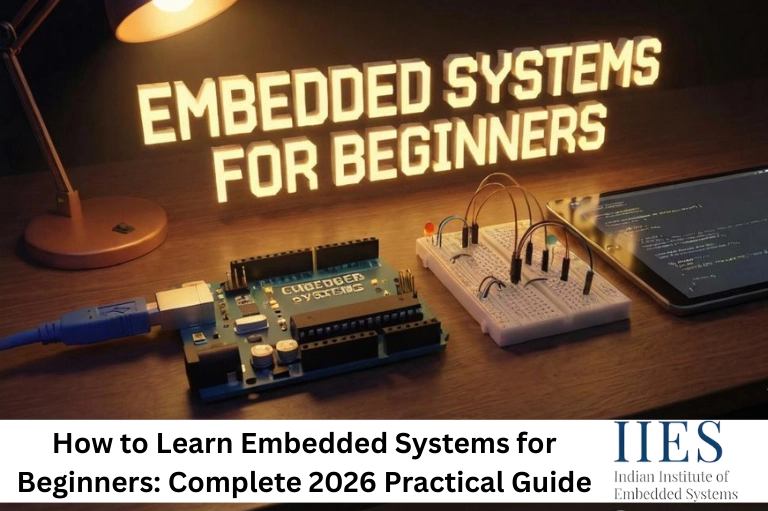
What Are Embedded Systems?
An embedded system is a specialized computing system built to perform a dedicated function within a larger system. Unlike desktop computers that handle multiple applications, embedded systems are optimized for efficiency, speed, and reliability in a narrow task domain.
These systems are tightly integrated with hardware components such as sensors and actuators. They are often designed to operate continuously, sometimes for years, without failure. This focus on reliability and determinism distinguishes embedded development from many other software domains.
Core Characteristics
- Designed for a specific function
- Resource-constrained (limited memory and processing power)
- Often required to meet real-time deadlines
- Integrated directly with hardware components
- Optimized for energy efficiency

Basics of Embedded Systems
To understand embedded systems for beginners, you must first grasp their foundational structure. Every embedded system combines hardware and software in a tightly controlled environment.
Main Components
Most embedded systems include:
- Microcontroller (MCU)
- Memory (RAM and Flash)
- Input/Output interfaces
- Sensors and actuators
- Power management circuitry
Beginner-friendly platforms such as Arduino and Raspberry Pi simplify hardware interaction and allow learners to experiment without designing circuits from scratch.
At the beginner level, development focuses on writing small programs that interact with LEDs, sensors, motors, and communication modules. As skills improve, developers move toward register-level programming and performance optimization.
Programming in Embedded Systems
Programming is central to embedded development. The most widely used language is C because it provides direct control over memory and hardware registers. This level of control is necessary since embedded devices often operate with only a few kilobytes of RAM.
Here is a simple embedded C example demonstrating LED toggling:
#include <avr/io.h>

#include <util/delay.h>

int main(void) {

   DDRB |= (1 << PB0);

   while(1) {

       PORTB ^= (1 << PB0);

       _delay_ms(1000);

   }

}
This small program highlights a key difference from high-level programming: direct manipulation of hardware registers. Understanding such low-level interaction is part of mastering the basics of embedded systems.
Is Embedded Systems Hard to Learn?
For beginners, embedded systems are not inherently difficult, but they demand discipline and consistency. The difficulty increases when moving from simple hobby projects to professional, safety-critical systems.
The learning curve becomes steeper because embedded development requires knowledge of:
Unlike web or mobile development, mistakes in embedded systems may lead to hardware malfunction rather than just software errors. This raises the complexity level as projects scale.
Key Challenges in Embedded Systems for Beginners
Embedded systems for beginners become challenging mainly due to the integration of multiple technical domains.
1. Hardware–Software Integration
Embedded engineers must understand circuit behavior alongside programming logic. This interdisciplinary requirement can feel overwhelming at first but becomes intuitive with practice.
2. Limited Resources
Memory and processing constraints are significantly tighter than in desktop systems.
Platform | Typical RAM |
Desktop Computer | 8–32 GB |
Microcontroller | 2 KB – 256 KB |
Efficient coding practices are essential to prevent stack overflows or memory corruption.

3. Real-Time Constraints
Many embedded applications must respond within strict timing limits. Systems such as automotive controllers or industrial machines cannot tolerate delays. Developers often use real-time operating systems like FreeRTOS to manage tasks and scheduling.
4. Debugging Complexity
Unlike traditional software debugging, embedded debugging may require hardware tools such as oscilloscopes or logic analyzers. Development environments like Keil uVision assist in firmware-level debugging, but hardware-level faults demand deeper investigation.
Market Growth and Demand
The embedded systems industry continues to expand rapidly.
- The global embedded systems market exceeds USD 100 billion in valuation.
- IoT-connected devices are projected to surpass 29 billion devices by 2030.
- Automotive electronics and industrial automation remain dominant growth sectors.
This data demonstrates strong long-term career demand for embedded engineers skilled in firmware, RTOS, and system optimization.
Automotive Engine Control
Consider a vehicle’s engine control unit (ECU). Sensors measure engine temperature, air intake, and throttle position. The microcontroller processes these signals in real time and adjusts fuel injection accordingly. Delays of even milliseconds could reduce efficiency or damage the engine.
This example illustrates why reliability, timing precision, and optimized firmware are critical in embedded systems.
Mini Practical Workflow for Beginners
A structured learning path makes embedded systems far more approachable.
Step 1: Build Electronics Foundations
Understand voltage, current, resistance, and digital logic basics.
Step 2: Start with Simple Microcontroller Projects
Use platforms like Arduino to build small projects such as LED control or sensor reading.
Step 3: Learn Embedded C Deeply
Focus on pointers, memory handling, and bitwise operations.
Step 4: Move to ARM-Based Systems
Many professional systems rely on architectures from ARM Holdings, making this a valuable progression step.
Step 5: Explore RTOS and Communication Protocols
Study task scheduling, interrupts, and protocols like I2C or SPI.
Embedded Systems in Intelligent Devices
Modern embedded platforms now support optimized AI inference at the edge. This enables applications such as:
- Predictive maintenance in factories
- Voice recognition in smart assistants
- Vision processing in robotics
Instead of sending raw data to cloud servers, embedded processors increasingly perform local decision-making. This reduces latency and improves reliability in mission-critical systems.
Beginner-Friendly Project Ideas
Practical projects reinforce learning and strengthen understanding.
- IoT weather station
- Smart home automation controller
- Line-following robot
- Automatic irrigation system
- Digital energy meter
These projects introduce communication protocols, sensor integration, and power management concepts gradually.
Future Outlook of Embedded Systems
Embedded systems will remain central to:
- Autonomous vehicles
- Smart infrastructure
- Industrial automation
- Secure IoT devices
- Low-power edge computing systems
As hardware becomes more powerful and efficient, embedded engineers will continue to bridge the gap between physical systems and intelligent software.
Final Thoughts
So, are embedded systems hard to learn?
At the beginner level, it is structured and achievable. The key is mastering the basics of embedded systems before advancing into real-time optimization and safety-critical applications.
Embedded systems for beginners may seem complex initially, but with consistent practice, real-world projects, and progressive learning, the field becomes not only manageable but highly rewarding.