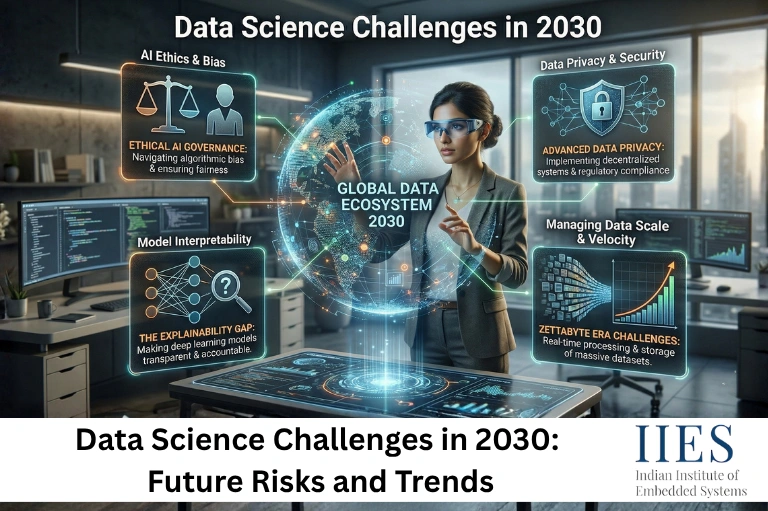
The Growing Importance of Data Science
The world is producing data at an unprecedented scale. Industry estimates suggest that global data creation may exceed 180 zettabytes by 2025, and this growth is expected to continue into 2030. This explosive rise directly impacts data science industry trends, as companies need better systems to process, analyze, and secure massive datasets.
This is where the future scope of data science becomes broader than ever:
- Real-time analytics for business intelligence
- Predictive maintenance in IoT systems
- AI-driven healthcare diagnostics
- Autonomous transportation
- Fraud detection in finance
- Customer behavior modeling in retail
The challenge is no longer just collecting data. The real problem is extracting trustworthy insights while maintaining security, speed, and compliance.

Data Science Growth Statistics
The scale of global data and AI adoption is growing rapidly, making data science challenges more complex and business-critical each year. Recent industry reports estimate that worldwide data creation reached around 181 zettabytes by 2025, and enterprise data volumes could grow more than 10× by 2030, driven by IoT, cloud platforms, and AI-powered systems.
This explosive growth directly influences data science future trends, especially in privacy, infrastructure scaling, and real-time analytics.
Metric | 2026 | Expected by 2030 |
Global data created | 181 ZB | 350+ ZB |
Enterprise AI / GenAI usage | 65% | 85–90% |
Real-time analytics & inference workloads | 40% | 70% |
Demand for ML & AI engineers | High | Very High |
Data Privacy in Data Science Will Become a Major Challenge
One of the biggest data science challenges for 2030 will be privacy protection. As data pipelines collect user behavior, location, biometrics, medical records, and financial activity, regulations are becoming stricter across the world.
Laws such as GDPR, DPDP, HIPAA, and evolving AI regulations require organizations to manage data responsibly. This makes data privacy in data science a central issue rather than an optional concern.
Key privacy problems
- Consent management
- Data anonymization failures
- Re-identification risks
- Cross-border data transfers
- Third-party API exposure
- Model leakage from training data
Example
A healthcare AI model trained on patient records can improve disease prediction, but if the data is not properly anonymized, it creates legal and ethical risks.
Challenge | Impact | Solution |
Poor anonymization | Identity exposure | Differential privacy |
Data leakage | Compliance penalties | Access control + encryption |
API misuse | Data theft | Zero-trust security |
Weak consent tracking | Legal risk | Consent lifecycle systems |
Automation Will Change the Role of Data Scientists
Automation is often misunderstood as a threat. In reality, it is transforming workflows rather than replacing experts.
AutoML platforms, no-code analytics, and AI copilots now automate:
- Data cleaning
- Feature engineering
- Model selection
- Hyperparameter tuning
- Reporting dashboards
This shift changes the future of data science 2030 career paths. Professionals will spend less time on repetitive preprocessing and more time on:
- Business strategy
- AI governance
- Domain collaboration
- Model explainability
- Responsible deployment
So, one of the most important future scope of data science trends is the evolution from technical analyst to strategic AI problem solver.
Model Explainability and Trust
As AI systems become deeply integrated into banking, healthcare, and public systems, black-box predictions will create serious challenges.
Imagine a loan application rejected by an AI system without explanation. Businesses and regulators increasingly require models to justify outcomes.
This makes explainable AI one of the most critical challenges in data science.
Explainability methods
- SHAP values
- LIME
- Feature importance ranking
- Counterfactual explanations
- Interpretable neural networks
The rise of deep learning and transformer-based systems means transparency must improve alongside accuracy.

Scaling Big Data Infrastructure
The volume, velocity, and variety of data will continue to test infrastructure limits.
By 2030, data science future trends will heavily depend on scalable architectures such as:
- Distributed cloud data lakes
- Real-time stream processing
- Edge AI
- Federated learning
- Hybrid cloud systems
Example architecture workflow
- IoT sensors collect data
- Edge nodes preprocess in real time
- Cloud pipelines aggregate streams
- ML models predict anomalies
- Dashboards trigger alerts
This creates demand for data scientists who understand engineering concepts beyond notebooks and dashboards.
Bias and Ethical AI
Bias in datasets remains one of the most serious data science challenges.
When historical data contains discrimination, machine learning systems may unintentionally amplify unfairness in:
- Hiring
- Lending
- Insurance
- Policing
- Healthcare recommendations
The data science industry trends of 2030 will strongly focus on fairness auditing.
Bias reduction techniques
- Balanced sampling
- Bias-aware training
- Fairness constraints
- Human review layers
- Continuous model monitoring
Ethics will become a required skill, not just a theoretical topic.
Talent Gap and Continuous Learning
The tools used in data science today may look very different by 2030.
Professionals will need to keep learning:
- LLM-powered analytics
- AI agents
- vector databases
- multimodal AI
- synthetic data pipelines
- edge intelligence
- quantum-inspired optimization
This is where the future scope of data science remains highly promising. The field will continue expanding, but only for professionals who evolve with it.
Skills that will dominate by 2030
Technical Skills | Strategic Skills |
Python, SQL, Spark | Problem framing |
Deep learning | Communication |
MLOps | Business alignment |
Data governance | Leadership |
AI security | Ethical reasoning |
Industry-Specific Challenges in Data Science
Different industries will face unique barriers.
Healthcare
- patient privacy
- diagnostic bias
- regulatory approvals
Finance
- fraud model drift
- explainable credit scoring
- anti-money laundering compliance
Retail
- personalization vs privacy
- demand forecasting volatility
- customer data fragmentation
Manufacturing
- sensor noise
- real-time defect detection
- predictive maintenance failures
These examples show how data science industry trends vary widely depending on the business environment.
Future Trends That Will Shape 2030
The future of data science 2030 will likely be defined by these trends:
- AI + IoT integration
- edge analytics
- privacy-preserving machine learning
- multimodal models
- real-time decision intelligence
- digital twins
- synthetic data generation
- human-AI collaboration
- decentralized analytics
- responsible AI frameworks
These data science future trends indicate that the field is not slowing down—it is becoming more specialized and business-critical.
Roadmap: Data Science Challenges from 2026 to 2030
Understanding how the field may evolve year by year helps businesses, students, and professionals prepare for upcoming disruptions. This roadmap highlights how data science challenges are likely to progress as technology, regulation, and AI adoption continue to accelerate.
2026: Privacy and Governance Become Top Priorities
Organizations are expected to strengthen compliance frameworks as global privacy regulations expand. The focus will shift toward secure data pipelines, encryption standards, and governance policies to address rising data privacy in data science concerns.
2027: AutoML and Workflow Automation Expand
Automation tools will increasingly handle data cleaning, preprocessing, feature selection, and model tuning. This trend will reshape challenges in data science, requiring professionals to focus more on strategy, validation, and business alignment.
2028: Explainable AI Regulations Increase
As AI systems influence healthcare, finance, and legal decisions, governments and enterprises will demand transparency. Explainability, fairness audits, and bias detection will become central to data science industry trends.
2029: Edge AI and Real-Time Analytics Go Mainstream
With IoT devices generating continuous streams of data, businesses will move analytics closer to the source. Edge AI adoption will become a major part of data science future trends, especially in smart cities, manufacturing, and autonomous systems.
2030: Human-AI Collaboration Dominates
By 2030, the future of data science 2030 will be driven by collaboration between humans and intelligent systems. Data scientists will work more closely with domain experts, AI copilots, and decision-makers to solve complex real-world problems faster and more responsibly.

Conclusion
The road to 2030 is filled with both opportunity and complexity. The biggest data science challenges will revolve around privacy, explainability, fairness, infrastructure, and evolving job roles. Yet these same challenges also define the future scope of data science, making it one of the most resilient and high-growth career paths in technology.
For businesses, success will depend on secure and ethical data strategies. For professionals, long-term growth will come from combining technical depth with strategic thinking, domain expertise, and responsible AI practices.
The future of data science 2030 is not about replacing humans with machines. It is about empowering better decisions through trusted intelligence.